
Mineral Wars Are Becoming Motor Wars
Last updated 06:56 AM EST • Read time: 7m
The next global race will not be won by who builds the most impressive drones or robots. It will be won by those who can outpace rivals by manufacturing, certifying, and scaling the motor and actuator stack hidden inside drones and robots.
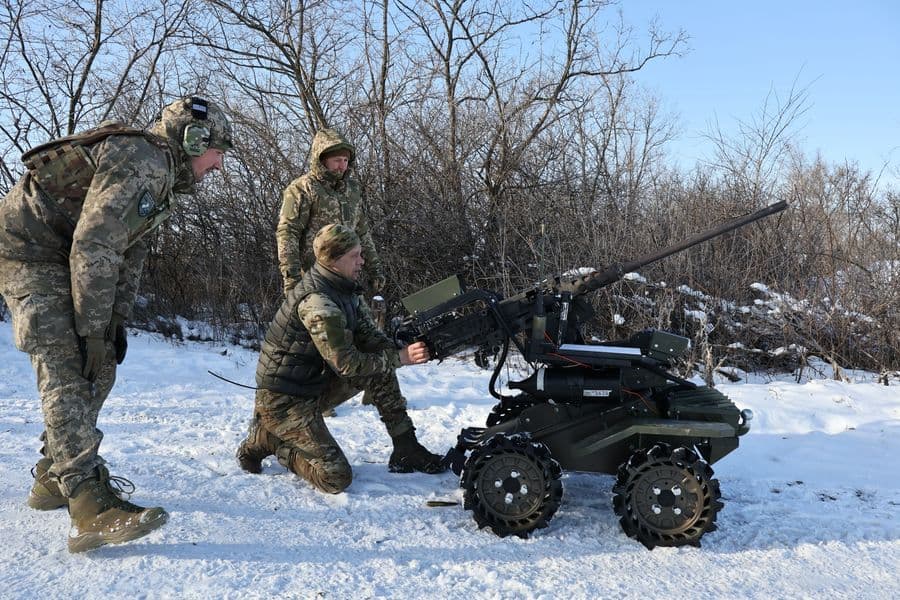
Drones are already reshaping modern conflict. Robotics is rapidly transforming our economies, moving fast from assembly lines, warehouses and farms into construction, industrial maintenance, and security. In both domains, the limiting factor is increasingly the same: small, high-reliability motors and other actuators delivered at scale, with predictable lead times and verified provenance.
That reality collides with a second one: no country can rebuild the entire stack fast enough alone. Governments may announce strategies and issue controls, but capacity is built by supply chains that run on tooling process know-how, repeatable quality, reliable access to materials and long-term buyer commitments.
This is where “mineral wars” are turning into “motor wars.” Minerals matter, but they become strategic only when they are converted into industrial components that power systems at scale. The chokepoint is not only upstream. It is often in the middle, in the parts that are hard to substitute, hard to audit, and painfully slow to ramp.
The motor stack is the real bottleneck
Motors and other actuators require a variety of inputs: motor-grade alloys, permanent magnets, precision bearings, copper windings, control electronics, machining tolerances, adhesives, heat treatment, and quality assurance. When any part is constrained, finished systems stall.
Permanent magnets are often forgotten, yet they are a binding constraint inside that stack. They concentrate specialized know-how, require stable upstream inputs, and are tied to limited industrial capacity. When magnet supply tightens or faces friction, the downstream impact translates into a motor shortage. And yet, the public debate often misses the real constraint.
Framing this solely as a raw materials issue misses the mark. When restrictions, incentives, or investments are concentrated only at the top of the supply chain, the pressure does not disappear. It simply shifts downstream into components and subassemblies.
Resilience is defined less by where the original material is mined or refined and more by whether the entire chain - from raw input to motor to finished system — is traceable, auditable, and scalable.
The West cannot build it all alone, fast enough
The United States, Europe and Japan are rightly investing in industrial resilience. But even as suppliers andams face the same physical constraints: building plants, training people, qualifying suppliers, and establishing repeatable QA. It all takes time. Meanwhile, drones and robotics are scaling now.
The fastest path is by leveraging allied capacity. Not outsourcing but distributing production across trusted partners under shared compliance standards. Allied capacity reduces timeline risk by adding redundancy and speed, and by preventing new single-point dependencies from forming.
In periods of conflict, the argument is purely pragmatic. When an industrial stack is concentrated, it becomes brittle. When it is distributed across trusted partners, it becomes resilient - and, critically, financeable.
A practical model: Ukraine, Europe, the United States, and Asian capital
A workable allied production model already exists. It can be described as a four-node system:
- Ukraine: high-velocity engineering, learning cycles, field feedback, and training.
- Europe (Central, Eastern, Northern): compliant industrial production lanes and proximity to Ukrainian talent without extracting it.
- United States: capital, standards, procurement pull, quality systems, and market scale.
- Japan and Taiwan: strategic investment discipline and world-class downstream manufacturing demand.
The combined strength of these partners would help ensure that rapid motor adoption is not constrained at any point along the upstream value chain — from sintered magnets to alloy production, metallization, oxide separation, leaching, and other foundational processing steps — all the way back to the mine gate, where materials such as rare earths are extracted.
This model also avoids the trap of brain drain. The goal is not to relocate Ukrainian engineers or Taiwanese foundries. It is to keep engineering, training, and quality assurance anchored in Ukraine while scaling compliant production elsewhere, with Ukraine’s long-term industrial strength intact.
That is “brain circulation.” It is also a better security outcome. Capability stays distributed, innovation stays close to real operating conditions, and the industrial base grows across allied jurisdictions instead of being concentrated in one place.
Combining allied strengths helps prevent unplanned and costly duplication of effort, misallocation of funds, and wasted capital. By pooling markets across both civilian and dual-use applications, partners can create a center of gravity that strengthens capital formation and accelerates the path to optimal scale.
What policymakers and industry should do now
This is solvable, but only if policy and industry act on the bottleneck they are facing.
- Move from raw materials to motor-stack standards
Governments and large buyers should define what “trusted motor stack” means: traceability for motor and actuator components, auditable quality systems, and supplier certification requirements that can be enforced across borders through standardized audits, traceability documentation, and third-party testing. The goal is to push transparency and compliance into the component layer where risk and value concentrate. It is not only about the nodes in the chain, but also about connectivity between the nodes.
- Create an allied supplier qualification lane
Trusted allied suppliers should not need years of redundant paperwork to sell into US or European procurement. Create a fast-track qualification pathway for suppliers that meet security and compliance standards. This includes standardized audits, common documentation, and a clear checklist that lets suppliers invest with confidence.
- Use procurement pull-through to unlock financing
Factories scale on demand certainty, not speeches. Multi-year commitments tied to compliance milestones unlock debt and project finance, critically reducing the cost of capital. This is especially important for mid-chain components like magnets, motor subassemblies, and precision parts. Without predictable offtake, capacity remains theoretical.
- Finance capacity where it compounds
Public finance and blended capital should target the steps that compound into durable capability: tooling, QA labs, workforce training, and process automation. “Capacity” should be measured in qualified output, not in announcements. Investment vehicles that link capital to audited milestones will move faster and waste less.
- Build a value-sharing structure that prevents new monopolies
The goal is not to replace one concentration of industrial power with another. Concentration creates leverage, and leverage causes instability. A resilient allied stack shares value creation across partners, keeps innovation where it is strongest, and creates political durability because benefits are visible on all sides.
Why this fits “Mineral War” thinking
Minerals become strategic when they shape industrial power. Industrial power becomes strategic when it delivers systems at scale. The next phase of competition will be measured in output, quality, and lead times across the motor stack.
That is why the right question is not “Who has the minerals in the ground?” It is “Who can turn inputs into certified motors and actuators fast, repeatedly, and at scale?”
The West can do this, but only if it acts like manufacturing is the strategy. A distributed allied production network is the fastest way to compress timelines while improving resilience.
A grounded perspective from the field
In Volodymyr Berezhniy’s work building K66, a magnets-to-motors supply chain initiative designed around allied industrial resilience, the same pattern appears repeatedly: systems fail downstream when the mid-chain is ignored. The solution is not a single factory or a single country. It is a compliance-first production network that can scale across trusted partners.
In Tomasz Nadrowski’s work at the intersection of capital and strategic supply chains, the financing logic is equally clear: money flows to capacity when demand is predictable, risk is measurable, and standards are enforceable. A motor-stack strategy provides all three.
The bottom line
The world is entering a period where drones and robotics will expand rapidly, and where the motor stack will become the quiet constraint on both security and economic competitiveness.
The answer is not isolation. It is shared capacity built early enough to matter: Ukraine anchored for engineering and learning, Europe for compliant production, the United States for capital and market pull, and Japan and Taiwan for strategic investment and downstream demand.
Mineral wars are becoming motor wars. The winners will be the alliances that can build.
Tomasz Nadrowski is a portfolio manager at Amvest Terraden Critical Minerals Fund and the author of “Mineral War: China’s Quest for Weapons of Mineral Destruction.”
Volodymyr (Vol) Berezhniy is a Ukraine-born entrepreneur based in Texas building K66, a magnets-to-motors supply chain initiative focused on allied industrial resilience.

Iranian Cyber Operations
By Michael Groen • RealClearDefense
Reflecting on an Epic Horse Campaign in the Mountains of Afghanistan
By Brian Glyn Williams • RealClearDefense
The Godfather of American Foreign Policy Realism Speaks to Today’s World
By Francis P. Sempa • RealClearDefense
In Pursuit of Nuclear Abolition
By Peter Huessy • RealClearDefense
Innovation Alone Won’t Prepare the U.S. for the Future Battlefield
By Joshua Segal • RealClearDefense

26th MEU – U.S. Needs Crisis Response MAGTF
By Marine Corps Compass Points
The Influence of History on a Sea Power
By CDR Salamander
Navy Civilianizes Six Former Flag Billets, Reduces Six to Captains
By Mongilio, USNI N.
Raytheon's $8B Contract for Strategic Comms Terminal Modernization
By M+A El
America’s Maritime Moment Will Not Wait
By CDR Salamander