
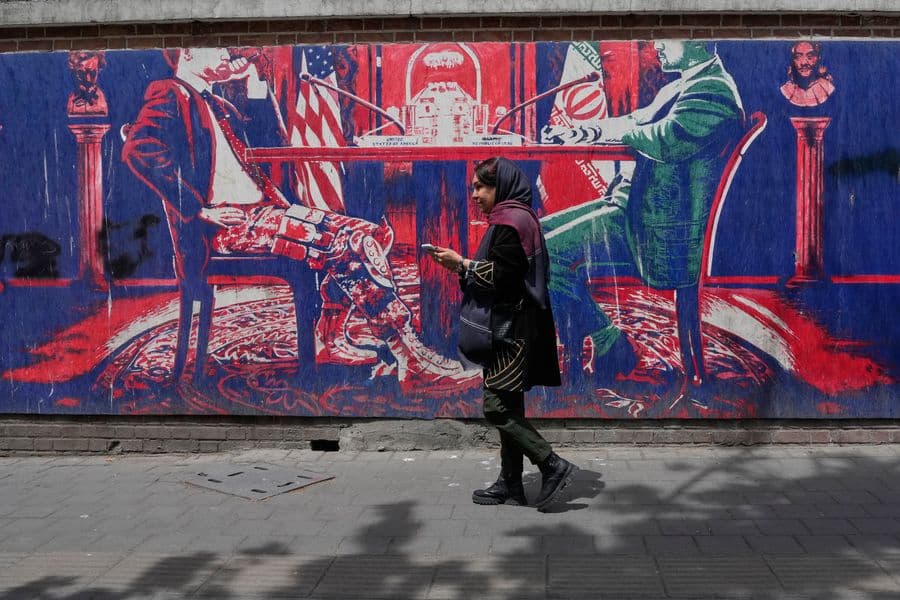
When Washington Wants Options Before Objectives
Last updated 06:27 AM EDT • Read time: 13m
The scene is familiar even before the first aircraft move. Around the table, the talk is already operational. Timelines are pinned down. Targets are compared. Escalation ladders are gamed out. Allies are considered, then briefed in principle. The military question becomes concrete faster than the political one because military instruments are easier to visualize. A strike package can be mapped. A political object cannot.
That was the recurring problem in the conflict with Iran. As the administration moved toward and then through hostilities, public reporting on the deliberations inside the White House revealed goals that shifted, timelines that compressed, and a question that went unresolved: what was force actually meant to accomplish? By the time a ceasefire emerged, it was still described in provisional terms, and senior leaders were discussing not only the opening of the Strait of Hormuz but the need for a practical plan to make shipping move again. The problem was not that Washington lacked options. It was that options were maturing faster than objectives.
History is unforgiving of conflicts begun without clearly defined political aims. The Iran conflict is the latest illustration. These are not struggles unique to one administration. They are recurring features of a civil-military process that has learned to work around the absence of clear aims rather than demand them.
This piece argues that when civilian leaders cannot, will not, or do not define political aims clearly, the senior military officer's duty is to discipline the dialogue. Drawing on Desert Storm, Vietnam, and the Iran conflict, and anchored in Clausewitz's treatment of war's relationship to policy, this piece develops a four-part framework: draw out implicit aims before the first option is built; stress assumptions before they harden into planning guidance; tie every option honestly to costs, risks, and termination criteria; and force the acceptable-outcomes conversation before assets move and allies are briefed. The argument is not that military officers should make policy. It is that they have a professional obligation to help civilian leaders make strategy coherent before action begins. That discipline is not optional. It is the precondition for deterrence, coherent campaigning, and the public legitimacy that will sustain a long fight.
This is a recurring American pattern. Washington asks for options before it has settled the political aims those options are meant to serve. Sometimes that is understandable. Presidents bear ultimate decision-making responsibility and nearly always face incomplete information, domestic pressure, coalition constraints, and adversaries who get a vote. Ambiguity can preserve room for bargaining or protect decision space. But once that ambiguity is translated into planning guidance without being disciplined, it stops being a political convenience and becomes a strategic liability.
There is a difference between fluid strategy and vague aims, and the distinction matters. Fluid strategy, the capacity to adapt ways, means, and orchestration as conditions change, is a virtue. But that adaptability only has meaning when anchored to a clear political aim. Without that anchor, flexibility becomes drift. Washington has grown adept at presenting the latter as the former, treating the absence of clear aims as though it were strategic sophistication. It is not.
There is also an institutional logic to the pattern. Civilian leaders often want to preserve freedom of action. Military staffs, by design, want to reduce uncertainty, turn guidance into executable choices, and prepare for the moment when words must become action. Neither instinct is wrong. The problem is the seam between them. If nobody forces a more explicit conversation about political purpose, assumptions begin to do hidden strategic work. The request for "options" quietly substitutes for a decision about ends. Planning acquires momentum, and by the time the real debate should happen, forces may already be moving, allies may already be informed, and the cost of reopening the political question has become much higher. That is how options become strategy by accident.
Desert Storm shows what disciplined strategy can look like, but it did not begin with perfect clarity. In the early months of the crisis, as Desert Shield defended Saudi Arabia and a larger force assembled, senior civilians pressed for military options before a political objective was fully settled. Powell resisted the logic of planning in search of an aim, insisting that the question had to begin with what the U.S. was trying to achieve. By early November 1990, that aim had sharpened: the coalition decided not merely to defend Saudi Arabia but to reverse Iraq’s occupation of Kuwait. That mattered because it gave the campaign a comparatively clear immediate purpose and tied the military approach to a defined political end. Desert Storm was not simply a display of force. It was force nested in a political decision about what was to be achieved and what was not. The coalition would liberate Kuwait. It would not march on Baghdad. Powell drew the lesson plainly: success came from matching force to a clearly defined political aim, and lives must never be squandered for unclear purposes.
The strength of the 1991 campaign was therefore not just operational excellence. It was strategic discipline. Powell and others understood that the military instrument worked best when the political aim was both serious and bounded. Termination was not an afterthought. It was part of the campaign's logic from the start. Yet Desert Storm also reminds us that strategic clarity is never permanent. The coalition's limited aim made the war coherent, but it did not settle the longer question of how the U.S. would live with Saddam Hussein afterward. That ambiguity did not break the 1991 campaign. It did, however, leave unresolved political residue that later policy had to absorb. Even good strategy can defer problems it does not solve. What it cannot do is pretend those problems are not there.
Vietnam presents what the pattern looks like when it goes uncorrected. The United States was not completely without stated aims, but its aims were layered, unevenly prioritized, and strategically unstable. A 1965 Pentagon memorandum put the matter starkly: 70 percent of the U.S. aim was to avoid a humiliating defeat to American credibility, 20 percent was to keep South Vietnam and adjacent territory out of Chinese hands, and only 10 percent was to permit the people of South Vietnam a better and freer way of life. That was not a hierarchy likely to produce strategic coherence. It was an admission that military effort was being asked to serve several different political purposes at once, some instrumental, some reputational, and some only weakly connected to conditions on the ground.
That ambiguity mattered institutionally as much as politically. The machinery kept moving because the machinery is built to move. Civilian leaders wanted leverage without decisive strategic clarity. Military leaders translated ambiguous guidance into campaigns, metrics, and movement – which is not the same thing as strategy. None of that meant the officer corps was setting policy. It meant the system had learned how to proceed without forcing the policy question to closure. Vietnam's lesson is not merely that the U.S. chose poorly. It is that once the political aim is obscure, diffuse, or internally contradictory, tactical and operational activity can continue for years without producing a persuasive answer to the most important strategic question: what political outcome is this violence meant to secure?
Clausewitz remains valuable here precisely because he is so often reduced to a bumper sticker. His point was not simply that war is connected to policy. It was that war is a political instrument whose logic must remain subordinate to the purpose that called it into action. Policy does not end when violence begins; it continues to pervade military action, constrain it, and give it meaning. If the political aim is unclear, then strategy cannot honestly claim coherence, no matter how precise the plan may be.
His "remarkable trinity" sharpens the point. Violence and passion, chance and probability, and reason and policy are always interacting. No commander gets to operate in a purified military space free from political context. That is why a disciplined relationship between civilian authority and military professionalism is not optional. It is a condition of sound strategy. The harder the problem, the greater the need to keep returning force to policy rather than letting means acquire a logic of their own.
What, then, is the senior military officer's duty when political aims are vague? The first obligation is to draw out implicit aims before the first option is built. In the conflict with Iran, the aims themselves blurred punishment, deterrence, coercion, freedom of navigation, and restoration of credibility. Those are not interchangeable aims. They imply different theories of success, different tolerances for escalation, and different end states. The military officer's task is not to choose among them unilaterally, but to make clear that different options are already smuggling different political purposes inside them. To ask for "options" is often, in practice, to reveal a preferred end without naming it.
Second, stress assumptions before they harden into planning guidance and do it early, when they can still be challenged. Every plan rests on assumptions about adversary behavior, coalition support, economic resilience, escalation, and termination. In Desert Storm, the coalition had the benefit of a relatively disciplined alignment between political aim and campaign. In Vietnam, assumptions about credibility, signaling, and pressure accumulated far faster than they were honestly reexamined. The professional obligation of the strategist is to drag those assumptions into the light before they become embedded in troop deployments, alliance messaging, and domestic expectation.
Third, tie every option honestly to costs, risks, and termination criteria. This is where too much strategy talk becomes theater. Costs are named in generalities, risks are softened into caveats, and termination is postponed as though clarity on the back end can wait until after the opening shots. It cannot. In the Iran conflict, the continuing uncertainty over the ceasefire's scope and over the practical restoration of shipping in the Strait of Hormuz showed why termination cannot be treated as a separate phase of the problem. It is part of the problem from the start. A course of action that cannot explain how fighting plausibly stops is not a strategy. It is an opening move in search of one.
The fourth duty is the hardest, and perhaps the most avoided: force the acceptable-outcomes conversation before assets move and allies are briefed. This is the point at which military professionalism most clearly risks looking like policy advocacy. But the alternative is worse. If no one compels civilian leaders to define what outcomes are acceptable, military action begins to create its own political facts based on unstated assumptions. The officer's task is not to insist on perfect clarity. It is to insist that leaders confront the choices they are already making implicitly. That is not insubordination. It is one of the highest forms of strategic discipline.
The stakes are larger than Iran. Beijing studies American power, but it also studies American process. The Defense Department's 2025 report on Chinese military power notes the People's Liberation Army's strategic focus in the First Island Chain, and recent analysis of Chinese political warfare argues that, in a Taiwan contingency, Beijing would seek not only operational advantage but the fracturing of U.S. alliances, the disruption of force mobilization, and the erosion of domestic morale. That means the political coherence of American strategy is itself part of deterrence. The question is not merely whether the United States can generate combat power. It is whether it can align purpose, process, and coalition behavior under pressure.
That is why the conflict with Iran matters beyond the Middle East. Beijing will study this episode as part of a broader pattern of American decision-making. Chinese political warfare doctrine is explicitly concerned with shaping the strategic environment, weakening intervention coalitions, and making U.S. resistance appear politically untenable. Against that backdrop, ambiguity in American war aims does not register merely as nuance. It can register as irresolution, disunity, or an opportunity to intensify pressure where Washington is least strategically settled.
In a Taiwan scenario, the margin for improvisation will be smaller. The political aim will have to be clearer, the alliance dimension more central, and the termination criteria defined before the first shot is fired. If Washington’s national security enterprise has not trained itself to force the ends-ways-means conversation before options harden into action, then the first crisis will not be the time to learn. Strategy education cannot guarantee wisdom. What it can do is make certain habits harder to avoid, including the habit of asking what options are actually meant to achieve. The officers who will sit at that table are being educated right now. What they are being taught, and whether they have been pushed to ask the hard questions before the hard questions become urgent, will matter enormously.
That is where education and training play a specific, often underappreciated role. Not in producing officers who know the right answers, but in producing officers who know which questions must be asked and cannot be deferred. A curriculum that forces future senior leaders to wrestle with political aims before they are clear, interrogate assumptions before they harden, and think seriously about termination before the first option brief is built is doing strategic work that process reform alone cannot replicate. At its best, it prepares senior leaders to recognize when the most dangerous failure is not a lack of options, but a failure to ask what those options are meant to achieve. That, too, is a habit, and habits can be taught.
The conflict with Iran should therefore be read not only as a regional episode but as a warning about method. A republic that asks for military options before it has clarified political aims is not displaying flexibility. It is often postponing the only conversation that can make force strategically coherent. When that happens, the military profession has a duty not to solve the political problem by stealth, but to discipline the dialogue until civilian leaders confront the choices they are already making implicitly. That is not a procedural suggestion. It is a professional obligation.
Erik Fisher is a colonel in the U.S. Air Force and an assistant professor at the National War College. He previously served in the Pentagon as a defense policy strategist in the Office of the Secretary of Defense and as branch chief for logistics on the Joint Staff. A graduate of the Air Force Weapons School and distinguished graduate of the National War College, he has logged more than 4,000 flight hours primarily in the C-17.
Jon Waller is a colonel in the U.S. Air Force who has served two tours on the Joint Staff in global operations and joint force development. He currently serves as assistant professor, course director, and Joint Chair at the National War College. He is a graduate of the Eisenhower School and combat-experienced pilot with over 4,200 flight hours in the C-17, C-208, and T-1 aircraft.
The views expressed herein are those of the authors and do not reflect the official policy or position of the National Defense University, the Department of War, or the U.S. Government.

In Pursuit of Nuclear Abolition
By Peter Huessy • RealClearDefense
Innovation Alone Won’t Prepare the U.S. for the Future Battlefield
By Joshua Segal • RealClearDefense
The sUAS Tactical Trifecta
By Bryan T. Woody • RealClearDefense
The Revolutionary War: When Strategic Options Share the Same Weakness
By Henry Yep • RealClearDefense
The Houthis Are Testing the Limits of Collective Defense
By Saima Afzal • RealClearDefense

Who Shoots Down the Drone Over the Shipyard?
By John Ferrari & Dillon Prochnicki • RealClearDefense
Northrop Grumman Breaks Out the Big Guns at AUSA
By Daniel Terrill, Defense News
Army Pursuing Diverse Array of New Anti-Air Interceptors
By Trevithick, The WarZoneWho Shoots Down the Drone Over the Shipyard?
By John Ferrari & Dillon Prochnicki, RCD
F-35C Lands for the First Time on a Ford-Class Aircraft Carrier
By The Aviationist