
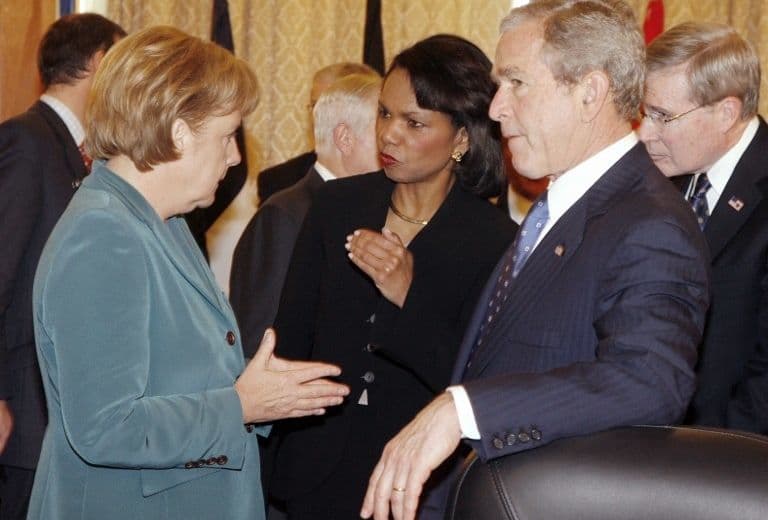
European Security - The Cost of Compromise
Last updated 06:58 AM EDT • Read time: 12m
How Merkel, Sarkozy, and the 2008 Bucharest Betrayal Unraveled European Security
As Angela Merkel's political legacy undergoes an intense and long-overdue reassessment across the West, an uncomfortable truth is finally emerging: the "stability" she was long credited with maintaining was, in reality, a structured retreat that left Europe profoundly vulnerable. For nearly two decades, Western Europe operated under the illusion that economic interdependency could tame a revisionist power. Today, the cost of that miscalculation is being paid in blood.
To understand how Europe sleepwalked into this geopolitical trap, one must return to the watershed moment of modern European insecurity: the 2008 NATO Bucharest Summit.
An Insider's Account
I was a Member of the Georgian Parliament in April 2008. I had also fought as a soldier — rifle in hand — during the August 2008 Russian invasion. I know what was at stake at Bucharest not as an analyst reading declassified cables after the fact, but as someone who lived it from inside.
Prior to the summit, Georgia's state and intelligence apparatus had provided comprehensive warnings to both Washington and European capitals: if Georgia and Ukraine were denied the NATO Membership Action Plan (MAP), a Russian military invasion was not a distant possibility — it was an imminent certainty. I was personally involved in preparing portions of that documentation.
The high-stakes drama reached its peak exactly one week before the summit, when President Mikheil Saakashvili visited the White House. Staying at Blair House — the official guest residence across from the White House — an extraordinary event occurred. At 8:00 AM, two hours before his scheduled meeting with President Bush, Saakashvili received a direct call from Chancellor Angela Merkel. Her message was unambiguous: "I know you are entering a meeting with Bush. No matter what he promises you, know that Germany will not support the MAP for Georgia in Bucharest."
Upon entering the Oval Office, Saakashvili immediately relayed Merkel's preemptive warning to the American President. Bush's reaction was defiant. Turning to the Georgian president, he said: "You focus on your other affairs, and I will handle that woman." He went on to reassure the delegation: "We are working. You will get the MAP. You will absolutely become NATO members. Everything is going according to plan." Buoyed by these explicit assurances, the Georgian delegation left Washington convinced that American diplomatic weight would prevail.
The depth of Bush's personal commitment was later recounted by Matthew Bryza, Deputy Assistant Secretary of State for European and Eurasian Affairs (2005–2009). As Bush headed to the critical working dinner in Bucharest where final decisions were to be made, he stated: "I'm going to fight like crazy, I'm going to fight like mad, I'm going to fight like hell for what I believe is right — and what is right is for Georgia to have a chance to join NATO when it meets the criteria for admission."
The Night NATO's History Was Written in Retreat
When the summit commenced on April 2nd, Merkel was categorical in her opposition to MAP for Georgia and Ukraine. French President Nicolas Sarkozy took a characteristically ambiguous position, signaling that if Berlin could be persuaded, he would follow. The resulting deadlock was so profound that the leaders of the Western alliance spent the entire night in heated debate — unprecedented in NATO summit history.
At dawn on April 3rd, the session was suspended and a one-hour recess called. Outside the closed doors, members of the Georgian delegation anxiously waited for any information from inside. The Presidents of Lithuania, Poland, and Romania stood as a fierce bulwark, categorically opposing any deferral to December. Recognizing she had encountered a wall of regional resistance, Merkel personally approached Polish President Lech Kaczyński — the statesman who, along with nearly his entire government, would later perish in the 2010 Smolensk air disaster — and asked him directly where he saw a way out.
Following that exchange, four heads of state sat in a tight circle to reignite the discussion. Out of that claustrophobic negotiation came the final, deeply flawed compromise: no MAP. The decision deferred. But because of the fierce resistance from Poland and the Baltic states, a declaration was forced into the final resolution stating that Georgia and Ukraine would become NATO members — without a date, without a mechanism, without teeth.
Moscow read the hesitation perfectly. Before December could arrive, Russian tanks rolled into Georgia.
The Sarkozy Variable
Sarkozy's backing of Merkel's veto was essential to ensure Germany would not stand alone. His public posture was that of a pragmatic neutral; his conduct was something else. As the rotating EU Council President during the August 2008 war, Sarkozy positioned himself as mediator between Russia and Georgia. I witnessed this process from the ground. What he characterized as diplomacy was, in practice, sustained coercive pressure on the Georgian leadership to accept terms that reflected Putin's dictates — delivered through a government nominally led by Dmitry Medvedev, but directed throughout by Putin himself.
What French courts have since established reframes this conduct entirely. Sarkozy has been convicted on multiple counts across separate proceedings. A Paris court found him guilty of criminal conspiracy for accepting millions of euros in illegal payments from the late Libyan ruler Muammar Gaddafi — the first time a former French president received a custodial sentence. France's highest court separately upheld his conviction for corruption and influence peddling while serving as head of state.
A leader operating under that degree of legal exposure and personal compromise does not negotiate as a neutral broker. Such vulnerabilities inevitably raise questions about susceptibility to external influence — and whether or not Moscow directly exploited them, the perception alone was sufficient to compromise the integrity of his mediation. His ambiguous stance at Bucharest, and his conduct as mediator in August 2008, should be understood in that light: not as the expression of a coherent strategic vision, but as the behavior of a man who could not afford to be on the wrong side of Moscow.
The Energy Architecture
The MAP veto did not occur in isolation. It was consistent with a broader pattern Merkel sustained throughout her chancellorship: the systematic deepening of European — and specifically German — dependence on Russian energy, which funded the Kremlin's militarization while dismantling Europe's economic leverage.
The precedent had been set by her predecessor. Gerhard Schröder served as German Chancellor from 1998 to 2005. Within days of leaving office, he became Chairman of the Supervisory Board of Nord Stream AG — the Gazprom-controlled pipeline he had championed while in power. He later joined the board of Rosneft. The relationship between Berlin's political leadership and Moscow's energy infrastructure had become structurally embedded before Merkel took office.
Merkel did not reverse this. She extended and deepened it. Under her chancellorship, Germany expanded rather than reduced its dependence on Russian gas, systematically resisting pressure from Eastern European allies who warned, repeatedly and correctly, that energy dependence was a strategic liability — not a commercial arrangement.
According to information that circulated within Georgian intelligence and political circles at the time, Moscow had indicated that Merkel could expect post-chancellorship arrangements similar to those Schröder had received. This has not been confirmed through public documentation and should be understood as such. But the pattern of Berlin's energy policy across sixteen years remains, at minimum, insufficiently explained.
The Formation: Dresden, Donetsk, and Unresolved Questions
To understand Merkel's accommodationist orientation, one cannot ignore her formative years in communist East Germany. Raised under a totalitarian system, she joined the Freie Deutsche Jugend (FDJ) — the official communist youth organization controlled by the ruling Socialist Unity Party. While many describe this as a pragmatic survival strategy, historical documentation — including the investigative biography The First Life of Angela M. — indicates that during her time at the Academy of Sciences, Merkel served as FDJ secretary for "Agitation and Propaganda." She has described the role as primarily cultural. The record suggests something more institutional.
In 1986, as a 32-year-old scientist, she spent several weeks in Donetsk — then Soviet Ukraine — for advanced Russian language training.
During that same era, from 1985 to 1990, Vladimir Putin served as a KGB officer in Dresden, East Germany. His specific mandate included coordination with the Stasi — the GDR's internal security apparatus — and the recruitment of Western-facing assets from East German academic and professional networks. He rose to Lieutenant Colonel. Dresden defined him: it was there, watching Soviet power collapse while Moscow stayed silent, that his worldview of strength, leverage, and imperial restoration was formed.
These facts do not constitute evidence of a direct relationship between Putin and Merkel. They do represent a convergence — of geography, of institutions, of era — that raises unresolved historical questions deserving serious scholarly examination. The Stasi files pertaining to Merkel remain sealed. German courts have declined to order their release. Whether they contain anything of substance is unknown. That the question has not been examined with greater rigor is itself a reflection of the institutional reluctance that defined Europe's posture toward Russia throughout this period.
Putin, who understood this background precisely, knew how to engage a Western leader whose early institutional conditioning made her uniquely oriented toward bilateral, non-confrontational dialogue with Moscow — and uniquely resistant to the warnings of those in Russia's immediate neighborhood who understood what that dialogue was concealing.
A Continent Compromised
Merkel and Sarkozy were not anomalies. They represented the visible architecture of a broader pattern of elite accommodation.
In London, when Russian oligarchs Boris Berezovsky and Roman Abramovich faced each other in court — Berezovsky, Putin's declared enemy, later found dead under suspicious circumstances; Abramovich, Putin's loyal instrument to this day — the sitting UK Attorney General took formal leave from his official duties to serve as Abramovich's chief legal counsel. The structural implication requires no elaboration.
In Italy, Silvio Berlusconi's transactional relationship with Putin was not merely personal. Berlusconi acted as Putin's primary political advocate within EU councils while facilitating deep energy dependencies between ENI and Gazprom. When figures like Berlusconi or Sarkozy defended Moscow's interests, their motivations were visible enough that they could be discounted. When Merkel legitimized the same orientation under the guise of diplomatic pragmatism, she provided it with a veneer of respectability that no other European leader could have supplied.
Merkel's most consequential role was not merely that of an accommodator. It was that of a converter — using Germany's economic weight and her carefully maintained image as a principled broker to systematically draw other European leaders toward the doctrine of appeasement, fracturing Western deterrence from within.
The Award
On May 19, 2026, the European Parliament awarded Angela Merkel its inaugural European Order of Merit — placing her in the category of "Distinguished Members" alongside Volodymyr Zelenskyy and Lech Wałęsa. The selection committee included Michel Barnier, José Manuel Barroso, and Josep Borrell: the senior architects of the European establishment honoring one of their own.
Zelenskyy leads a nation fighting for survival against Russian aggression. Wałęsa spent years in a Soviet-era prison resisting the same imperial system. To place Merkel alongside them is not a historical judgment. It is a historical revision.
For Pekka Toveri — former head of Finnish military intelligence and now a Member of the European Parliament — the award sent the wrong signal about the EU's strategic thinking. He argued that Merkel was among the key European politicians whose decisions helped create the conditions that led to the war in Ukraine. That assessment does not come from a Western European ideological perspective. It comes from a country that lived under Soviet occupation and understood, from the beginning, what Merkel's Russlandpolitik would produce.
Conservative MEPs who boycotted the ceremony brought signs reading "Wir schaffen das" and "Merkel ruined the EU." The first phrase was Merkel's own — spoken in 2015 as she opened Europe's borders without a coordinated framework, triggering a political crisis whose consequences are still being managed. The second is a judgment that history is rendering, however slowly, and however reluctantly European institutions choose to acknowledge it.
To bestow an honor celebrating "European integration and values" upon the architect of Europe's strategic paralysis is a masterclass in institutional cynicism. It is an insult to those currently dying to repair the vulnerabilities she created — and a signal that the establishment has learned nothing from the era she defined.
The Lesson
Today, the West is urgently rebuilding the deterrence architecture that was systematically dismantled during the Merkel era. The lesson of the past two decades is unambiguous: strategic ambiguity and compromised leadership do not prevent conflict. They invite it.
True European resilience cannot be built on a foundation of revised history, however many medals the establishment deploys to cover it. The Bucharest declaration promised Georgia and Ukraine NATO membership without a date, a mechanism, or the political will to enforce it. That promise was tested four months later. It failed.
No award changes that record. No ceremony rewrites what happened in the night session of April 2nd and 3rd, 2008 — or in the decades of policy that preceded and followed it.
Key Takeaways
- Angela Merkel's veto of NATO MAP for Georgia and Ukraine at the 2008 Bucharest Summit was a decisive turning point; Georgian intelligence had provided explicit warnings that Russian invasion would follow MAP denial, and the author contributed directly to that assessment.
- Sarkozy's role as co-blocker at Bucharest and as "mediator" during the 2008 war must be reexamined in light of his multiple French court convictions for corruption — his conduct raised serious questions about the credibility and neutrality of his mediation.
- Schröder's post-chancellorship integration into Gazprom and Rosneft was not an aberration — it was the most visible expression of a structural relationship between German political leadership and Russian energy interests that Merkel extended and deepened throughout her chancellorship.
- Putin served as a KGB officer in Dresden from 1985–1990, coordinating with the Stasi and recruiting assets from East German institutional networks — during the same years Merkel lived, worked, and held positions within those same structures; this convergence raises unresolved historical questions that deserve serious examination.
- The European Parliament's decision to award Merkel its inaugural Order of Merit reflects an institutional preference for comfortable historical narratives over strategic accountability — and dishonors those still paying the price for the decisions that narrative protects.
Emzari Gelashvili served as a Member of the Georgian Parliament (2008–2012) and as a senior official across Georgia's Ministry of Defense, Ministry of State Security, and Ministry of Internal Affairs (1996–2008), where his work focused on countering Russian and Iranian intelligence operations. He fought as a soldier during the 2008 Russo-Georgian War. He publishes geopolitical analysis at emzargelashvili.substack.com and in outlets including RealClearDefense, The Hill, and Newsweek.

In Pursuit of Nuclear Abolition
By Peter Huessy • RealClearDefense
Innovation Alone Won’t Prepare the U.S. for the Future Battlefield
By Joshua Segal • RealClearDefense
The sUAS Tactical Trifecta
By Bryan T. Woody • RealClearDefense
The Revolutionary War: When Strategic Options Share the Same Weakness
By Henry Yep • RealClearDefense
The Houthis Are Testing the Limits of Collective Defense
By Saima Afzal • RealClearDefense

Who Shoots Down the Drone Over the Shipyard?
By John Ferrari & Dillon Prochnicki • RealClearDefense
Northrop Grumman Breaks Out the Big Guns at AUSA
By Daniel Terrill, Defense News
Army Pursuing Diverse Array of New Anti-Air Interceptors
By Trevithick, The WarZoneWho Shoots Down the Drone Over the Shipyard?
By John Ferrari & Dillon Prochnicki, RCD
F-35C Lands for the First Time on a Ford-Class Aircraft Carrier
By The Aviationist