
It's Time the United States Put the 'Pivot to Asia' Behind
Last updated 04:53 AM EDT • Read time: 7m
The Trump administration’s decision to abruptly halt the U.S. rotational deployment to Poland not only caught Warsaw off guard, but it also highlights the ongoing strategic shortsightedness that has defined multiple U.S. administrations, whether Democrat or Republican. Since 2012 and President Obama’s ill-conceived “pivot to Asia” policy guidance, Washington has been caught up in building support for the “Asia First” strategy. More than a decade later, the same logic continues to dominate Washington’s strategic debate, even though the U.S. military is involved in another war in the Middle East—a theater that was supposed to be fourth in priority according to the latest 2025 National Security Strategy. Once more, the U.S. can operate in the Middle East only because of its bases and weapon supplies in Europe; without these, projecting power from the Continental United States would be impossible. And yet, the “Asia-Firsters” continue to insist that China must take priority, primarily by virtue of China’s economic weight. Yet the argument often rests on surprisingly thin geopolitical foundations.
The main reason for the Asia-First strategy has been the cost — after twenty years of GWOT “scheduled wars” in the Middle East and Afghanistan, which failed to achieve their goals and for which the U.S. taxpayer paid some eight trillion dollars, no administration had been willing to increase defense spending to the necessary level until the Trump administration’s recent request for a $1.5 trillion defense budget for FY2027.[i] This left the U.S. military dangerously underfunded in both the Atlantic and Pacific theaters, while the “just-in-time” weapons and munitions production schedules drained the Joint Force of the magazine depth and redundancies needed to fight a peer adversary. In effect, the ‘pivot’ became a substitute for the resource commitments required to sustain credible deterrence in both key theaters simultaneously. It is ironic that only after depleting munitions during the campaign against Iran, we are finally talking about a defense budget large enough for the task.
Worse still, the Trump administration decided to dismiss European NATO allies as supposedly unable to contribute to America’s defense, bluntly criticizing them even as – under pressure from Donald Trump – they finally started allocating significant funds to rearmament. All this was happening while the U.S. bases in Europe supported direct power projection into the Persian Gulf, and access to U.S. stocks in Europe facilitated the operation. Granted, some allies, especially Spain, acted poorly by refusing the U.S. use of their airspace; however, overall, Europe has remained what it has been since 1945: the United States’ indispensable strategic platform across the Atlantic.
Alliances have always been U.S. force multipliers—essential advantages over our adversaries. Publicly dismissing and insulting our NATO allies benefits no one and only shows reckless hostility toward Europe among some critics. Similarly, efforts to reset relations with Moscow stem from a fundamental misunderstanding of Russia’s geopolitics, its historical strategic culture and longstanding imperial outlook. The idea that the United States can negotiate a sphere-of-influence agreement with Russia in Europe, or even steer Russia away from China, reflects a poor understanding of Russia among those advising the president on strategy and security policy. Strategic policy grounded in personal diplomacy rather than structural realities rarely endures. Pursuing a dismissive strategy towards Europe is a sure way for America to lose its foothold in the Atlantic, which, for 80 years, has enabled it to project power, access the world’s resources, defend the homeland, and protect its economic interests.
There is a reason why each administration since 1945 has relied on Europe as the foundation for projecting power globally. Every dollar spent helping Europe defend itself imposes a disproportionate cost on Russia while strengthening America’s main alliance system. It also limits China's ability to gain economic influence on the continent. Similarly, supporting Ukraine, reinforcing NATO’s Nordic/Baltic Northeast Corridor, and expanding European defense production weaken an adversary at relatively low U.S. risk. In contrast, in the Pacific, deterrence demands substantial forward investments in ships, missiles, bases, and logistics where allied political cohesion and operational integration remain less mature than in NATO. The cost-imposition dynamic in the Pacific has always been less favorable, and the payoffs have always been more long-term.
Despite all the talk about the U.S. shifting focus to Asia, traditional geopolitics still holds true. Europe continues to be the largest center of advanced industrial economies outside North America. It is strategically located along sea lanes and air routes linking the United States to the rest of the world. The Atlantic remains the shortest and most reliable route between the U.S. and its main allies. During both world wars and the Cold War, American strategists understood an important fact: a hostile power controlling Europe would have the industrial capacity, population, and geographic advantage to threaten the United States directly. This strategic logic shaped U.S. involvement in World War I, the “Germany First” strategy during World War II, and the establishment of NATO and forward bases after 1945.
That logic applies once again. A revanchist Russia, supported by China, Iran, and North Korea, is trying to reshape the European security order by force. If Moscow succeeds in coercing or dividing Europe’s eastern flank, the consequences will go far beyond Ukraine or the Baltics. They would mark the first successful break-up of the post-1945 security system and send a global warning that American guarantees are no longer reliable, or even meaningful. The Pacific involves a maritime struggle over vast distances, while Europe faces a land-based conflict near Atlantic routes. The latter has more immediate implications for defending the American homeland.
It's time to refocus America's strategic discussion on core geostrategic principles and recognize the importance of the NATO alliance. While Europe’s political leaders can often be frustratingly slow and inefficient in decision-making, and prevailing European political orthodoxies may sometimes clash with American sensitivities, the reality is that both sides of the Atlantic rely on each other. The U.S. remains more effective at a lower cost when fully engaged with Europe through NATO, and the same holds true for Europe. It's time to move beyond the “pivot debate.” No rhetorical reframing can eliminate the resource requirements necessary to defend U.S. interests globally because adversaries retain agency regardless of American strategic preferences. The Atlantic and the Pacific are not separate theaters; for a naval power like the United States, they are one and the same challenge. It's time for our foreign policy experts and decision-makers in Washington to recognize that.
Andrew A. Michta is Professor of Strategic Studies at the Hamilton School at the University of Florida, a Nonresident Senior Fellow at the Atlantic Council in Washington, D.C., and a Visiting Fellow at the Hoover Institution at Stanford University. The views expressed here are his own.
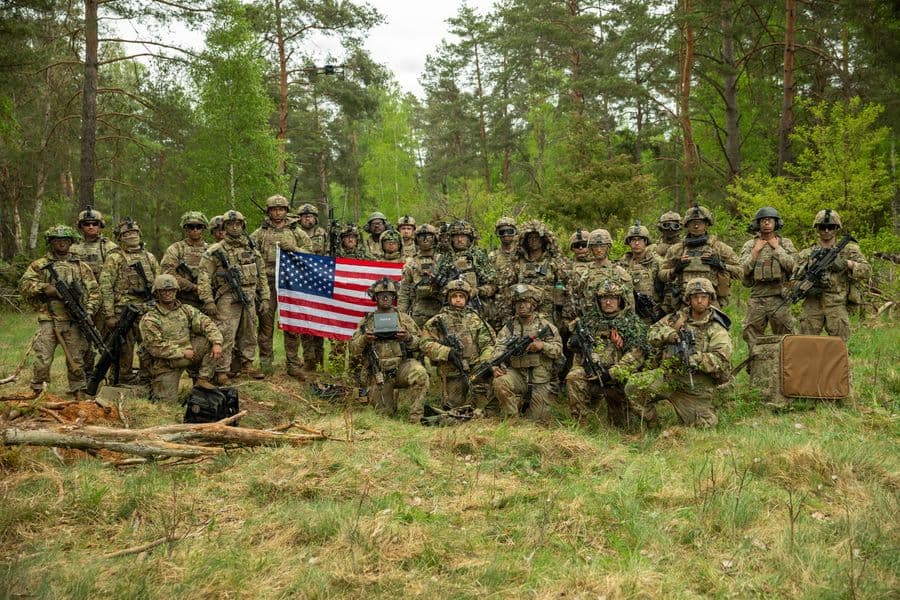
Image: U.S. Soldiers assigned to 1st Squadron, 2nd Cavalry Regiment, pose for a picture after the completion of a dry-fire exercise during Saber Strike May 7, 2026, in Bemowo Piskie, Poland. From April 27 to May 31, 2026, U.S. and Allied forces will exercise the North Atlantic Treaty Organization’s (NATO) Eastern Flank Deterrence Initiative, demonstrating NATO’s ability to fight and win on the modern battlefield. Nearly 15,000 troops from eleven nations will train across the High North, Baltic region, and Poland. They will execute rapid maneuvers, air defense, counter-drone operations, and cyber defense to validate NATO’s regional defense plans in real time. This series of linked exercises includes Saber Strike, Immediate Response, and Swift Response. The exercises turn investment into capability. Soldiers integrate unmanned systems such as AI-enabled command and control and live data networks to move, decide, and fight more effectively across all domains. Sword 26 demonstrates how U.S. Army Europe and Africa drives transformation at scale while strengthening deterrence. Together with our allies, we are building a unified, lethal force ready to defend NATO territory and respond to any threat. (U.S. Army Reserve photo by Sgt. Shaun R. Rajasekar)
Note:

In Pursuit of Nuclear Abolition
By Peter Huessy • RealClearDefense
Innovation Alone Won’t Prepare the U.S. for the Future Battlefield
By Joshua Segal • RealClearDefense
The sUAS Tactical Trifecta
By Bryan T. Woody • RealClearDefense
The Revolutionary War: When Strategic Options Share the Same Weakness
By Henry Yep • RealClearDefense
The Houthis Are Testing the Limits of Collective Defense
By Saima Afzal • RealClearDefense

Who Shoots Down the Drone Over the Shipyard?
By John Ferrari & Dillon Prochnicki • RealClearDefense
Northrop Grumman Breaks Out the Big Guns at AUSA
By Daniel Terrill, Defense News
Army Pursuing Diverse Array of New Anti-Air Interceptors
By Trevithick, The WarZoneWho Shoots Down the Drone Over the Shipyard?
By John Ferrari & Dillon Prochnicki, RCD
F-35C Lands for the First Time on a Ford-Class Aircraft Carrier
By The Aviationist