
Elbridge Colby and Clausewitzian Diplomacy
Last updated 01:00 AM EDT • Read time: 6m
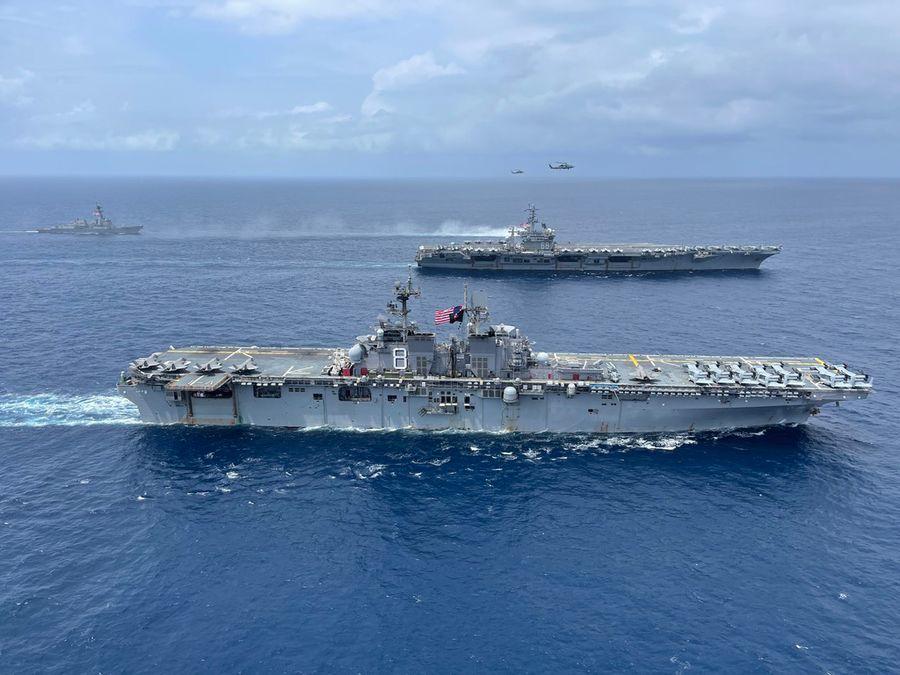
Amphibious assault ship USS Makin Island (LHD 8), aircraft carrier USS Nimitz (CVN 68), and USS Chung Hoon (DDG 93) perform expeditionary strike force (ESF) operations, Feb. 15, 2023 in the South China Sea. Nimitz Carrier Strike Group (NIMCSG) and amphibious assault ship USS Makin Island (LHD 8) with embarked 13th Marine Expeditionary Unit are conducting joint ESF operations, representing unique high-end war fighting capabilities, maritime superiority, and power projection, demonstrating the U.S. commitment to our allies and partners in the Indo-Pacific region. (U.S. Navy photo by MC3 Kendra Helmbrecht)
Appearing on John Batchelor’s always informative podcast, former Trump national security official Elbridge Colby makes three important points about the current challenges posed by Russia in Ukraine and China in the western Pacific: first, China’s geopolitical ambitions go well beyond Taiwan and the western Pacific and reach across Asia into Africa and even Latin America; second, China’s challenge to America’s global leadership dwarfs Russia’s regional aggression in Ukraine; and third, the United States does not have unlimited resources and should not wage a two-front war in Eastern Europe and the western Pacific. The United States must strategically pivot to Asia.
Colby served as Deputy Assistant Secretary of Defense for Strategy and Force Development in the Trump administration, and played a key role in drafting DoD’s 2018 National Defense Strategy, which shifted strategic planning toward great power rivalries instead of peripheral conflicts. He is co-founder of the Marathon Initiative whose stated mission is to “develop the diplomatic, military, and economic strategies the nation will need to navigate protracted competition with great power rivals.” He is the author of The Strategy of Denial: American Defense in an Age of Great Power Conflict (2021).
Colby told John Batchelor that the American media’s focus on the war in Ukraine has magnified the relative importance of that conflict in comparison to the major challenge we face in the Asia-Pacific and beyond from China. Colby understands that war--even a Cold War--should be approached with Clausewitzian principles, especially a focus on the enemy’s “center of gravity” and a “concentration” of resources at the “decisive point.”
Clausewitz in his famous On War defined the center of gravity as “the hub of all power and movement, on which everything depends” and “the point against which all our energies should be directed.” In today’s Cold War, the center of gravity is China and the Indo-Pacific, not Eastern Europe. Matt Pottinger, who served as Deputy National Security Adviser in the Trump administration, and John Pomfret, the former Beijing Bureau Chief for the Washington Post, conclude in a recent Foreign Affairs piece that Beijing is preparing for war. Pottinger and Pomfret note the opening of several National Defense Mobilization offices” across China, the passage of a law to enable the PLA to “more easily activate its reserve forces and institutionalize a system for replenishing combat troops,” and four recent speeches where President Xi Jinping “described a bleak geopolitical landscape, singled out the United States as China’s adversary, exhorted private businesses to serve China’s military and strategic aims, and reiterated that he sees uniting Taiwan and the mainland as vital to the success of his signature policy to achieve ‘the great rejuvenation of the Chinese ethnos.’” Xi, they conclude, “is clearly willing to use force to take” Taiwan.
Colby notes that China’s strategic ambitions go “well beyond Taiwan,” and those ambitions are manifest in China’s military posture in the South China Sea and its acquiring of ports and bases in the Indian Ocean, Africa, and even Latin America. China, he says, seeks a “hegemonic position in Asia and from that . . . vantage global preeminence.” Today, Colby says, Europe is important but “it is considerably less important than Asia.” And America’s power is not unlimited. We must make “tough choices” and prioritize the challenges we face. We must, he remarked, “prioritize the primary theater,” which is Asia, not Europe.
Batchelor and Colby discussed the charges of isolationism being leveled against those political officials and strategists who view the Asian theater as strategically more important than Europe. Colby noted that the “old guard” foreign policy establishment--which includes GOP leaders in Congress--are Atlanticists or neo-interventionists (he mentions John Bolton) who act as if there are no limits to American power. But Colby also criticized libertarians like Sen. Rand Paul who go too far in the other direction. We must “husband our resources,” Colby says, and approach the world with “conservative realism.” And conservative realism today means an Asia-first foreign policy. The stakes are greater in Asia than in Europe.
“The arsenal of democracy is being depleted in Europe,” Batchelor noted. And Colby remarked that if current trends continue China will have nearly twice the number of warships as the United States by 2028. “Our defense industrial base,” Colby said, “is in sorry shape . . . relative to the scale of the problem.” If Taiwan falls, Colby opined, it will be a “disaster” for the United States. The Biden administration and a lot of Republicans who think the main focus of our national security policy should be Ukraine have created this “grim” situation. We cannot “do” Ukraine, China, Iran and North Korea simultaneously, according to Colby.
Russia’s strategic partnership with China makes the challenge greater and more complex, but as our commitment to Ukraine grows and we pour more money and resources into Eastern Europe, we move away from the Clausewitzian concentration of resources at the Asian center of gravity. Difficult and uncomfortable choices have to be made. Priorities have to be set. Otherwise, we risk falling into a two-front war that could strain our resources to the breaking point and result in World War III.
Francis P. Sempa is the author of Geopolitics: From the Cold War to the 21stCentury, America’s Global Role: Essays and Reviews on National Security, Geopolitics and War, and Somewhere in France, Somewhere in Germany: A Combat Soldier’s Journey through the Second World War. He has written lengthy introductions to two of Mahan’s books, and has written on historical and foreign policy topics for The Diplomat, the University Bookman, Joint Force Quarterly, the Asian Review of Books, the New York Journal of Books, the Claremont Review of Books, American Diplomacy, the Washington Times, The American Spectator, and other publications. He is an attorney, an adjunct professor of political science at Wilkes University, and a former contributing editor to American Diplomacy. Mr. Sempa also writes a monthly column for RealClearDefense including his latest "America Misses the Power Objective" and America Sleepwalks Into War with Russia."

A Defense Win for Americans and Israelis in Arkansas
By Bradley Bowman • RealClearDefense
A Path to Success Against Iran
By Michael Schwartz • RealClearDefense
The World Cup Is Over. The Drone Threat Isn’t.
By Mitzi Perdue • RealClearDefense
AI Should Speed Veterans’ Benefits, Not Decide Them
By Rob Schroder • RealClearDefense
Don’t Be Swayed by Tactical Nukes
By Benjamin Giltner • RealClearDefense

Big Surface Combatants are so Hot Right Now
By CDR Salamander
USS Stout Loses Power During Port Visit Due to ‘Engineering Casualty’
By USNI News
Air Force Lessons Learned From Operation Epic Fury
By Tabitha Reeves, National Defense
Marines Need Nine More Amphibious Warships To Carry Out Its Missions
By TWZ
AFRL, ACC Fly XQ-67A Drone To Test Autonomous Teaming
By Airforce Technology