
The World His Mother Opened
Last updated 06:47 AM EST • Read time: 9m
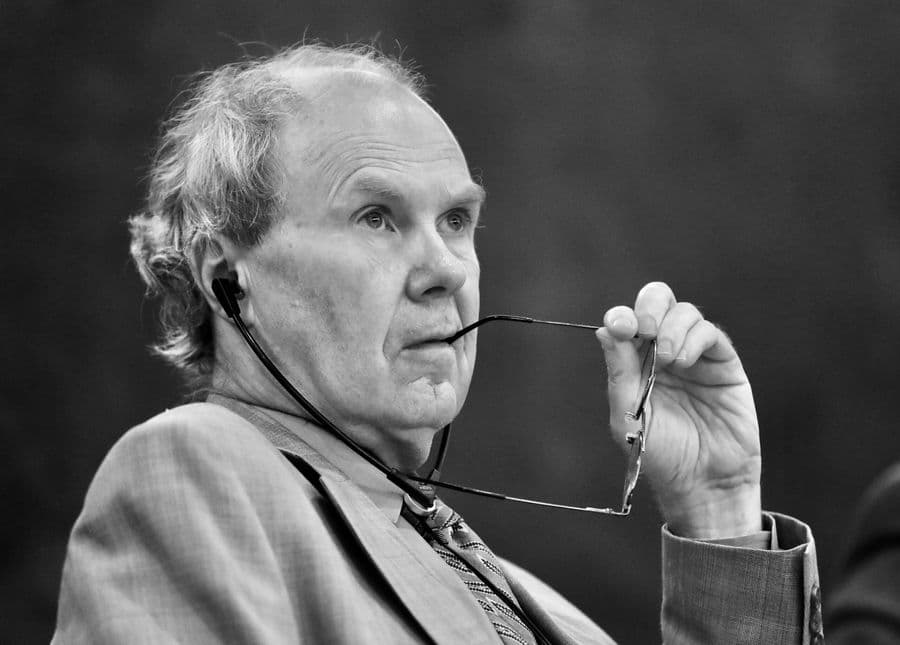
We were talking about China when Mathew Burrows began to tell me about his mother. She had broken her pelvis at Christmas, and he was looking after her, working for the Stimson Center from home; everyone there, he said, had been very kind. I was caring for a parent of my own, and for a time the rivalry between the world’s two great powers waited while we talked about looking after the people who once looked after us. She was mending well, and he was grateful to be with her.
He owed her a great deal, he told me, above all his love of learning. When he was a child, he asked a librarian for another book on the French Revolution, and the librarian was surprised enough to mention it to his mother. I liked that word, “another.” Even then he suspected that one account could never be the whole story. His mother encouraged him to read about history, about other countries and the lives people led in them, and he spoke of that encouragement the way others speak of an inheritance.
The civilization whose rise Mathew spent years forecasting has long made that kind of mother its ideal. Mencius, whom later tradition ranked second only to Confucius, was raised by a woman remembered almost as well as he is. Liu Xiang’s Lienü zhuan, from the first century BCE, records that she moved house three times for his sake. Beside a graveyard, the boy played at burials; beside the market, at being a merchant. Only beside a school, where he began to imitate its rituals, was she content. When he neglected his lessons, she took a knife to the cloth on her loom: to abandon learning halfway, she told him, was to ruin it as she had ruined her weaving. For 7 centuries, Chinese children learned her story in the opening lines of their first primer, the Three Character Classic. The boy she raised grew up to advise kings and warn them against ruinous wars. Mathew, who owed his learning to his own mother, would one day sound the same warning.
The boy who wanted another book earned a Cambridge doctorate in European history and became an intelligence officer. Mathew Burrows worked for 25 years at the CIA, the last 10 at the National Intelligence Council. There he was principal author of three editions of Global Trends, the long-range assessments prepared for incoming presidents. The 2008 edition warned of “an historic transfer of relative wealth and economic power from West to East.” Years later, he told me, he had briefed senior officials that China, an ancient civilization whose economy had been larger than the West’s before the industrial revolution, would not long accept a world whose rules were written in Washington. They thought the idea outrageous and he could hardly blame them: here was an "egghead" from the intelligence community telling them that China was different in scale and in history. He later carried the work to the Atlantic Council and Stimson, where he worked until his death in October 2026, at 73. When I told him I, too, wanted to serve, he understood at once.
I was more pessimistic about the West than he was. I spoke of its decline as a verdict already delivered; Mathew treated it as a question still open. He wanted to know where an argument led, and whether I would still stand by it once I had followed it to the end. I remember when he sent me the manuscript of Dreamwalkers, the book he had written with the German political scientist Josef Braml, and asked for my criticism before it appeared in Germany in 2023 as Die Traumwandler. Few things are as bracing as being asked for your opinion by someone who knows far more. In the book he quoted Edward Grey, Britain’s foreign secretary in 1914, on why there had been no time that July to reflect on what a modern war would mean: “In a crisis people cannot change their settled points of view on general matters; they are too busy with particulars of the moment.” Mathew's whole career can be read as a reply to that sentence. The thinking has to be done before the crisis, while minds can still change. I suspect that is what he was doing with me.
Hope never made him complacent. "True patriotism isn't blind worship, it's demanding better", he once told me. Having grown up in the 1950s and 1960s, he found American culture so sunk in triviality as to be almost unrecognizable. What troubled him most was ignorance, the opposite of his mother’s gift; at times, he said, it was as if there were no will left to save our civilization. He had little patience for the mindless attacks of left and right on each other, or for a Congress and White House interested mainly in reelection. For a historian whose work was imagining consequences, ignorance was not a matter of taste but a strategic weakness. His book recalls that when the Cuban missile crisis came, John F. Kennedy had recently read Barbara Tuchman’s The Guns of August, a history of how rigid war plans dragged Europe into war. Kennedy told his brother he would not follow a course that would let anyone write a comparable book called The Missiles of October. One book about 1914 helped keep October 1962 from becoming another August. A public that no longer reads such books may not recognize its own July until it is too late.
Dreamwalkers opens in Sarajevo in June 1914. That summer the Kaiser, reading Serbia’s reply to Vienna’s ultimatum, concluded that every reason for war had fallen away, and Europe was at war within days all the same. Mathew put it to me more simply: nobody had wanted that war, yet none of the leaders would stick his neck out to stop the drift. He told me China and the United States could slide the same way, into a war he feared would be devastating for everyone and for our planet. The Kaiser, the Tsar and the King were cousins, and the book quotes Margaret MacMillan’s observation that the blood ties between the German and British royal families, which might have eased their antipathy, “did quite the opposite.”
Mencius, the weaver’s son, had diagnosed this failure 22 centuries earlier, in a conversation with King Xuan of Qi. The king had once seen an ox being led to sacrifice, trembling with fear, and could not bear it; a sheep took its place. He pitied the ox because it was in front of him. The sheep he never saw. Mencius told him that this pity was enough to make him a true king, if only he would extend it to his people: “Honor the elders of your own family, and extend that honor to the elders of other families.” He also asked whether the king really enjoyed raising armies, endangering his soldiers, and earning the hatred of other rulers. His warning was blunt. A ruler who extends his kindness can protect everyone within the four seas; one who does not cannot protect even his own wife and children. 4 years after August 1914, Nicholas II, the British king’s first cousin, was shot in a cellar in Yekaterinburg with his wife and their five children.
In any great rivalry, the other side’s people become the sheep: studied closely as capabilities and intentions, rarely seen as families. Matthew's scenarios were a way of bringing the unseen into view before anything was decided. I came to believe that his tenderness toward his mother and his fear of war were not separate things. Mencius would have recognized him: a son whose care reached as far as his imagination could carry it.
Near the end of the book, he and Braml turned to South Africa for a way out. In 1991 and 1992, 22 South Africans from opposing camps met at Mont Fleur, outside Cape Town, to imagine their country’s next decade. With no mandate to negotiate, they agreed on four scenarios instead. In “Lame Duck,” a settlement produced a government too hobbled to govern; in “Flight of the Flamingos,” the country took off slowly, flew high, and flew together. The exercise did not end the crisis. It gave people a common language for discussing consequences while their disagreements remained, and the language spread. One Sunday a sermon urged a congregation toward the Flamingos; on a rural radio phone-in, someone voiced a fear of the Lame Duck.
This was the opposite of the culture Mathew feared. A society far more divided than ours had found a way to talk about its future in church and on the radio. He and Braml asked why the West, China, Russia, and the Global South should not try something similar. The idea sounds naive only until one remembers how improbable Mont Fleur once seemed.
They dedicated the book “To the Peacemakers of this World” and thanked the families and friends who had given them “peace in worrying times.” At first, I read those words as a customary expression of thanks. Now they seem to me among the most moving lines in the book. The people around him had made a difficult time more bearable, giving him some of the peace those words describe. And he showed me that same generosity.
I will miss being able to ask him what he makes of things. He would ask me what I was thinking and how I had reached my conclusions, and even his disagreement was a comfort. He could take a fear seriously without letting it settle every question. The conversation would go on, and I would have more work to do.
I return, too, to the way he spoke about his mother. He was glad she was recovering and saw nothing remarkable in what he was doing for her. “There was little sacrifice on my part,” he said. Mencius’s mother cut the cloth from her loom so that her son would finish what he had begun. Mathew's mother encouraged a small boy who wanted another book. He had once been his mother’s future.
Rest in peace, Mathew Burrows, and thank you for your service to country and humanity.
Carlo J.V. Caro is a strategic analyst trained in international security at Columbia University. He previously served as Vice President of a private equity firm.

Eight Months of Epic Fury and Still No Internal Alternative
By Stephen D. Cook • RealClearDefense
The Readiness Cliff: Pacific Lessons Drawn from the Middle East
By Brian McSorley • RealClearDefense
The Pentagon’s Real Modernization Problem Is Time, Not Technology
By Bruce Allen Lubbering • RealClearDefense
The World His Mother Opened
By Carlo J.V. Caro • RealClearDefense
Wake Island Lessons for Expeditionary Advanced Base Operations
By Brian J. Dunn • RealClearDefense
Wake Island Lessons for Expeditionary Advanced Base Operations
By Brian J. Dunn • RealClearDefense
U.S. Navy Expands Unmanned Mine Hunting
By Global Defense News
MRF-SEA Will Maintain Continuous Presence in the Philippines
By Mahadzir, USNI News
Space Force Weighs Proliferated Cislunar Satellite Constellation
By C. Albon, A&SF
America-Class Amphibs Enable New Ship-to-Shore Attack Strategies
By Warrior M.