
Granting Potential Adversaries Spheres of Influence is a Bad Idea - Lessons from History
Last updated 02:39 AM EDT • Read time: 10m
The U.S. 2025 National Security Strategy states that “The United States must be preeminent in the Western Hemisphere as a condition of our security and prosperity—a condition that allows us to assert ourselves confidently where and when we need to in the region.” The document also describes the importance of other regions of the world, such as Indo-Pacific, Europe, and the Middle East, but does not claim a dominate role for the U.S, in those regions.[1]
Several national security commentators fear that the logical conclusion of this strategy is that the world would be divided between the three major powers, and that in exchange for granting the United States preeminence in the Western Hemisphere, Russia and China would be able to dominate their spheres in Europe and Asia respectively.[2],[3],[4],[5],[6],[7],[8],[9]
The United States and the Western World do not have a good track record when it comes to preemptively granting spheres of influence to potential adversaries/future enemies. Following are three examples from history demonstrating that point.
The United States and Japan divide the Western Pacific into Spheres of Influence, 1905-1908
After the American victory in the 1898 Spanish-American War, and as Japan was wrapping up its win in the 1904-1905 Russo-Japanese War, Secretary of War (and future President) William Howard Taft and Japanese Prime Minister signed the Taft-Katsura Agreement on 27 July 1905. Under this agreement, the United States acknowledged Japanese rule over Korea and condoned the Anglo-Japanese alliance of 1902. At the same time, Japan recognized U.S. control of the Philippines.
The Treaty of Portsmouth, arbitrated by President Theadore Roosevelt and signed by Japan and Russia on 5 September 1905, ended the Russo-Japanese War, recognized Japan’s dominance in Korea, and transferred to Japan Russia’s leasehold on the Liaodong Peninsula (Port Arthur, Dairen), control of the South Manchuria Railway south of Changchun.
Three years later, on 30 November 1908, U.S. Secretary of State Elihu Root and Japanese Ambassador Takahira Kogorō and signed the Root-Takahira on November 30, 1908. Under This agreement, similar to the Taft-Katsura Agreement, the U.S. recognized Japan’s pre-eminence in Korea and Southern Manchuria, while Japan recognized U.S. control over its territories of the Philippines and Hawaii.
These agreements effectively demarcated spheres of influence in the Western Pacific between the U.S. and Japan. These agreements definitively established a quid pro quo exchange of Korea for the Philippines.[10]
The U.S. objective of demarcating the Western Pacific into mutually agreeable spheres of influence was not successful. Japan retained and enhanced its sphere of influence in Korea and Manchuria, while it violently intruded into the U.S. sphere of influence, seizing not only the Philippines, other U.S. possessions Guam, Samoa, and Wake Island, and British, Dutch, and French territories in Asia at the beginning of World War II in the Pacific.
Western Allies Granting Germany its Sphere of Influence in Central Europe, 1925 -1938
The Locarno Pact of 1925 consisted of several agreements between Germany, France, Great Britain, Belgium, Italy, Poland, and Czechoslovakia to resolve differences peacefully under the League of Nations. While Germany pledged to guarantee the inviolability of the borders with France and Belgium, there was notably no guarantee of Germany’s eastern borders with Poland and Czechoslovakia.
The reason for the disparity in security guarantees between Germany’s western and eastern neighbors was that the Western European nations, especially Britain, wished to stabilize Germany’s position in Western Europe. British Foreign Secretary Austin Chamberlin felt that the key to European security would be a revitalized and confident Germany that would not resent the loss of its Eastern territories. Chamberlin envisioned that a warmer French-German relationship would lead France to drop its establishment of a cordon sanitaire among the newly independent Eastern European nations against Germany. This would allow Germany to seek revisions in its border with Poland and ameliorate the most painful terms of Versailles.[11]
Under Adolf Hitler, Germany began to gradually abrogate the terms of the Versailles Treaty, including reoccupying the Rhineland (1936), annexing Austria (Spring, 1938), both with the acquiescence of Britain and France, and threatening to seize the ethnic German population of Czechoslovakia, called the Sudetenland (Fall 1938). Britain’s Prime Minister, Neville Chamberlin (younger half-brother of Austin Chamberlin) fearing a conflict even worse than the First World War, sought to accommodate Germany’s territorial demands and received from Hitler a signed pledge to limit German annexation to just the Sudetenland, guaranteeing “Peace in our time.”
The British and French objective of allowing Germany to annex ethnic German parts of Central and eastern Europe (Austria and the Sudetenland) in exchange for limiting its demands to those areas and guaranteeing peace with Western Europe failed miserably. In March 1939, Germany seized the Czech areas of Czechoslovakia and permitted the establishment of the German puppet state of Slovakia. In September 1939, Germany attacked Poland, resulting in a war far worse than World War I.
1945 Yalta Agreement, Granting a Soviet Sphere of Influence in Eastern Europe
In October 1944 as U.S. and British forces from the west, and Soviet forces from the east were converging on a crumbling Germany, British Prime Minister Winston Churchill feared that the Red Army would overrun Eastern Europe and establish a Soviet sphere of interest. Hoping to preserve some Western influence in the region, he met with Stalin in Moscow and proposed that Southeastern Europe be divided into relative ratios as follows: Romania 90% Soviet, 10% Western Greece 90%Western, 10% Soviet, Yugoslavia 50%-50%, Hungary 50%-50%, Bulgaria 75% Soviet, 25% Western.
By February 1945, when the Big Three of Franklin Roosevelt, Churchill, and Joseph Stalin met in Yalta, Crimea, the Red Army had pushed even deeper into Eastern Europe, liberating Romania and Bulgaria, and was 65 kilometers from Berlin. At this point, the two western allies could only hope to avert total Soviet control over Eastern Europe and sought to reach an agreement with Stalin that would allow the liberated nations to be free to select their own form of government.
Stalin, on the other hand, feared that free elections could lead to unfriendly powers on the Soviet Union’s borders, and wished to control this buffer zone between it and Germany. One area of special concern was Poland, whose freedom was the cause for which Britian and France went to war against Germany at the beginning of the war.
The question over Poland revolved around two issues, post-war borders, and government composition. The Soviets insisted on shifting Poland’s borders hundreds of miles west. The Soviets goal was to recoup the lands they seized in accordance with the Molotov-Rippentrop Pact when Germany and the Soviet Union jointly attacked Poland and partitioned the country. Poland would be compensated by taking German territory east of the Oder-Niese line, yielding German Silesia to Poland.
The United States and Britain acquiesced to the Soviet land grab of Poland’s eastern territories, in exchange for the Soviets agreeing to a joint Communist-non-Communist coalition government. However, the non-Communists were later purged, and the Soviets got their satellite state in Poland.
In spite of Churchill’s efforts to preserve some percentage of Western influence in Eastern Europe, the Soviets/Communists got 100% of Romania, Bulgaria, Hungary, and Yugoslavia. They also got 100% of Poland and Czechoslovakia, which were not on the Churchill-Stalin tradeoff. The West did succeed in retaining Greece, though.
Summary of Historic Failures to Divide Regions into Spheres of Influence
Conclusion – Granting Russia and China Their Own Spheres of Influence Would Lead to a Disaster
With this extremely poor historic track record of trusting adversaries to stay within their own spheres of influence while respecting the sphere of the West, it would be a fool’s errand to believe that in today’s world, the Russians would be content with some or all of Ukraine and Chinese with Taiwan. In fact, Russia and China’s long-term objectives are as follows:
Russian objectives. In a 30 November 2023 address to the World Russian People's Council, Russian President Putin declared that the Russian world includes Ancient Rus, the Tsardom of Muscovy, the Russian Empire, and the Soviet Union.[12] Putin’s desired expansion could thus extend to the historic borders of the Russian Empire and Soviet Union, that is, Ukraine, Moldova, and the Baltic States, and possibly to the Soviets’ and Russians’ greatest historic expansion, Poland.
Chinese Objectives. In the 1980s, Admiral Liu Huaqing, head of the PLA Navy from 1982 to 1986, described China’s long term goal for a maritime sphere of influence was to be able to control the First Island Chain (from the Kuril Islands through Japan, Taiwan, and the Philippines) in the 2000s, the Second Island Chain (from Japan through Guam to New Guinea) in the 2020s, and to be able to operate with a global navy with aircraft carriers to the third Island Chain (Hawaii) by 2050.[13],[14]
The attempts to negotiate stable spheres of influences with the expansionist, autocratic regimes of Imperial Japan, Nazi Germany, and the Communist Soviet Union in hopes of averting conflict brought not peaceful security but in fact emboldened those adversaries to make additional power grabs that led precisely to conflict, namely World War II and the Cold War. As with these previous attempts, a U.S. granting of spheres of influences to Russia and China today would likely encourage aggressive actions against American allies in Europe and Asia, leading to war. To prevent this, the United States should not only deny Russia and China these spheres, but it should strengthen its alliances with its regional partners, which has kept them secure for the last 81 years.
MAJ Dennis S. Nelson (U.S. Army, ret.)
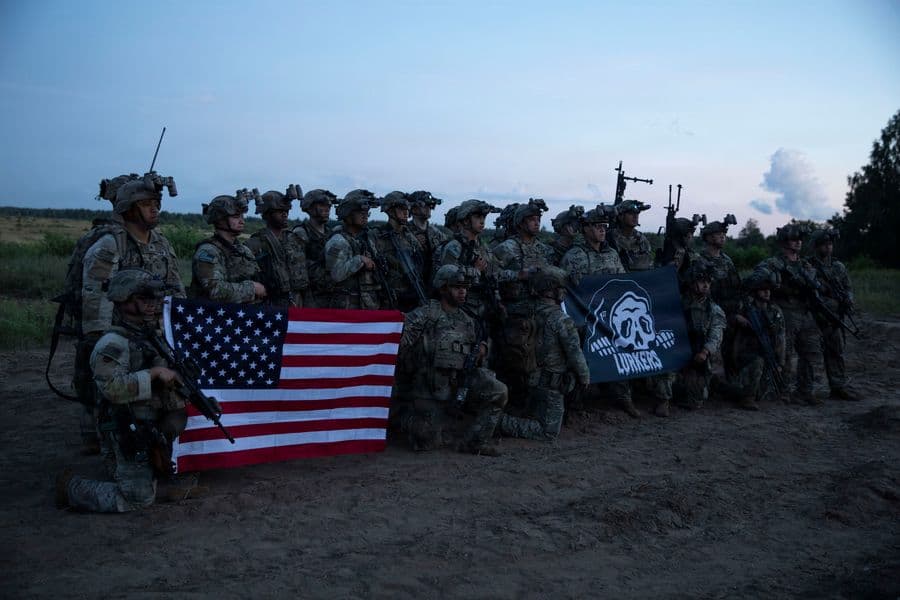
image: U.S. Soldiers from 1st Platoon, Charlie Company, 2nd Battalion, 37th Armored Regiment, NATO Forward Land Forces Battle Group-Poland, stand together prior to the night live-fire exercise at Bemowo Piskie Training Area (BPTA), Poland, on Aug. 12, 2026. The training area hosts NATO Forward Land Forces Battle Group–Poland, one of V Corps’ ready forces in Europe. The battle group builds vigilance, lethality, and interoperability through collaborative forums, multinational exercises, unit-level training, and professional relationships with allies. (U.S. Army Reserve photo by Staff Sgt. Emilie Lenglain)
notes:
[1] National Security Strategy of the United States of America, November 2025, https://www.whitehouse.gov/wp-content/uploads/2025/12/2025-National-Security-Strategy.pdf
[2] Edward Wong, Trump’s Vision: One World, Three Powers? New York Times, 26 May 2026. https://www.nytimes.com/2025/05/26/us/politics/trump-russia-china.html
[3] Paul R. Pillar, Trump’s World and the New Three Emperors’ League, National Interest, 4 March 2025. https://nationalinterest.org/blog/paul-pillar/trumps-world-and-the-new-three-emperors-league
[4] The Return of Spheres of Influence: Will Negotiations Over Ukraine Be a New Yalta Conference That Carves Up the World? Monica Duffy Toft, Foreign Affairs, 13 March 2025. https://www.foreignaffairs.com/united-states/return-spheres-influence
[5] Bradley N. Nelson, Donald Trump’s Spheres of Influence Strategic Doctrine: What is it? And What Are the Global Consequences of it? Journal of Global Strategic Studies, Vol. 05 No. 01, June 2025. https://www.researchgate.net/publication/393543044_Donald_Trump's_Spheres_of_Influence_Strategic_Doctrine
[6] Trump’s worldview is causing a global shift of alliances – what does this mean for nations in the middle? The Conversation, 30 June 2025 https://theconversation.com/trumps-worldview-is-causing-a-global-shift-of-alliances-what-does-this-mean-for-nations-in-the-middle-257113
[7] Parallel Trajectories? Trump’s Foreign Policy and Russia’s Vision of Multipolarity, Europe, Policy & Politics, 9 May 2026. https://saisreview.sais.jhu.edu/parallel-trajectories-trumps-foreign-policy-and-russias-vision-of-multipolarity/
[8] Stacie E. Goddard, Trump’s New Spheres of Influence, International Chronicles, 11 May 2025. https://www.theinternationalchronicles.com/2025/05/11/trumps-new-spheres-of-influence/
[9] Parallel Trajectories? Trump’s Foreign Policy and Russia’s Vision of Multipolarity, Europe, Policy & Politics, 9 May 2026. https://saisreview.sais.jhu.edu/parallel-trajectories-trumps-foreign-policy-and-russias-vision-of-multipolarity/
[10] Simple Conversation or Secret Treaty?: The Taft-Katsura Memorandum in Korean Historical Memory, Kirk W. Larsen, Joseph Seeley, Journal of Korean Studies, Volume 19, Number 1, Spring 2014, pp. 59-92 https://doi.org/10.1353/jks.2014.0003
[11] Patrick O. Cohrs, The Locarno Pact’s enduring legacy, Engelsberg Ideas, 12 Nov 12 2025 https://engelsbergideas.com/essays/the-locarno-pacts-enduring-legacy/
[12] Putin, Vladimir, 'We Are Now Fighting Not Just For Russia's Freedom But For The Freedom Of The Whole World' November 30, 2023, MEMRI Special Dispatch No. 10991, https://www.memri.org/reports/putin-we-are-now-fighting-not-just-russias-freedom-freedom-whole-world
[13] Captain Bernard D. Cole, U.S. Navy (Retired), Island Chains and Naval Classics, Proceedings Vol. 140/11/1,341, Nov 2014 https://www.usni.org/magazines/proceedings/2014/november/island-chains-and-naval-classics
[14] First Island Chain: How Geography Cages China's Navy, Geopol.uk https://geopol.uk/concepts/first-island-chain/