
Key Principles of the Democratic World in Response to Authoritarian Challenges
Last updated 06:42 AM EDT • Read time: 5m
The contemporary international security environment is undergoing a period in which democratic states face increasing pressure from authoritarian regimes. These regimes employ military, informational, economic, and technological instruments to expand their influence and undermine the resilience of democratic societies. In recent years, it has become evident that traditional response mechanisms—based on inertia and expectations of gradual crisis resolution—have ceased to function effectively. The democratic world has found itself in a situation that requires not only timely reaction but also a strategic reassessment of the principles on which collective security is built.
Military threats posed by authoritarian states have acquired a transregional character. The aggression against Ukraine has become the largest armed conflict in Europe since the Second World War and has demonstrated that dictatorships are willing to use force to alter international borders. At the same time, there is a growing level of strategic tension in the Indo‑Pacific region, where authoritarian states are showing a clear intention to revise the existing balance of power. These developments are interconnected: together they form a unified field of instability that compels democratic countries to act in a coordinated manner to preserve an international order based on the rule of law.
Informational threats have become no less significant. Authoritarian regimes actively employ disinformation, manipulation, and aggressive propaganda to undermine trust in democratic institutions. Large‑scale campaigns aimed at distorting facts, influencing public discourse, and creating false narratives have become part of the foreign‑policy strategy of dictatorships. This requires democratic states to strengthen information resilience and enhance their ability to protect their societies from targeted influence operations.
Under these conditions, it is becoming increasingly clear that the democratic world needs a coherent set of principles that define its approach to countering dictatorships. Such a set is not a political slogan or a declarative statement. It is a practical framework for action, based on real events and the experience of states that have already faced the challenges of authoritarian aggression.
The Principles for Democratic States in Countering Dictatorships
1. Commitment to democratic values.
Freedom, human rights, the rule of law, and political pluralism remain the foundation on which the resilience of democratic societies is built. Upholding and protecting these values is not an abstract task but a practical necessity, as they become the first targets of attacks by authoritarian regimes.
2. Understanding the necessity of unity among democratic countries.
Recent events have shown that only collective action makes it possible to effectively counter military, informational, and economic threats. Democratic states acting in isolation become vulnerable to authoritarian pressure. Coordinated decision‑making, joint initiatives, and alignment of efforts form the basis of the resilience of the democratic space.
3. Resilience to the lies of aggressive propaganda by dictatorships.
Democratic states strengthen mechanisms of protection against disinformation, expose false narratives, and prevent decisions based on distorted data. This has become particularly important in conditions where information attacks aim to undermine trust in democratic institutions and create internal instability.
4. The ability to sacrifice the current well‑being of one’s own country for the future security of all democratic states.
Countries such as Lithuania, the United Kingdom, Sweden, and Denmark have already accepted significant economic and political costs while supporting Ukraine under conditions of armed aggression. They provide military, political, and humanitarian assistance, demonstrating that the security of the democratic space requires decisive action. Their experience shows that readiness for sacrifice becomes a factor capable of influencing the course of the conflict and depriving the aggressor of even the slightest hope for success.
At the same time, a number of states prefer to avoid collective commitments. In recent years, certain democratic leaders have declared their unwillingness to participate in mechanisms of mutual defense provided for by international agreements if such participation may entail domestic political risks, economic consequences, or involvement in a conflict they consider unnecessary or unrelated to their national interests. Such positions create a precedent that undermines trust in the existing system of collective security and calls into question the ability of the democratic world to respond to threats.
5. A commitment to supporting states subjected to attacks by dictatorships, regardless of their internal or external political orientation.
Recent events show that political, economic, technological, and defense assistance becomes a key element in preventing further spread of instability. Support for Ukraine has become an example of how democratic states can strengthen international law and prevent the destruction of the security architecture.
These principles form the foundation on which the democratic world can build a strategy for countering dictatorships. They reflect the experience of states that have faced authoritarian aggression and the necessity of preserving an international order based on the rule of law. Under conditions of growing pressure from authoritarian regimes, reaffirming and strengthening these principles becomes a matter of resilience and the future of the democratic world.
Sergey E. Ivashchenko is a strategic analyst working at the intersection of escalation dynamics, information strategy, and long‑range strategic forecasting.
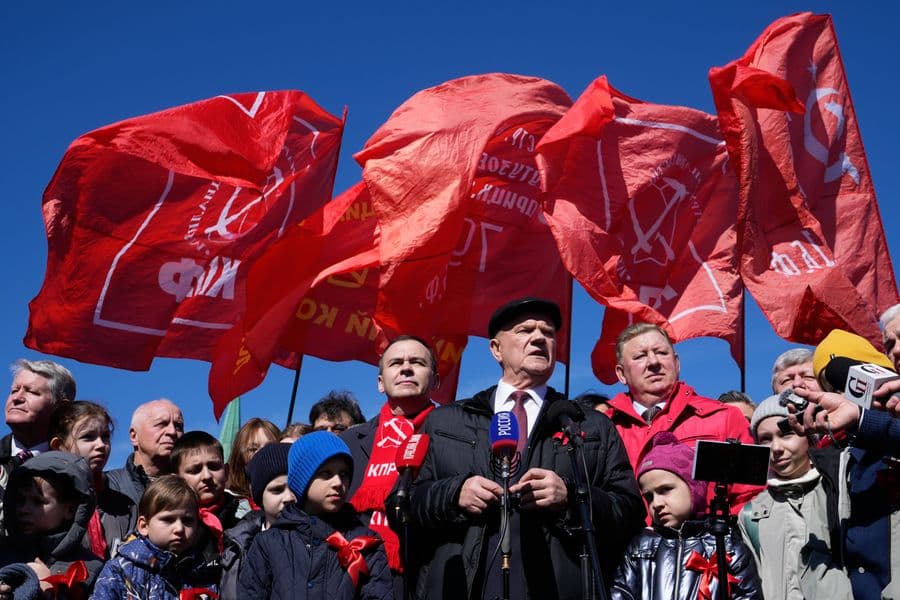
image: Russian Communist Party leader Gennady Zyuganov, center, speaks to journalists after laying flowers at the mausoleum of USSR founder Vladimir Lenin in Red Square, in Moscow, marking the 156th anniversary of his birth on Wednesday, April 22, 2026. (AP Photo/Pavel Bednyakov, File)