
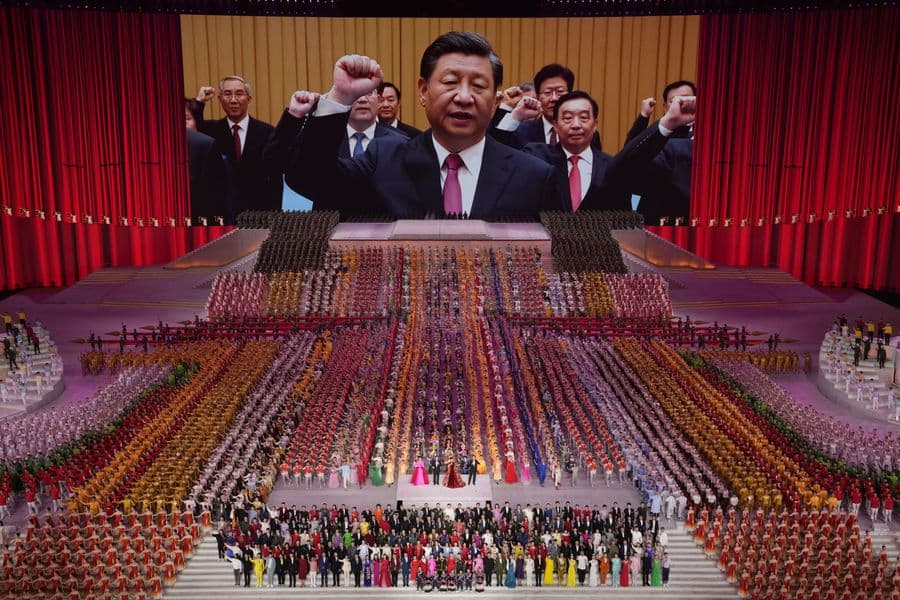
Break the Asian Machine Age
Last updated 11:22 PM EST • Read time: 11m
Two years before the September 11 attacks on the World Trade Center, two senior military officers in the People’s Liberation Army (PLA) published the book Unrestricted Warfare (1999). They argued that to defeat a technologically superior opponent, an inferior power must erase the boundaries between the battlefield and civilian life and pursue a modern, asymmetric strategy. “The first rule of unrestricted warfare is that there are no rules, and nothing is forbidden,” the authors wrote. A frontal assault on the battlefield would be suicide. But attacking the enemy’s currency, flooding his country with illegal narcotics, attacking his cultural and governance institutions through fostering social discord, and undermining his confidence through false media narratives and psychological operations can achieve national goals without ever crossing the kinetic ceiling. This kind of war is permanent and omnipresent—it happens simultaneously in the financial, legal, digital, and psychological domains. And yet, a regime that treats individuals as automaton gearworks is defenseless against an unapologetically American system of free-moving energy. What follows is part two in a series of conversations with entrepreneur and designer Ross Calvin on the future of global politics, the Chinese Communist Party, and how the West will overcome machine age psychology. Part one can be found here.
Define the Asian Machine Age psychology.
A brand of obedience engineering that uses surveillance, scoring systems, and fear-based incentives to reshape individual behavior into a corral of algorithmic loyalty. It is a cybernetic authoritarianism that adapts messaging directly to the “client.”
Transforming human thought, movement, and decisions into fenced-in, machine-readable data sets. How does the CCP operationalize this psychology among its population?
The CCP has its roots in the syndication of tongs, local clans and crime families across the old kingdoms, into a pyramid with Beijing at the top. Secrecy across the party operates with a kind of non-vocalized omertà. This pattern is migrated downstream via contemporary technology tools. The CCP fuses state power with economic control to dominate the Chinese people. Cynically-named “Smart Cities” integrate data across public and private domains. 700M+ cameras track facial, voice, and movement data. QR codes, loyalty apps, and scoring systems monitor ideological conformity. Health apps are repurposed for political suppression, all to engineer a kind of behavioral enforcement which staves off for as long as possible the social volatility of the CCP’s empire. Citizens can be charged for “picking quarrels,” “spreading rumors,” or “endangering security.” Dissent leads to job loss, blacklisting, or family reprisal. Children are trained to report non-loyal behavior in parents. Saving-face technologically enforced.
So, the state is like a coder-parent that programs behavior for maximum compliance. How do state-owned businesses spread Machine Age psychology?
Over 70% of China’s banking assets are state-owned enterprises (SOEs), and major sectors like energy, telecom, and logistics are run by CCP-controlled SOEs. Party secretaries work in company leadership to ensure political loyalty above return on assets. The large, successful private companies like Alibaba, Tencent, and ByteDance are obligated to cede veto power to CCP appointees. Private tech CEOs are routinely removed or sidelined for perceived disloyalty. Like the British Empire did to the English people, the CCP uses domestic financial repression as a global weapon (although this is running out of steam). For all the CCP’s whining about unequal treaties, they only complain because they were losers, not because of their own loyalty to any principles of justice. They have created an imperial program not only over the Chinese heartland, but increasingly over Central Asia and Africa far larger than the British ever did. Low savings deposit rates and capital controls funnel household savings to be extracted for state priorities. This suppressed domestic consumption preserves large trade surpluses to fuel massive outbound investment in Belt and Road programs. It amounts to global asset acquisition from ports and infrastructure, minerals to land to startups and enormous bribery backed by confiscated and redirected domestic capital.
How does the CCP export its psychology abroad?
Most local regimes have welcomed the CCP because they present as friendship amongst the “global south” and not as British colonial masters. The CCP manipulates naturally high-trust institutions in open societies, embedding itself through culture, commerce, and coercion masked as diplomacy. It thrives on being presumed rational, peaceful, and benign, while it frames criticism as racist or Sino-phobic. We’ve often heard we just “deeply angered 1.4 billion Chinese people.” Rather than generate surplus revenues through exports, the CCP is exporting itself lock, stock and barrel. Surveillance platforms have been exported to over 70 countries (Hikvision, Huawei Safe Cities, etc.). It exports cybersecurity laws modeled after China’s into countries like Iran, Cambodia, and Venezuela. CCP-aligned technology specifications standards now influence global regulatory bodies. Technology exports in particular are a trojan horse to install the Beijing command and control system – what one idiot I used to know called the “Beijing Consensus.” Infrastructure loans and telecom contracts include built-in data access terms which pipe information and control back to Beijing. Chinese-built ports, satellites, and telecom networks serve dual commercial and strategic functions, such as BeiDou satellite navigation system which is also used for logistics, surveillance, and military support. In the West, we’ve seen Chinese acquisition of marijuana grows staffed by armed Chinese paramilitaries from Maine to New Mexico as a deeper feature of the fentanyl-centered opium war which has extracted hundreds of billions in precious US dollars to stabilize the rampant credit profligacy at party-run banks while degrading the social psyche of the enemy. It’s a more egregious and insidious fraud than any East Africans could marshal.
How does the CCP project itself through the Chinese diaspora and Western corporations?
The United Front Work Department embeds in diaspora groups, universities, business networks and the MSS uses joint ventures, student exchange programs, and shell organizations for intelligence and to build dependency into the ministries of target governments. The diaspora is monitored and repressed as well. Students and expats are surveilled through campus groups and embassies. Activists abroad are harassed and their families back home punished. Unbelievably, Beijing claims jurisdiction over Chinese nationals, and sometimes even just the ethnically Chinese, everywhere worldwide. Western corporations, investors, and institutions capitulate and enable CCP control in order to preserve precarious access and prevent sunk capital in-country from seizure for broadly-defined reasons, including reasons of political rhetoric alone. Firms like Apple, LinkedIn, and Disney alter products, content, and actively curate internal code and products for CCP approval. Fashion and tech brands retract human rights statements after state pressure, reneging on the very principles which foster their existence. In this way, private sector firms more and more act as self-regulating proxies for censorship. They’ve unwittingly installed the CCP’s tong omertà, rolling over for the new branch of colonial magistrates.
Insanely, global investors are corralled into holding stakes in CCP-controlled companies tied to surveillance, repression, or forced labor, as well as financing the construction of a modern Chinese Navy. Chinese companies are listed in primary investment indices (e.g. MSCI, FTSE) which quietly channels Western public retirement and pension capital into CCP-linked firms. Meanwhile, due diligence firms and auditors are prevented by Chinese law from performing SEC-required reporting because any CCP-lined company information is treated as a “sensitive” state secret. CCP-linked companies publicly traded on American stock exchanges are simply absolved from reporting requirements. Then the corporate and political leaders invited to forums, exchanges, and investment schemes for special treatment and co-opting. United Front proxies broker influence through “friendship” and partnership.
In Unrestricted Warfare, two PLA colonels suggest that to overcome the United States, China must move beyond the military and exploit vulnerabilities in trade, legal, and psychological domains—there are no rules and nothing is forbidden. Explain their theory of “mid-level violence” against the United States.
The Chinese leadership are old hands at what we only in modernity call “mid-level violence,” proliferating manipulation and light coercion, coming just under the trigger point of violent escalation, where self-defense responses are used as pretext for the coercion and escalation that was intended in the first place. This exploits American’s willingness to be farmed absent a clear, overt signal from the exquisitely-built social system and republican institutions we so delicately want to preserve. It is just as much America’s fault for tolerating dysfunctional cultural patterns and outcomes triggered by these programs as it is the existence of these CCP unrestricted warfare programs themselves. Overt, positively forceful behavior diminishes the temptation for mid-level violence. But it’s already very long in the tooth and Americans must awaken.
You say that our own defense planners have fundamentally misunderstood China, such that the U.S. is “watering redwoods while the CCP is churning out cheap chainsaws.” Explain this analogy.
America’s penchant for blitzkrieg and exquisite systems is a paradigm the Chinese simply do not share. A simplistic example of this difference is that the top 85 DoD programs take 10+ years to develop, $2T to build, rarely scale beyond 100's of units and cost $4T to sustain. China steals the program’s IP, adds a few features with little better software inside its own fused military industrial complex, developed largely with American capital and trade surpluses with the United States, then inexpensively scales them with overwhelming volume. Yes, “the US is watering redwoods and the CCP is churning out cheap chainsaws.” This pattern has proliferated across all these omni-dimensional fronts including an incredible propaganda enterprise geared to reducing America’s social self-awareness and obscure its ability to modulate how it invests in defense and cultural programs. To understand the CCP, it’s critical to understand that it essentially endeavors to use the same human farm management skills on Americans and Europeans as it has used domestically for centuries, and accelerated to a science since 1960. It’s ability to think in terms of small trajectory adjustments, corralling and gating of attention and investment inputs follows a kind of multistage offense developed in the three millennia-long management of the disparate kingdoms of the Chinese Empire – now with Leninist characteristics.
And yet, you believe the CCP system is doomed to fail. Why?
The CCP system is structurally disintegrating because its productive miracle was built on a foundation of mercantilist cannibalization, where local prosperity was short-sold to fuel state-directed credit expansion. But it will be a long, complicated unwinding, not something we can guarantee or ignore. And it will be a hard fight. The system is currently hitting a terminal wall similar to Japan’s 1987 peak, but with far greater systemic volatility and much less internal cohesiveness. China carries the US-equivalent of $50 trillion in total debt. A $3 trillion property insolvency such as the collapse of state-backed property developer China Vanke effectively nullifies the People’s Bank of China's foreign exchange reserves it took decades to earn. As Americans, we cannot forget that this immolated wealth was the product of liquidating our heartland manufacturing to finance US trade deficits, which were then directed into ghost city full-employment projects supporting the CCP’s domestic legitimacy deficit.
The dystopian Asian Machine Age will fail against a society that retains the ability to think, speak, and create in changing rhythms. You see an opportunity to break the neurotic, control-oriented Machine Age and restore the Western Age of Man. Explain your view.
I believe this credit market disintegration is a secular failure of the human farm logic, not a normal credit cycle. When 75% of household wealth is tied to a frozen housing sector, and foreign direct investment and trade surpluses are contracting, the CCP’s financial controls become a major liability. The CCP's mercantilism which treats individuals as automaton gearworks cannot survive an American breakaway of creative destruction generated by a resuscitated American System which champions the Promethean spirit of the individual. I believe that leading Americans must imbue the world with a sense of a heroic and noble mythos because this is the world our children will come to inhabit. They passed on to us a world forged in, and steeped in a mythos of, creative destruction. The willingness to consistently supersede and overcome the hedonic desire for the lukewarm steady state which requires no exertion is the character of a frontier people. Our historical comfort for disruption interdicts our modern, sallow rhythm exploited by the CCP, which our own exquisite, complacent systems have invited. It’s imminently in our power to break them down. I believe we are at long last entering a restoration of the Western Age of Man.
John J. Waters is author of the postwar novel River City One (Simon and Schuster, 2023).

Iranian Cyber Operations
By Michael Groen • RealClearDefense
Reflecting on an Epic Horse Campaign in the Mountains of Afghanistan
By Brian Glyn Williams • RealClearDefense
The Godfather of American Foreign Policy Realism Speaks to Today’s World
By Francis P. Sempa • RealClearDefense
In Pursuit of Nuclear Abolition
By Peter Huessy • RealClearDefense
Innovation Alone Won’t Prepare the U.S. for the Future Battlefield
By Joshua Segal • RealClearDefense

26th MEU – U.S. Needs Crisis Response MAGTF
By Marine Corps Compass Points
The Influence of History on a Sea Power
By CDR Salamander
Navy Civilianizes Six Former Flag Billets, Reduces Six to Captains
By Mongilio, USNI N.
Raytheon's $8B Contract for Strategic Comms Terminal Modernization
By M+A El
America’s Maritime Moment Will Not Wait
By CDR Salamander