
Iran Is Winning the Narrative War — and the Window To Stop It Is Closing
Last updated 07:25 AM EDT • Read time: 12m
The United States and its allies are approaching a moment of profound strategic danger in the Middle East, one that has been building slowly, quietly, and deliberately for decades. Iran has learned to shape events not only through military action but through narrative control—framing itself as the victim, the defender, the regional stabilizer, and the champion of resistance against Western interference. This narrative is false, but it is effective. It has allowed Iran to consolidate gains, rebuild capabilities, deepen alliances with Russia and China, and expand its influence across the Middle East and beyond. It has emboldened radical Islamists who see Iran’s defiance as a model, and it has unsettled moderate Muslims who fear that the region is once again being dragged into a conflict shaped by external powers rather than internal aspirations. The danger now is not simply that Iran is advancing its nuclear program, rebuilding its military, or expanding its regional influence. The danger is that Iran is shaping the story of this conflict—and the world is beginning to believe it.
Iran’s mastery of narrative control is not accidental. It is the product of a long-term strategy that recognizes the vulnerabilities of Western democracies. Iran understands that the United States is constrained by political cycles, partisan division, and public fatigue. It understands that Europe is divided, risk-averse, and hesitant to embrace decisive action. It understands that Russia and China are eager to exploit Western hesitation. And it understands that controlling the narrative allows it to operate in the shadows, advancing its objectives while the world debates, delays, and hopes for diplomatic breakthroughs that Iran has no intention of honoring. The result is a widening gap between Iranian capability and Western political will—a gap that is becoming increasingly difficult to close.
Iran has used this gap to rebuild its military capabilities even as Western leaders claim that its forces have been degraded. It is true that Iran’s larger navy and air force have suffered grave damage. But Iran has two navies, and the smaller, more agile one remains intact. Its fast boats, mobile missile launchers, and dispersed rocket systems are still operational. Its missile arsenal, including long-range, medium-range, and precision-guided systems, remains a clear and present danger. Its drone capabilities continue to expand. And its ability to saturate the battlespace with rockets, drones, and unconventional weapons has not been eliminated. Iran is wounded, but it is not incapacitated. It is damaged, but it is not defeated. And it is using the perception of weakness to delay, rebuild capability, and prepare for the next phase of conflict.
The nuclear dimension is even more urgent. Iran has shortened its timeline for producing weapons-grade uranium and hardened its nuclear infrastructure. It has dispersed its nuclear assets, buried facilities deep underground, and developed the ability to rapidly convert enriched uranium into weapons-grade material under crisis conditions. The world has focused on the visible aspects of Iran’s nuclear program—centrifuges, enrichment facilities, and stockpiles. But the more dangerous elements are the ones Iran has hidden, dispersed, or buried deep underground. Iran has learned to use narrative control to obscure its nuclear advances. It portrays its program as peaceful, its intentions as defensive, and its capabilities as exaggerated by Western intelligence. This narrative has allowed Iran to continue enriching uranium, expanding its centrifuge capacity, and dispersing its nuclear assets without triggering the decisive response that such actions warrant. The danger now is that Iran is approaching a position of latent nuclear deterrence—a point at which it can threaten rapid nuclearization in a crisis, deterring Western action and constraining American strategy. If Iran reaches that point, the cost of confronting it will rise dramatically.
The political dimension is equally perilous. A mass-casualty chemical or biological attack on U.S. forces would not simply be a battlefield disaster. It would be a political catastrophe. The American public has grown accustomed to limited-casualty conflicts. A sudden, devastating attack on Marines or paratroopers would shock the national conscience, fracture political unity, and undermine the resolve needed for a sustained campaign. Iran understands this. It knows that American political will is vulnerable to sudden shocks, media narratives, and partisan division. It knows that a single catastrophic event could derail the entire operation. And it knows that controlling the narrative before such an event occurs is essential to shaping the political fallout afterward. If Iran can portray itself as the victim, the defender, or the reluctant actor forced into desperate measures, it can shape global perceptions even in the aftermath of a chemical or biological attack. This is the danger of narrative control. It allows Iran to prepare the world to interpret future events in ways that benefit its strategic position.
The diplomatic dimension is equally frustrating. The current administration has squandered opportunities to eliminate this global threat once and for all. It has allowed political pressures, economic anxieties, and diplomatic caution to shape its strategy. It has pursued negotiations that Iran has no intention of honoring. It has embraced incrementalism in the face of an adversary that thrives on delay. And it has allowed the narrative of restraint, patience, and diplomacy to overshadow the reality of Iranian aggression, deception, and expansion. The result is a diplomatic environment in which the United States appears hesitant, divided, and reactive. Iran, by contrast, appears determined, unified, and initiative-taking. This perception is dangerous because it shapes the behavior of allies, adversaries, and neutral states alike. If the world believes Iran is winning, Iran will win. If the world believes the United States is wavering, the United States will waver. And if the world believes the conflict can be managed through diplomacy alone, Iran will use diplomacy to stall while preparing for the next phase of confrontation.
The Global Consequences of Iran’s Expanding Influence
The danger of allowing Iran to control the narrative is not confined to the Middle East. It reverberates across Europe, where political divisions over Ukraine, NATO, and American leadership have already weakened transatlantic cohesion. Iran has exploited this drift masterfully. It has cultivated ties with Russia and China, presenting itself as a partner in a broader struggle against Western dominance. It has used energy leverage, proxy violence, and diplomatic maneuvering to widen the cracks between Washington and European capitals. And it has positioned itself as a central player in a new geopolitical alignment that threatens to reshape the global balance of power.
Russia benefits from Iran’s defiance because it distracts the West, divides NATO, and complicates American strategy. China benefits because Iran’s resistance to Western pressure reinforces Beijing’s narrative of a declining United States and a rising multipolar world. Iran benefits because these partnerships provide diplomatic cover, economic support, and military cooperation. The more Iran appears resilient, the more Russia and China see value in supporting it. The more Iran appears embattled, the more Europe hesitates to confront it. And the more Iran appears indispensable to regional stability, the more the United States risks losing the initiative.
This erosion of Western unity is not accidental. It is the product of Iran’s long-term strategy of narrative control. Iran has learned that American signals are inconsistent, politically constrained, and often shaped by domestic pressures rather than strategic imperatives. It has learned that Europe is divided, risk-averse, and reluctant to embrace decisive action. And it has learned that Russia and China are eager to exploit Western hesitation. By controlling the narrative, Iran has created an environment in which its actions appear less provocative, its ambitions less threatening, and its resilience more impressive. This is not simply a diplomatic victory. It is a strategic one. It allows Iran to rebuild its military, recover its nuclear materials, and expand its regional influence under the cover of perceived legitimacy.
The economic dimension is equally destabilizing. Iran’s ability to disrupt global energy markets, threaten maritime chokepoints, and destabilize shipping routes has already produced ripple effects across the world economy. The longer Iran controls the narrative, the more it can portray these disruptions as defensive measures rather than aggressive ones. This narrative allows Iran to impose costs on global trade without triggering decisive retaliation. It allows Iran to threaten the Strait of Hormuz while claiming to defend it. And it allows Iran to use economic coercion as a tool of strategic influence. The danger now is that Iran is learning how to weaponize global economic vulnerability. It is learning how to use energy leverage to influence European politics, how to use shipping disruptions to pressure global markets, and how to use economic uncertainty to weaken Western resolve. If Iran continues to control the narrative, these economic disruptions will be interpreted as unavoidable consequences of regional instability rather than deliberate acts of coercion.
The Cost of Maintaining U.S. Forces on Station
There is another dimension to this crisis that receives far too little attention: the staggering cost of maintaining U.S. military forces on station in the region while Iran continues to benefit from delay. The United States is sustaining carrier strike groups, amphibious ready groups, air wings, special operations forces, logistics hubs, intelligence platforms, and forward-deployed units across the Middle East. These forces are operating at high tempo, under constant threat, and with no clear timeline for relief. The cost of this posture is immense—not only in dollars but in readiness, fatigue, and strategic opportunity.
Every day that U.S. forces remain on station without decisive action is a day in which Iran benefits from delay. Iran pays no comparable cost. It is not sustaining global deployments. It is not maintaining distant bases. It is not funding carrier groups or expeditionary forces. It does not bear the burden of global leadership. Iran’s expenses are local, limited, and asymmetric. The United States, by contrast, is spending billions to maintain a posture that is reactive rather than proactive. It is sustaining forces that are waiting for political decisions that never come. It is burning readiness that cannot be easily restored. And it is absorbing costs that Iran does not have to pay.
The economic burden of this posture is not confined to defense budgets. It affects global markets, energy prices, shipping routes, and economic confidence. The longer the crisis persists, the more uncertainty spreads across global supply chains. The more uncertainty spreads, the more markets react. And the more markets react, the more the world economy suffers. Iran understands this. It knows that delay imposes costs on the United States and its allies. It knows that prolonged deployments strain budgets, weaken readiness, and erode public support. And it knows that controlling the narrative allows it to portray these costs as self-inflicted wounds rather than consequences of Iranian aggression.
The United States cannot sustain this posture indefinitely. It cannot maintain carrier groups on station for months or years without degrading readiness. It cannot sustain high-tempo operations without exhausting personnel. It cannot absorb the economic costs of prolonged crisis without affecting domestic stability. And it cannot allow Iran to benefit from delay while the United States pays the price. The longer the United States waits, the more Iran gains. The more Iran gains, the harder it becomes to confront it. And the harder it becomes to confront it, the more likely it becomes that the United States will face a crisis on Iranian terms rather than American ones.
The Last Opportunity
The United States may only have one last opportunity to permanently eliminate this destabilizing threat. A change in the political environment, whether through elections, congressional shifts, or public opinion, could derail these efforts and undo all the progress that has been made. Iran understands this. It knows that American politics are cyclical, divisive, and unpredictable. It knows that a shift in political leadership could produce a shift in strategic priorities. And it knows that controlling the narrative now increases the likelihood that future American leaders will inherit a conflict shaped by Iranian terms rather than American ones.
This is the ultimate danger of narrative control. It allows Iran to shape the future by shaping the present. It allows Iran to influence American politics by influencing global perceptions. And it allows Iran to prepare for a future in which the United States is less willing, less able, or less unified in confronting the threat. The warning is urgent. The United States cannot allow Iran to control the narrative. It cannot allow Iran to dictate the tempo, the framing, or the psychological conditions of this conflict. It cannot allow Iran to rebuild its military, recover its nuclear materials, expand its regional influence, or deepen its ties with Russia and China under the cover of perceived legitimacy. And it cannot allow political hesitation, diplomatic caution, or economic anxiety to shape its strategy.
The stakes are too high. The danger is too great. And the window of opportunity is too narrow. The United States must reclaim the narrative. It must articulate the reality of Iranian aggression, deception, and expansion. It must expose Iran’s nuclear ambitions, proxy networks, and asymmetric capabilities. It must demonstrate resolve, unity, and strategic clarity. And it must act decisively before Iran reaches a position from which it cannot be dislodged without catastrophic cost.
This is not a call for reckless action. It is a call for strategic realism. Iran has spent nearly fifty years preparing for this moment. The United States may not get another chance. The narrative must be reclaimed now, before Iran uses it to reshape the future in ways that threaten not only the Middle East but the entire world.
James M. Deitch served as the Motor Transport Operations Chief for 6th Motor Transport Battalion, 1st Fleet Service Combat Support Group during Operation Desert Storm from 1990 to 1991. He served in the Marine Corps from 1984 to 1996.
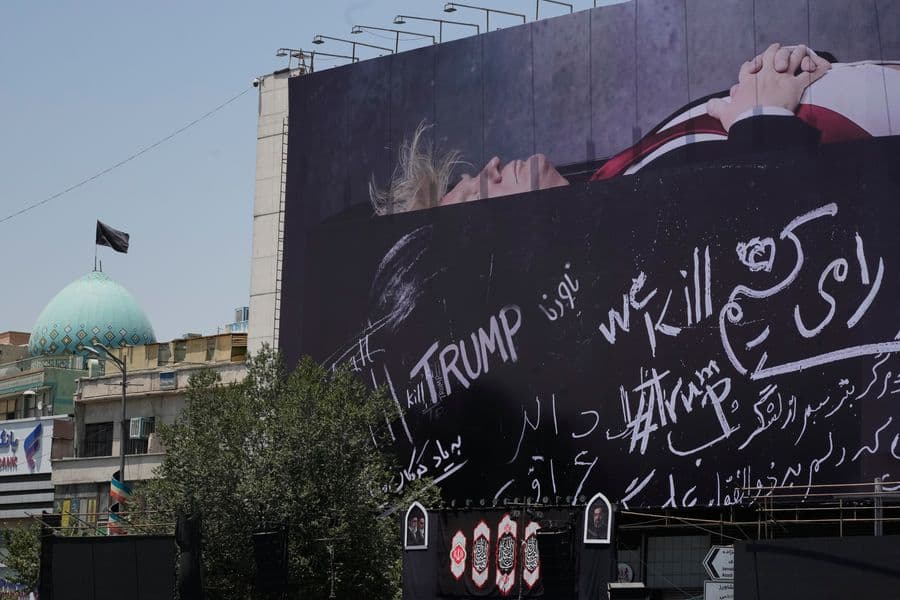
imgae: A billboard depicting U.S. President Donald Trump lying on what appears to be a coffin and bearing anti-Trump messages, including the phrase "We Kill Trump," is seen at Islamic Revolution Square in downtown Tehran, Iran, Wednesday, July 15, 2026. (AP Photo/Vahid Salemi)

Innovation Alone Won’t Prepare the U.S. for the Future Battlefield
By Joshua Segal • RealClearDefenseThe sUAS Tactical Trifecta
By Bryan T. Woody • RealClearDefense
The Revolutionary War: When Strategic Options Share the Same Weakness
By Henry Yep • RealClearDefense
The Houthis Are Testing the Limits of Collective Defense
By Saima Afzal • RealClearDefense
Radio Frequencies in the Intelligence Ecosystem
By Craig Brower • RealClearDefense