
India's Drone Army
Last updated 06:16 AM EDT • Read time: 9m
The Indian Army is Fast Tracking the Acquisition and Fielding of its Drone and Counter-drone capabilities
During a recent research trip to India, we met with senior military leaders, defense officials, and researchers to discuss the lessons of Operation Sindoor, India’s four-day military operation against Pakistan in May 2025. India and Pakistan both employed a wide variety of unmanned aerial vehicles during the short but intense conflict. One of the biggest lessons the Indian Army took from the operation was how effectively drones enhanced military capabilities and how broadly those capabilities needed to be distributed throughout the force. That has led to one of the world’s fastest and boldest initiatives to procure, produce, and integrate drones into a military outside of Ukraine and Russia.
India’s Emergency Procurement and Fast-Track Procedure are mechanisms that allow its military to rapidly bypass traditional, multi-year acquisition cycles to address urgent operational capability gaps. In the 2000s, the United States military created similar processes during its wars in Afghanistan and Iraq—such as the Rapid Equipping Force and other wartime procurement processes—to rapidly equip deploying or deployed forces. Yet what sets India’s current efforts apart from previous US efforts is the scale—India’s Army, Navy, and Air Force are authorized to spend up to fifteen percent of their capital budgets on emergency procurements—and when they can be used—India’s military can use the fast-track procedures in both peace and war.
The emergency procurement powers were first granted in 2016 following “surgical strikes” by the Indian Army across the Line of Control in Kashmir in response to a terrorist attack on an Army base in Uri, in the former Indian state of Jammu and Kashmir. This marked the first significant engagement between the two nations since the 1999 Kargil War. Following the strikes, India recognized that it needed to quickly modernize its military in multiple areas. It also recognized that its traditional acquisition system was too slow to respond to those requirements and that it needed a mechanism to rapidly field critical capabilities.
In 2019 India conducted another surgical strike across the Line of Control in response to a suicide bombing in Pulwama that killed forty Indian police. Many questioned the effectiveness of the Balakot airstrike, with some describing it as a military failure but a strategic success because it represented a significant shift in Indian policy despite uncertainty about the damage inflicted. Regardless of the debate surrounding the operation, Balakot reinforced India's determination to improve its military capabilities and its ability to respond rapidly to future crises. Following the strikes, India once again invoked emergency powers to accelerate military modernization.
To figure out what they needed, Indian military leaders told us they watched the 2020 Nagorno-Karabakh War, where Azerbaijani forces demonstrated the battlefield potential of unmanned systems against Armenian defenses. They said that the war in Ukraine has only reinforced this observation. Soon thereafter, India began fielding numerous drone systems including the Israeli-made Heron and Heron TP while developing indigenous systems such as the Rustom-II and Switch.
Operation Sindoor provided India the opportunity to test its newly acquired capabilities and to see if the lessons it had learned from observing other wars had been correct. During the four-day military response, Indian forces employed drones for intelligence, surveillance, reconnaissance, strike operations, battle damage assessments, logistics, and other tasks. In many instances sensitive targets were observed by high-altitude reconnaissance drones, hit by large precision guided munitions, and then hit again by loitering munitions such as Israeli-made Harop that could collect battle damage assessments on their way to a secondary strike. Officers repeatedly emphasized the value of persistent surveillance and the ability to maintain awareness of enemy activity across large areas without relying solely on traditional reconnaissance assets. When Pakistan attempted to retaliate, India’s air-defense and counter-drone networks proved largely effective, intercepting a vast majority of the missiles, drones, and loitering munitions launched against Indian targets.
Now the discussion inside the Indian Army has shifted from whether drones belong on the battlefield to how broadly they should be distributed and how quickly units can incorporate them into daily operations. Only a few months after the end of Operation Sindoor, India’s Chief of the Army Staff, General Upendra Dwivedi announced his “Eagle on the Arm” initiative. He described the program as his “clarion call” for the force. His objective is to place a drone in the hands of every single Indian soldier to use from initial entry training, the service academies, to every day while in their unit. The effort extends well beyond issuing equipment. Production, training, experimentation, and adaptation are being pushed down to battalions and tactical units across the Army.
The emphasis on drones extends beyond individual soldiers and battalions. The Army has already stood up three dedicated drone regiments and intends to create twenty-six. Those formations place unmanned systems alongside other capabilities that have long warranted dedicated organizations.
Battalions are being equipped with 3D printers and encouraged to manufacture some drone components locally, with the long-term goal of producing tactical drones in-house. Motors, batteries, and microchip components continue to come from outside suppliers, although efforts are underway to reduce India’s dependencies on them over time. During our discussions, officers spoke about shortening the distance between identifying a battlefield requirement and fielding a solution. Several described local modifications to systems as part of an ongoing process rather than an exceptional event requiring approval through multiple layers of bureaucracy.
According to General Dwivedi, Indian Army units internally produced approximately 40,000 drones during fiscal year 2025. While much of that production occurred through unit-level innovation and the use of 3D printers, India’s defense industry is rapidly expanding its own capacity. Indian military experts have suggested that future conflicts could require as many as 40,000 drones per month, and manufacturers are already increasing output to meet that demand. The production effort reflects an approach that treats drones less as specialized equipment and more as tools expected to be available across the force. Military organizations have confronted similar challenges before. Tanks entered inventories before armies understood how armored warfare would evolve. Radios arrived before commanders fully appreciated the operational advantages they could create. New technologies frequently appear before doctrine, training, and organizations fully adapt to them.
The Indian Army's current efforts suggest an awareness of a bigger problem. For many armies, the discussion about drones centers on buying and fielding products. The training programs, maintenance requirements, production capacity, doctrine, personnel policies, battlefield employment across every warfighting function, and culture are not addressed. Those topics rarely attract the same attention as new technology, yet they often determine whether a capability succeeds once conflict begins.
With General Dwivedi’s bottom-up and expansive approach, soldiers are increasingly treating drones as a routine part of military operations rather than as a novelty added onto existing methods. The presence of a drone is becoming as routine as carrying a rifle and the changes are noticeable. During one unit visit, Indian Army leaders attended a company-level drone competition organized by soldiers themselves. Teams tested their systems in a maneuver race through the wooded and mountainous terrain of Kashmir, comparing modifications, operator skill, and performance. The event reflected how deep experimentation with drones has already spread into operational units.
India is now backing efforts like General Dwivedi’s with substantial investment. The Army is pursuing more than $2 billion in accelerated drone procurement and $1.8 billion on loitering munitions from domestic manufacturers. The decision to create formations built specifically around unmanned systems reflects how central drones have become to the Indian Army’s future force design. Recent conflicts have demonstrated the value of maintaining access to large quantities of drones and loitering munitions and the ability to replace losses quickly during extended operations.
While India is making significant investments with its drone program, it is investing even more into its counter-drone capability. Despite its success in Operation Sindoor, India recognizes its counter-drone capability is not where it needs to be. As such, two months after Operation Sindoor, it spent $3 billion on integrated drone detection and interdiction systems, $1.5 billion on low-level lightweight radars, and $2.5 billion on very short-range air defense systems using fast-track procedures to rapidly advance its air defense systems across the military. It is worth highlighting that all these acquisitions made under the fast-track procedures are meant to be delivered within six to twelve months.
During our visit, it was difficult to find a discussion about the future of the Indian Army that did not eventually turn to drones and countering drones. The conversation rarely stayed focused on technology for long. It moved to training, organizations, production, leader development, and culture. Those are harder problems to solve than buying equipment.
The U.S. Army is wrestling with many of the same issues. Drones are becoming common on battlefields around the world. The challenge is no longer determining whether they matter. The challenge is building an institution capable of procuring and employing them at scale while at the same time countering the enemy’s drones and loitering munitions. From drone regiments to battalion-level production and the goal of putting a drone in the hands of every soldier, the Indian Army is conducting one of the most ambitious experiments in military adaptation underway today.
Liam Collins, Ph.D., is the director of the Madison Policy Forum and a distinguished military fellow with the Middle East institute. He is a retired Special Forces colonel with deployments to Iraq, Afghanistan, Bosnia, the Horn of Africa, and South America, with multiple combat operations in Fallujah in 2004. He is coauthor of Understanding Urban Warfare and author of Leadership & Innovation During Crisis: Lessons from the Iraq War.
John Spencer is chair of war studies at the Madison Policy Forum and host of the Urban Warfare Project Podcast. He served twenty-five years as an infantry soldier, which included two combat tours in Iraq. He is the author of the book Connected Soldiers: Life, Leadership, and Social Connections in Modern War and coauthor of Understanding Urban Warfare.
The authors recently returned from field research in India.
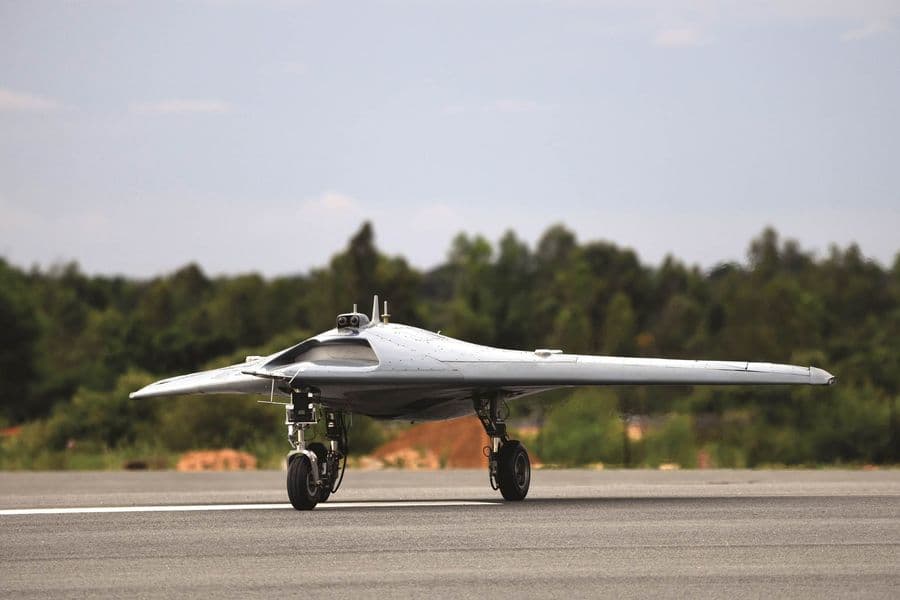
image: Maiden flight of the Autonomous Flying Wing Technology Demonstrator from Chitradurga ATR (Indian government via Wikimedia Commons)

In Pursuit of Nuclear Abolition
By Peter Huessy • RealClearDefense
Innovation Alone Won’t Prepare the U.S. for the Future Battlefield
By Joshua Segal • RealClearDefense
The sUAS Tactical Trifecta
By Bryan T. Woody • RealClearDefense
The Revolutionary War: When Strategic Options Share the Same Weakness
By Henry Yep • RealClearDefense
The Houthis Are Testing the Limits of Collective Defense
By Saima Afzal • RealClearDefense

Who Shoots Down the Drone Over the Shipyard?
By John Ferrari & Dillon Prochnicki • RealClearDefense
Northrop Grumman Breaks Out the Big Guns at AUSA
By Daniel Terrill, Defense News
Army Pursuing Diverse Array of New Anti-Air Interceptors
By Trevithick, The WarZoneWho Shoots Down the Drone Over the Shipyard?
By John Ferrari & Dillon Prochnicki, RCD
F-35C Lands for the First Time on a Ford-Class Aircraft Carrier
By The Aviationist