
Enlarging China's Malacca Dilemma
Last updated 10:11 AM EDT • Read time: 6m
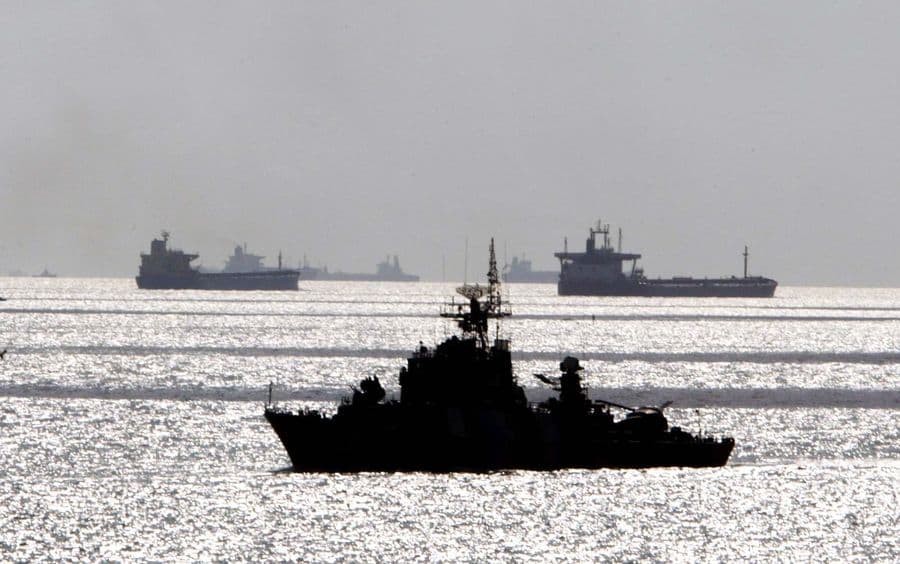
In 2003, then-Chinese President Hu Jintao noted China’s “Malacca Dilemma,” which referred to China’s energy and trade vulnerability to the possible closing by a hostile power of the Strait of Malacca—the narrow sea passage between Malaysia, Singapore, and Indonesia through which most of Chinese energy imports transit. One analyst calls it China’s “Achilles’ heel.” China is the world’s largest energy consumer, and it is estimated that eighty percent of its oil is imported and ninety percent of all of its trade is seaborne. The current war in Iran with the U.S. blockade of the Strait of Hormuz has served to enlarge China’s Malacca Dilemma by adding to it a Hormuz Dilemma—the Persian Gulf is the source of half of China’s imported oil and a third of its liquefied natural gas. Who controls those two sea lines of communication (SLOC) can wreak havoc on China’s economy and its national security.
The Trump administration recently struck a defense cooperation deal with Indonesia which allows American warplanes greater access to Indonesian airspace and thereby enhances our ability to monitor and, if necessary, control the Strait of Malacca. President Trump also persuaded the British government to shelve plans to hand over the Chagos Islands and the British-US base at Diego Garcia, strategically situated in the center of the Indian Ocean between Hormuz and Malacca, to Mauritius. Malacca and Hormuz are strategic chokepoints. There are others: Bab al-Mandeb between the Red Sea and the Gulf of Aden which connects with the Indian Ocean; the Suez Canal which connects the Mediterranean and the Red Seas; the Turkish Straits which links the Black Sea, the Sea of Marmara and the Mediterranean Sea; the Strait of Gibraltar which links the Mediterranean Sea and the Atlantic Ocean; the Danish Straits that connects the Baltic and North Seas; the Taiwan Strait which links the East China Sea and South China Sea; the Cape of Good Hope at the southern tip of Africa; and the Panama Canal which connects the Atlantic and Pacific Oceans.
The great British geopolitical thinker Sir Halford Mackinder wrote in 1902 that “The unity of the ocean is the simple physical fact underlying the dominant value of sea-power in the modern globe-wide world.” During what Mackinder called the “Columbian epoch” (roughly the late 15th century through much of the 19th century) the seafaring nations and empires politically filled-in the remaining blanks on the map of the world and thereby initiated the period of global geopolitics, which is still with us. British statesmen recognized the importance of the strategic chokepoints noted above, which is why British garrisons and naval forces were stationed at, or regularly accessed, Gibraltar, Malta, Suez, Aden, the South African cape, Colombo, Singapore, and Hong Kong.
The American naval historian and strategist Alfred Thayer Mahan characterized the oceans and seas as a “great highway” or “wide common” that linked the world’s continents. The sea, he wrote, is “the great medium of communications—of commerce,” and the seas and oceans are dotted with “well-worn paths” or “trade routes.” Throughout history, Mahan noted, commerce served both to deter wars but also at times engender conflict. During wartime, Mahan explained, nations with well-positioned and superior naval power can “cut the sinews of the enemy’s power by depriving him of sea-borne commerce.” That is accomplished by controlling strategic chokepoints.
Mahan was among the first strategists to recognize the importance of the Persian Gulf to global politics, and this was well before the discovery of oil in the Middle East. (Interestingly, it was Mahan who first gave the name “Middle East” to the region encompassing the Persian Gulf, the Levant, and the Arabian peninsula). He recognized that geographically, the Persian Gulf and the Strait of Hormuz linked the Middle East to the Indian Ocean and ultimately East Asia. Mahan also foresaw the rise of China and its potential threat to U.S. control of the Pacific Ocean.
As Lucas Myers of the Wilson Center’s Asia Program has pointed out, “China’s dependence upon sea lines of communication is largely unavoidable.” He quotes a Chinese national defense strategy document, which states: “At present and for a certain period in the future, the main route of China’s maritime transport is from the South China Sea into the Indian Ocean and the Red Sea through the Strait of Malacca.” The authors of the strategy document could have added the Persian Gulf and the Strait of Hormuz. Myers writes that China fears the consequences of a hostile blockade of the sea lines of communication through the Indian Ocean.
China’s naval build-up is designed to mitigate the Malacca and Hormuz Dilemmas. The People’s Liberation Army Navy (PLAN) has moved from a posture of “near seas defense” to one of “far seas protection” with the ultimate goal of building a strong, capable “blue water navy” that can compete with the U.S. Navy in many locations throughout the globe, including the strategic chokepoints noted above. Perhaps it is not coincidental that the Chinese admiral who set this naval transition on its present course, Liu Huaqing, was known as “China’s Mahan.”
If the Trump administration is going to offset China’s efforts to mitigate its Malacca and Hormuz Dilemmas, it will need to significantly increase the number of warships, greatly enhance our shipbuilding capacity, and continue to strike deals like the one with Indonesia that help facilitate the control of strategic chokepoints in time of war. There may be no better way for the U.S. to deter a Chinese attack on, or blockade of, Taiwan than signaling to China that we have the capability and the will to deprive them of most of their seaborne trade, including especially their energy supplies. The current U.S. blockade of the Strait of Hormuz along with the U.S.-Indonesian defense agreement is a start, but as retired Marine Corps officer Gary Anderson recently wrote in The American Spectator, we need to make good on the threat to China’s trade lifeline and we currently don’t have enough warships nor sufficiently armed Marine Expeditionary Brigades to conduct what he calls “chokepoint warfare.”
Anderson is right. Enabling our naval and Marine units to conduct successful chokepoint warfare will enlarge China’s Malacca Dilemma and, hopefully, avoid a war in the western Pacific that could metastasize into World War III.
Francis P. Sempa writes on geopolitics.

Iranian Cyber Operations
By Michael Groen • RealClearDefense
Reflecting on an Epic Horse Campaign in the Mountains of Afghanistan
By Brian Glyn Williams • RealClearDefense
The Godfather of American Foreign Policy Realism Speaks to Today’s World
By Francis P. Sempa • RealClearDefense
In Pursuit of Nuclear Abolition
By Peter Huessy • RealClearDefense
Innovation Alone Won’t Prepare the U.S. for the Future Battlefield
By Joshua Segal • RealClearDefense

Navy Civilianizes Six Former Flag Billets, Reduces Six to Captains
By Mongilio, USNI N.
Raytheon's $8B Contract for Strategic Comms Terminal Modernization
By M+A El
America’s Maritime Moment Will Not Wait
By CDR Salamander
Armor Up?
By Marine Corps Compass Points
Who Shoots Down the Drone Over the Shipyard?
By John Ferrari & Dillon Prochnicki • RealClearDefense