
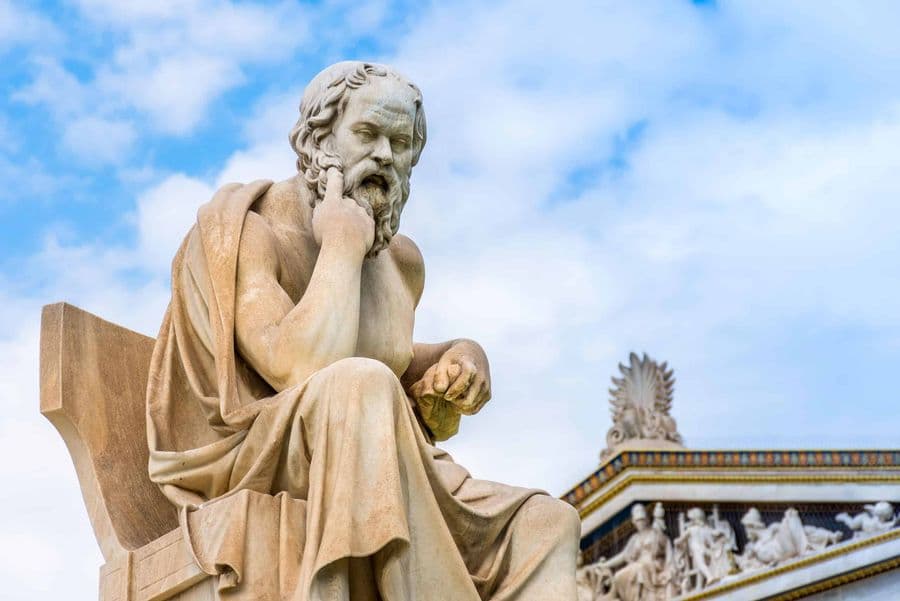
Stoic
Last updated 08:54 AM EST • Read time: 12m
Stoicism holds special appeal for the military. When a shipmate tells me to "suck it up," I know she means this command, not as reprimand but encouragement, a reminder that the way through hardship or difficult circumstance begins with self-discipline. "No man is free who is not a master of himself," said Epictetus, the Roman slave-turned-Stoic teacher. Whether confronting a determined enemy on the battlefield, completing an arduous course in jungle warfare, or even preparing for a long separation from family, Stoicism encourages servicemen and women to harden themselves, mentally and physically, against inevitable suffering.
Military commanders have drawn strength from the Stoics, particularly Epictetus, but also Seneca and Marcus Aurelius. In the late-eighteenth century, Prussian King Frederick the Great was known to carry books written by the Stoics in his saddlebags while on campaign and ordered statues of Marcus Aurelius built on the grounds of his summer residence near modern-day Berlin. Across the Atlantic in colonial Virginia, young George Washington grew acquainted with the works of Marcus Aurelius, Plutarch, and the Stoic philosophers through his mentor George William Fairfax, and, years later during a lull in the fighting at Valley Forge, staged a play about another famous student of Stoicism, Cato the Younger. During the War in Vietnam, while he floated gently down to earth underneath an open parachute, Admiral James Stockdale knew that he was "leaving the world of technology and entering the world of Epictetus." Stockdale would spend more than seven years as a prisoner of war, crediting the Handbook of Epictetus with giving him the strength to endure his ordeal. More recently, retired Marine Corps General Jim Mattis has said he always stashed a copy of Marcus's Meditations in his rucksack whenever he set off on deployment. These examples make clear that seeds planted by Stoics some 2,000 years ago continue to bear fruit for wartime commanders.
But do these books hold lessons for a modern peacetime audience, too? Enter Ryan Holiday.
Beginning with the release of The Obstacle is the Way in 2014, Holiday has published no fewer than five books inspired by Stoics in the last seven years, each one drawing on ancient philosophy to reveal new insights into how we understand ourselves amid the challenges and disorientation of a hyper-digital, self-absorbed modern life. Holiday's books are clear and focused, not on maintaining composure under fire or withstanding torture, but on everyday life, and readers have taken notice. Professional athletes, venture capitalists, celebrities, and government executives are learning from Holiday what young George Washington likely learned from Fairfax: you don't control the world, you only control how you respond.
Sounds simple enough. Perhaps so simple you'll forget the lesson as soon as you turn that final page and close the book. Fortunately, Holiday has a plan to help make reading a "practice," something you can return to each day, incrementally building the habits needed to convert book learning into bone knowledge. In The Daily Stoic, published in 2016, Holiday turns philosophy into a secular daily devotional, organizing selections and quotations from Stoic philosophers into 365 meditations on "wisdom, perseverance, and the art of living." Now, he returns with a new title to help us apply the lessons of the ancient Stoics to our own business and personal lives, drafting mini-biographies of Zeno, Epictetus, Marcus, and others to illustrate timeless principles. Below is an edited transcript of our recent telephone conversation about the new book, combat, and making time to cultivate an inner life.
First, tell me about the new book, Lives of the Stoics.
The new book is me taking a look at the biographies and profiles of the Stoics and doing this to say who the stoics are and what we can learn from them.
Okay, let's get down to brass tacks. I'm a lifelong reader of Epictetus -- why should I crack a book by Holiday?
Because I've been reading and thinking about these books my whole life, too, the wisdom that has worked for me, well, my books hopefully make that a bit more accessible to people who should be reading Stoicism.
A good description of what you do through all your books, right?
Basically, yes. I try to take philosophically beautiful ideas and illustrate them in a way that is accessible, visual, and can become a ritual for people. Most people read a book one time and are done with it, but I want to make reading a habit, a practice. Earlier, you brought up that story about Mattis carrying a copy of Meditations in his rucksack. I think that's a great illustration of what I'm talking about, but people don't need to carry the books around in their backpacks because they can keep this philosophy on their iPod, computers, or iPhones. Mattis likely carried the Stoics with him because he needed 10-15 minutes of quiet time and reflection, even as bombs were going off or other things were happening. People don’t read the Stoics because they don’t take 10-15 minutes to themselves, and I try to make that easier.
I've got 13 copies of Epictetus, all dog-eared. A favorite passage is one about the two coals, one hot and the other cold. When you touch them together, one coal either becomes cold, or the other will become hot. Can you put that into context of the Daily Stoic?
I like the quote, "that which doesn't transmit creates its own darkness." That’s an Aurelius quote on openness and acceptance. You can lead a horse to water, but you cannot make it drink. You need to create a mind as a vessel for wisdom. The practice of a daily Stoic meditation makes it easier to cultivate the habits of self-discipline, control, and others. People will criticize me as someone who is trying to get rich, but I can tell you from experience--
I have some experience trying to get rich off a book, and it didn't turn out very well...
Right, like, writing a book on ancient philosophy is not the way to get it done.
Another topic. I read so much military history; I have done this my whole life. I read so much that I cannot tell the difference between the Battle of Ramadi, the Battle of Chancellorsville, and being on the Remus with Marcus Aurelius. My mind is full of all these places. The places and stories start to merge. Do you have that feeling where life blends into history?
Julian the Apostate said to his critics that he spent far more time with the dead than the living. To answer your question, 'yes,' I do. Although I am not a veteran and would not want to over-represent the martial aspects of things I never experienced firsthand, unlike you, I know the oracle does say that you will become wise when you have conversations with the dead. Over the last 15 years, I have come to live with these figures, and it is an immersive world to live with Seneca, Epictetus, Marcus Aurelius -- it becomes almost real. It’s a strange and insane but also a beautiful experience to become immersed.
You have a way of absorbing stoic philosophy and infusing your own ideas and experiences into the works. By the way, it's similar to an experience I had reading military history and becoming one of Aurelius’s troopers or being at the Battle of the Wilderness.
That’s very kind. Aurelius described history as the same thing happening over and over again, the idea of eternal recurrence. You have experiences in war or philosophy or life, whatever a person is doing when a person experiences something and then goes and reads about it, you are struck by how similar everything is, and there is a realization that we have always essentially done things the same ways. It’s beautiful but also humbling to see this repetitiousness.
Do you know Barry Sadler?
I don't think so.
He was a Green Beret, and he wrote the Green Beret theme song. He also went on to write the first six books of the Casca series, an eternal warrior series, fantasy genre. The idea is that the Roman soldier who stabs Christ is condemned to live forever in the armies that follow. Cheap reads, but I’ve never forgotten the theme that man is doomed to repeat himself and repeat himself and repeat himself for all eternity.
I do not admire the Cynics or the Zen Buddhists because Stoicism is a balance between a philosophical life and an active life. I was introduced to Stoicism before I had my career, and I did not understand the ideas at the first read. When I pivoted from my marketing life to my writing life, I realized that things were not going in the direction I wanted. Just because you’re good at something doesn't mean you have to do it for the rest of your life. I can say confidently that Stoicism helped me break the chain of recurrence, at least in that phase of life.
We like to think of ourselves as "modern," 'we' meaning Americans living in the twenty-first century. Do you see yourself this way?
Joseph Brodsky wrote an essay about walking through Rome, and I don’t know exactly what it means, but he walks by the Marcus Aurelius statue. "If Aurelius is antiquity, then we are the ruins," he says. We may not be modern at all, in fact. So, 'no,' I do not see myself that way.
Switching topics again. Stoicism is a philosophy of action. How do you bring your ideas to bear on public life?
Writing. The Epicureans said, let’s retreat to our garden and avoid pain and enjoy pleasures, but the Stoics said that’s all well and good, but who is supposed to be in charge if everyone does that? It’s not a strategy for all. At least not if you want the Nation to head in the right direction, and Seneca is saying that man should and will be involved in public life and politics unless not possible. Writing is my profession, and I have a career outside of writing books, but my obligation to public life is through my books and writing.
When I was a boy, I had a vision of what I wanted to be, and it involved being a soldier who went to combat, among other things. I have achieved most of what I wanted, though there is still work to be done. Is it maturity, or is it embracing Stoicism that allows you to embrace others' success?
Combination.
I very much relate to what you are talking about. There are very few people that have managed to do enough in life that they do not look around and wonder, “how did they get that?” This has to do with getting comfortable with yourself and taking care of a few people close to you in your life. When we are younger, we associate success with the things we have in comparison to what others have, and that breeds jealousy. But all the energy spent being jealous or criticizing others is energy that you cannot spend on what is inside your control, and it takes your focus away from whatever is right in front of you. My book Ego is the Enemy came out in the fall of 2016 and it sold well, somewhere in the range of 600,000 - 700,000 copies, but I had breakfast with Steven Pressfield one time in Los Angeles, and his book Gates of Fire had sold a couple of million copies. I wanted to know what that was like. Steven said something to the effect of, "well, Unbroken by Laura Hillenbrand sold, like, 10 million copies." So I understand how envy is evolutionarily productive, but then I remind myself that Epictetus says life comes down to what we can control and what we cannot control. We have the choice to begrudge someone’s success or to celebrate their success.
Sort of comes back around to the coal thing we talked about before...
Right. Bottom line: there is a call for self-examination in Stoicism and, if you do that, you should reach a conclusion that "I did the best I could," and maybe it takes age to embrace that. My point is that philosophy is not an abstract or theoretical thing, and though it seems to have no application to boot camp or military life, I suspect that it can. For example, through reading, I know that Socrates was a hoplite infantryman, and on one occasion he had to make a retreat from battle, I think it was the Battle of--
Delium...
That's right, the Battle of Delium. Accounts of this retreat give proof that even during this trying and dangerous moment, Socrates was the picture of self-discipline and control, making an orderly retreat when others around him maybe were not so composed. This shows that although Socrates was a soldier, he was also a philosopher; he had a calm mind, honed through reading and reflection, that enabled him to comprehend a complex situation. Back then, philosophers were not turtleneck-wearing professors but artists, soldiers, politicians, and statesmen. They did all these things, and so I think 'modern' people engaged in the business of work or military combat can reap some of these same benefits in their own lives by taking the time to read Stoic philosophy, by making it a practice to read and reflect.
Able Magwitch is a U.S. government employee. His views are his own and not representative of the U.S. government or its agencies.

The First Test of Peace Lies in Ukraine's Borderlands
By Dennis T. Cosgrove • RealClearDefense
The VFW’s Gambling Addiction Victimizes Veterans
By Jack Yoest • RealClearDefense
Superintelligence Exposes a Gap in the Law of Delegated Authority
By Sue Ghosh Stricklett • RealClearDefense
When the Network Goes Dark, Who Controls the Battlefield?
By Jonathan K. Corrado • RealClearDefense
We Cannot Build Tomorrow's Weapons With Yesterday's Alloys
By Joseph F. Krause • RealClearDefense
When the Network Goes Dark, Who Controls the Battlefield?
By Jonathan K. Corrado • RealClearDefense
Air Force Should Buy 250 Blended-Wing Tankers, as 2027 Demo Looms
By A&SF Mag.
Long Deployments to Be Navy Standard For Next Couple Years
By Mongilio, USNI NewsWhen the Network Goes Dark, Who Controls the Battlefield?
By Jonathan Corrado, RCD
Marines Deploy Neros Archer Drone in Live Fire Exercise for First Time
By USNI News