
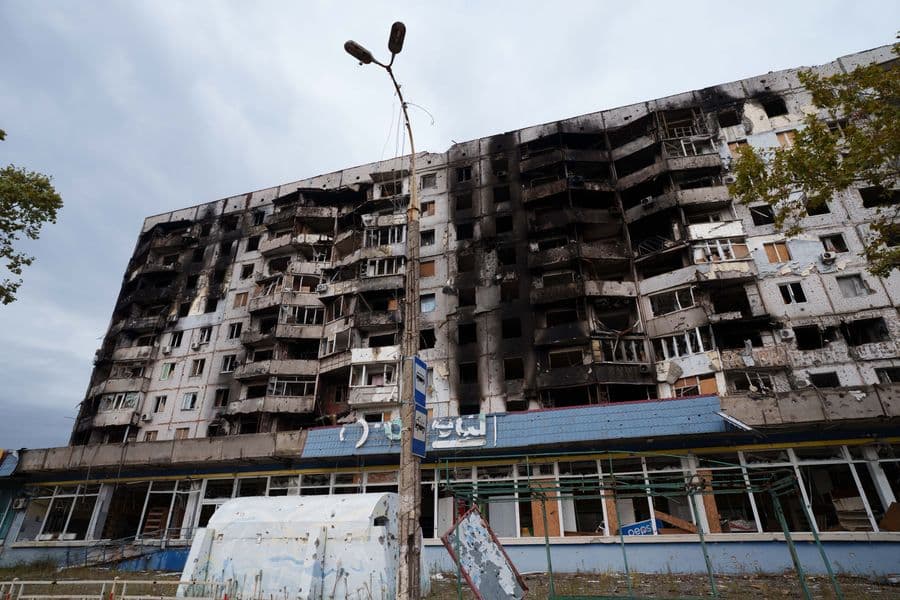
A residential building damaged from Russian attacks is seen during a local ceasefire related to a humanitarian aid mission in Oleshky, in Kherson, Ukraine, Thursday, Oct. 29, 2026. (AP Photo/Evgeniy Maloletka)
The First Test of Peace Lies in Ukraine's Borderlands
Last updated 04:43 AM EDT • Read time: 10m
The first time I walked into the headquarters of Russia’s Federal Security Service at Lubyanka, every instinct told me I was entering the wrong building.
I was the FBI Legal Attaché in Moscow. The Cold War had ended, but decades of suspicion between our institutions had not. Cooperation with the FSB did not come naturally, nor did trust.
I walked through the door anyway.
What followed taught me something I would encounter repeatedly during years of work in Russia, the Balkans, Central Asia, and other post-conflict environments: practical cooperation often begins before trust does.
That lesson may one day become critically important in Ukraine.
When the shooting eventually stops, attention will understandably focus on ceasefire lines, security guarantees, reconstruction, and the political terms of whatever settlement emerges. But beyond the negotiating tables in Kyiv, Moscow, and other capitals will lie another test: what becomes of the communities scattered across the scarred borderlands between Russia and Ukraine?
History suggests that peace agreements alone do not secure lasting peace. Wars may end with signatures on paper, but stability is ultimately measured by whether displaced families return home, businesses reopen, children attend school safely, and local institutions regain the trust of the people they serve. Nowhere will these challenges be more acute than in the regions that have borne the brunt of years of conflict.
The greatest danger facing a post-war Ukraine may not be another military offensive. It may be the gradual emergence of a security vacuum in vulnerable border regions where governance is weak, populations remain traumatized, criminal networks are opportunistic, and trust is in short supply.
During more than three decades working in law enforcement and international security cooperation—including assignments in Russia, the Balkans, Central Asia, Eastern Europe, and later as a senior advisor on border security and management at the Organization for Security and Co-operation in Europe (OSCE)—I observed a consistent pattern. The most successful post-conflict environments were not necessarily those with the most ambitious political declarations. They were the ones that developed effective mechanisms to address everyday problems: restoring public security, rebuilding institutions, combating organized crime, and fostering cooperation among communities that had learned to distrust one another.
As discussions increasingly focus on what a post-war settlement in Ukraine might look like, equal attention should be devoted to what happens after an agreement is signed. Peace will require more than reconstruction funds and diplomatic assurances. It will require sustained effort in the borderlands where the next crisis could begin.
Five priorities deserve immediate attention.
The first priority must be identifying missing children and facilitating their safe return to families and caregivers.
This effort will require highly skilled investigators, analysts, social service professionals, and technical specialists. While numerous government agencies, international organizations, and non-governmental organizations are already engaged in these efforts, the end of active hostilities will create opportunities for forms of cross-border liaison and cooperation that have not existed during the fighting. Effective channels for information exchange will be essential.
Law enforcement agencies will also need to work closely with NGOs, social workers, and mental health professionals. My experience helping establish Moldova's Center for Combating Trafficking in Persons—the first multi-agency center of its kind in a former Soviet republic—demonstrated both the challenges and benefits of such cooperation. Initially, there was reluctance on both sides. Law enforcement officers were unfamiliar with working alongside NGOs, while civil society organizations often distrusted government institutions. Yet over time, both came to recognize that meaningful assistance to traumatized victims required partnership. Success depended on leadership, mentoring, specialized training, and sustained dialogue. Similar approaches will be required to reunite families and support vulnerable children affected by the war.
The second priority is restoring legitimate cross-border movement and commerce.
The first families waiting to cross a reopened border may carry little more than a suitcase, faded photographs, and years of uncertainty. Others will simply hope to embrace relatives they have not seen since the war began. Border security officers will be among the first representatives of government they encounter, and the way those first crossings are managed will shape public confidence in the peace itself.
Border security agencies will play a central role in managing the movement of people and goods across reopened frontiers. Modern technologies—including biometric systems, facial recognition capabilities, and advanced traveler information systems—can help ensure that border crossing points remain secure while avoiding unnecessary delays.
The reopening of borders will necessarily be gradual and methodical. Security concerns will remain. Yet families separated by years of conflict must be able to reconnect. Legitimate trade must resume. Economic recovery depends upon restoring lawful movement while preventing newly reopened routes from being exploited by criminal actors. Achieving that balance will require professional border management, effective risk analysis, and close coordination among neighboring authorities.
The third priority is combating organized crime, trafficking, and corruption.
This may prove to be the most difficult challenge of all.
Post-conflict environments often create ideal conditions for criminal networks. Large flows of reconstruction funding, weakened institutions, displaced populations, and vast quantities of wartime matériel can provide fertile ground for organized criminal groups seeking new opportunities.
The borderlands will be particularly vulnerable. Human trafficking, weapons smuggling, corruption, illicit trade, and other criminal activities can quickly become entrenched if left unchecked. Once established, such networks are extraordinarily difficult to dismantle. Law enforcement agencies can spend years attempting to catch up after criminal structures have already taken root.
For Ukraine's border regions, such a scenario would be both dangerous and unacceptable. Effective law enforcement, intelligence sharing, anti-corruption measures, and cross-border cooperation should therefore be viewed not as secondary concerns but as essential components of post-war stabilization.
The fourth priority is rebuilding local institutional capacity and public trust.
During my years working in post-conflict societies, I came to appreciate that people rarely judge government by speeches delivered in distant capitals. They judge it by whether the local police answer the telephone, whether municipal offices reopen, and whether their children can once again walk safely to school.
The restoration of local governance and law enforcement will not occur automatically. It will require deliberate efforts to re-establish a visible, competent, and trusted government presence so that returning residents feel secure enough to rebuild their lives.
This challenge extends beyond infrastructure and equipment. It is fundamentally about relationships between institutions and the communities they serve.
While serving as a senior law enforcement advisor in the Balkans and Central Asia, I worked extensively on promoting community policing initiatives. In many of these societies, citizens viewed security services with skepticism and distrust, often for understandable historical reasons. Building confidence required sustained engagement, transparency, and meaningful collaboration between officials and local communities.
The same principles will apply in Ukraine's borderlands. Community engagement programs, public safety partnerships, workshops, roundtables, and professional training initiatives can help establish the trust necessary for long-term stability. Agreements can be signed in days. Trustworthy institutions take years to build.
The fifth priority is restoring mechanisms for cross-border cooperation.
This may be the most politically sensitive challenge of all.
Peace is sustained not only by national agreements but by everyday human interaction. Teachers, business owners, local officials, border security professionals, social workers, law enforcement officers, and ordinary citizens all play a role in rebuilding confidence and reducing tensions.
Some of this engagement will occur within Ukraine itself. Some, however, will need to extend across the border. Many of the practical problems that accompany post-conflict recovery—including locating missing children, managing border incidents, combating organized crime, facilitating lawful commerce, and preventing misunderstandings—cannot be solved by one country acting alone. They require structured channels of communication and cooperation between professionals on both sides, however difficult that may initially be.
History suggests a recurring pattern. Borderlands that remain isolated after conflict often become economically stagnant, politically fragile, and vulnerable to criminal exploitation. Long-term stability depends not only upon secure borders but upon restoring lawful movement, economic opportunity, and practical connections across them whenever conditions permit. I saw those dynamics from a different perspective during my service as the FBI Legal Attaché in Moscow in the late 1990s. Prior to arriving in Russia, my principal counterparts were investigators from the Ministry of Internal Affairs and prosecutors from the Prosecutor General's Office. The prospect of engaging directly with Russia's Federal Security Service (FSB) was far less comfortable. I still remember my first visit to FSB headquarters at Lubyanka. Given decades of Cold War history and an adversarial relationship between our institutions, every instinct suggested turning around and walking away.
Instead, I walked through the door.
What followed was neither friendship nor the disappearance of profound differences between our governments. It was something more enduring. Professionals on both sides recognized that certain law enforcement and security challenges could not be addressed effectively without communication, information sharing, and a willingness to engage despite deep mistrust. Cooperation emerged gradually, one conversation and one working relationship at a time.
The challenges facing Ukrainian and Russian authorities after the war will be far greater than anything I experienced. The wounds will be deeper, the political obstacles higher, and the emotions far more raw. Yet the objectives remain the same. The safe return of children, the reunification of families, the suppression of criminal networks, the management of border incidents, and the gradual restoration of lawful cross-border movement will all require professionals willing to take difficult first steps into the unknown.
Years later, I came to realize that walking through that door was less about entering FSB headquarters than accepting an uncomfortable truth: effective cooperation often begins before trust does. The first step is rarely taken because confidence exists. It is taken because the alternative is continued failure.
This does not mean ignoring the realities of the war or minimizing its consequences. Rather, it means recognizing that long-term stability requires practical mechanisms that allow everyday problems to be addressed before they become larger crises. Communication, cooperation, and problem-solving at the local level can often prevent misunderstandings and tensions from escalating.
Lasting peace rarely begins with trust. More often, it begins with the decision to engage despite its absence.
None of these priorities necessarily requires the creation of a grand new international organization. They do, however, require practical mechanisms that enable professionals to solve shared problems wherever cooperation becomes necessary. What matters is that those functions exist, are adequately resourced, and remain in place long after media attention has moved elsewhere.
The challenge facing Ukraine after the war will not simply be reconstruction. It will be preventing the emergence of abandoned borderlands where lawlessness replaces governance, criminal networks replace legitimate commerce, and mistrust replaces human contact.
The first test of peace will not occur in Kyiv or Moscow. It will occur in the borderlands.
Success will be measured not by diplomatic communiqués, but by children reunited with their families, commerce moving lawfully across reopened frontiers, communities protected from criminal networks, institutions that once again earn the confidence of the people they serve, and professionals willing to engage across borders when peace requires it.
If those tasks succeed, peace will have a chance to endure.
If they fail, no agreement signed in a distant capital will be enough.
Dennis T. Cosgrove is a former FBI Special Agent, legal attaché, and former Head of the Border Security and Management Unit at the Organization for Security and Co-operation in Europe in Vienna. He worked extensively in Central Asia, the former Soviet Union, and the Balkans in a variety of law enforcement, diplomatic, and international security roles, including numerous assignments with U.S. Embassies overseas. He writes on geopolitics, transnational threats, and strategic affairs, and is the author of two published books with a third currently in progress.

The First Test of Peace Lies in Ukraine's Borderlands
By Dennis T. Cosgrove • RealClearDefense
The VFW’s Gambling Addiction Victimizes Veterans
By Jack Yoest • RealClearDefense
Superintelligence Exposes a Gap in the Law of Delegated Authority
By Sue Ghosh Stricklett • RealClearDefense
When the Network Goes Dark, Who Controls the Battlefield?
By Jonathan K. Corrado • RealClearDefense
We Cannot Build Tomorrow's Weapons With Yesterday's Alloys
By Joseph F. Krause • RealClearDefense
When the Network Goes Dark, Who Controls the Battlefield?
By Jonathan K. Corrado • RealClearDefense
Air Force Should Buy 250 Blended-Wing Tankers, as 2027 Demo Looms
By A&SF Mag.
Long Deployments to Be Navy Standard For Next Couple Years
By Mongilio, USNI NewsWhen the Network Goes Dark, Who Controls the Battlefield?
By Jonathan Corrado, RCD
Marines Deploy Neros Archer Drone in Live Fire Exercise for First Time
By USNI News