
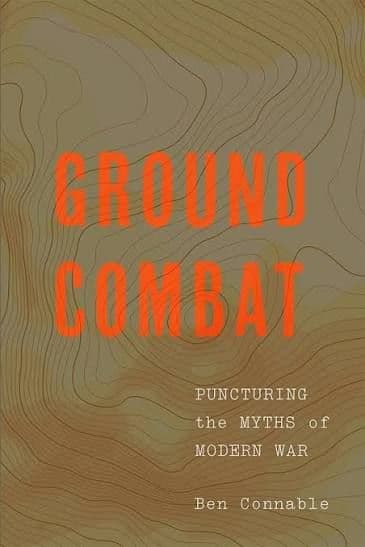
Ground Combat: Puncturing the Myths of Modern War
Last updated 07:48 AM EDT • Read time: 7m
Imagine a world where future wars will not be fought by boots on the ground but by the codes and automated systems. A future where victory belongs to machines, with algorithms making decisions and drones operating from remote control rooms. This alluring vision has gained traction in recent years and has repeatedly captivated the minds of defense establishments, military theorists, and technology entrepreneurs.
The book, Ground Combat: Puncturing the Myths of Modern War, serves as an evidence-based antidote to this school of thought. It is written by Ben Connable, a retired American Marine Major with extensive firsthand experience in the Middle East as well as a decorated career as a political scientist and military strategist leading research projects at RAND Corporation, Atlantic Council and the Battle Research Group Foundation with interest in ground combat, modern warfare and human behavior in wars. The author writes with the authority of someone who has stood inside the gap between what military theory promises and what land warfare actually delivers. He saw colleagues roll out high-tech solutions with great confidence in the Washington office, only to have them flop in the dust, chaos, and unpredictability of real battlefields.
The book is organized into nine chapters along a longitudinal and empirical line. After the introduction, the author commences by critiquing the U. S’s forecast approach of future wars over the last 50 years, starting from Westmoreland to the contemporary Marine Corps Force Design 2030. Connable argues that in each decade, the notion of transformative and revolutionary warfare prevailed, which failed to fully materialize due to the overly technophilic and subjective nature of predictions.
Following that, Connable empirically and extensively analyses more than 400 combats to substantiate the claim that change in ground combat characteristics is evolutionary. Taking World War II as a starting point — the first large-scale war to use combined arms tactics on a consistent basis at all levels of command — Connable charts the evolution of ground combat during the Cold War proxy wars, the Gulf War of 1991, the post-9/11 wars in Iraq and Afghanistan, the Syrian Civil War, the Nagorno-Karabakh war and the Russian invasion of Ukraine. He uses his Ground Combat Database to analyze each period, coding observable characteristics of battles, such as terrain, weapons, movement, drone use, indirect fire and more. What comes out of the process is not a story about wars, but a scientific snapshot of war as it really is, devoid of mythology and marketing.
One of the most thought-provoking aspects of the book is that the author masterfully challenges the dominant assumptions in strategic thought. Connable persuasively contends the assumption of the distinct character of war by calling it vague, ahistorical and ill-defined in military theories, utilized just to further institutional and tech agendas. He argues that even Clausewitz, to whom the character vs nature of war debate is attributed, never actually talked about the character of war. Rather, Clausewitz only defined the characteristics of war, including violence, friction, and uncertainty (P. 190). Thus, the author focuses on the observable characteristics of modern ground combat instead of claiming a universally changing character.
The writer furthers his critique by challenging military revolutionist thinkers such as I.S. Baloch, Giulio Douhet, B.H. Liddell Hart and even modern advocates of precision warfare and autonomous revolution. For instance, Connable questions a popular assertion that drones are a revolutionary ‘game changer’ and views them as another development in the long history of war (P.287). They are improving surveillance and precision strikes, but they have not eliminated combined-arms operations or revolutionized military affairs. When it comes to the Russia–Ukraine war, drone proliferation has even exacerbated attritional, trench-like warfare by narrowing the options for maneuver and surprise. In his view, warfare evolves gradually with incremental innovation, technological diffusion and continuous adaptation as opposed to abrupt revolutionary shifts.
Drawing on a database of more than 400 battles from 80 years, Connable seeks to discern general trends in combat by coding features and eliminating the distortion caused by selective case studies (P. 159). The results indicate that the fundamental aspects of warfare, like infantry, armored forces, artillery, and urban warfare, are constantly central in today's conflict. New technologies such as drones have grown more in auxiliary uses like reconnaissance, rather than in direct ground assault. The findings suggest that advances in military technology do not represent a transformation or revolution in warfare; rather, these new tools are being integrated into existing systems and methods, with infantry and artillery still enduring a major role in ground combat.
The book is most convincing when Connable challenges the orthodoxies and myths of modern military thinking. The 2020 Nagorno-Karabakh War between Armenia and Azerbaijan is often referred to as the definitive demonstration of a drone revolution, in terms of the use of Turkish Bayraktar TB2s and Israeli loitering munitions. Connable punctures this dominant belief systematically. In his arguments, though admitting the role of unmanned systems, he posits that the main elements of warfare – infantry, artillery, and combined arms maneuver – still matter.
Similarly, the Russia–Ukraine War, which has been repeatedly claimed as an example of a robotic war, is a testament to the continued relevance of combined arms operations, terrain, attrition, and human judgment. For Connable, technology is never going to be an alternative to traditional instruments of war but an add-on to military power.
The book also represents a sharp critique of the defense-tech sector, tech entrepreneurs, think-tanks, and tech visionaries who benefit from a narrative of radical transformation. Connable's criticism is against the hype surrounding the technology-driven revolution in warfare. He overtly targets the ‘ahistoricism of the commercial,’ which is blind to the fact that every new gadget is not a paradigm shift and that militaries need to preserve valuable capabilities, which they have acquired carefully, rather than abandoning them for untested ones.
Connable's main policy concern is that modern militaries are drifting towards technological overconfidence and risk aversion. In their quest for protection and accuracy, they are spending heavily on expensive platforms and slowly dismantling the mass and traditional combat power. For instance, Force Design 2030 is a revolutionary redesign which calls for divesting infantry and artillery while funding advanced military technologies, all because of the changing character of warfare. The author argues that this force redesign is based on ‘shaky grounds,’ untested assumptions and lacking historical consciousness, which may lead to a risky strategic gamble (P. 274).
One of the shortcomings of the book is that it relies on publicly available data in a large-N qualitative design, which makes it difficult to represent conflicts that are less well-documented, especially in Africa. Also, it focuses on observable factors, which leaves out many intangibles such as morale, leadership, and unit cohesion. Although it is methodologically comprehensible, it is not extensive in its evaluation of combat effectiveness. Apart from that, the author's criticism of military revolutions, at times, may have undermined the expanding role of emerging technologies. Although the author rightly questions technological determinism, the books appear to downplay the significant role of air power and integrated warfare, which have been proven by the recent conflicts, such as India-Pakistan and the U.S-Israel-Iran war.
Nevertheless, the book serves as a comprehensive and empirically grounded account of the myths of modern combat. This study is undeniably a vital resource for military theorists, strategic studies scholars, and novice practitioners within the defense industry. Overall, the book presents a compelling testament and sober corrective of the thought that magnifies revolution while overshadowing the gritty realities of war.
Ayeza Areej is a researcher at the Centre for Aerospace & Security Studies (CASS). Her expertise spans military strategy, defense modernization, emerging technologies, nuclear security, and the Revolution in Military Affairs (RMA). She has previously been affiliated with the Institute of Strategic Studies Islamabad (ISSI), the Islamabad Policy Research Institute (IPRI), and The Truth International, and has contributed to initiatives led by the ICRC and WWF. She can be reached at cass.thinkers@casstt.com

The Godfather of American Foreign Policy Realism Speaks to Today’s World
By Francis P. Sempa • RealClearDefense
In Pursuit of Nuclear Abolition
By Peter Huessy • RealClearDefense
Innovation Alone Won’t Prepare the U.S. for the Future Battlefield
By Joshua Segal • RealClearDefense
The sUAS Tactical Trifecta
By Bryan T. Woody • RealClearDefense
The Revolutionary War: When Strategic Options Share the Same Weakness
By Henry Yep • RealClearDefense

Navy Civilianizes Six Former Flag Billets, Reduces Six to Captains
By Mongilio, USNI N.
Raytheon's $8B Contract for Strategic Comms Terminal Modernization
By M+A El
America’s Maritime Moment Will Not Wait
By CDR Salamander
Armor Up?
By Marine Corps Compass Points
Who Shoots Down the Drone Over the Shipyard?
By John Ferrari & Dillon Prochnicki • RealClearDefense