
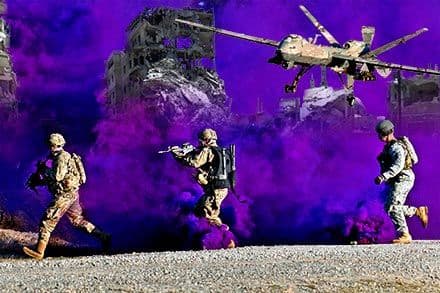
Society, Technology, and Future Warfare
Last updated 04:58 PM EDT • Read time: 2m
Key Points
- Warfare is being transformed by the information revolution. However, history has demonstrated that it is exceptionally difficult to know how new technology will redefine warfighting before the audit of battle.
- It is dangerous to assume that the U.S. will dominate the future battlefield simply because it is leading the information revolution.
- It is equally dangerous to assume that future warfighting will conform to American military cultural preferences, even though those are likely to drive how the United States adopts new technology.
- The key to understanding the future battlefield is that best practices, or the inherent optimum of new technologies, is just one variable among a range of societal factors.
Executive Summary
Today, military analysts are struggling to understand how the new technology of the information age will transform warfare. There is a persistent, dangerous tendency to assume that all actors will simply employ new technology according to a theoretical set of best practices—and an even more dangerous expectation that the United States will define those best practices and dominate the information-age battlefield because the U.S. is leading the information revolution.
Historical evidence from the early industrial era, when a similar transformation occurred, offers warnings on both counts.
Great Britain led the industrial revolution. It was the leading economy of the era and the primary source of civilian innovations that brought about the Industrial Revolution and the military innovations that redefined warfare. Yet its military forces were not the most effective practitioners of industrial-age warfare. Similarly, the experience of the Germans and French from World War I to World War II warns that it is extremely difficult to know beforehand which army has learned to use new technologies most effectively before the audit of battle.
Finally, the experiences of all these armies and that of the Israel Defense Force in the Second Lebanon War of 2006 demonstrate that, especially in the early decades of such a monumental transformation, the key determinant of how militaries will perform is less about the new technology’s capabilities and much more about how societal factors will shape militaries and their approaches to that technology.

The First Test of Peace Lies in Ukraine's Borderlands
By Dennis T. Cosgrove • RealClearDefense
The VFW’s Gambling Addiction Victimizes Veterans
By Jack Yoest • RealClearDefense
Superintelligence Exposes a Gap in the Law of Delegated Authority
By Sue Ghosh Stricklett • RealClearDefense
When the Network Goes Dark, Who Controls the Battlefield?
By Jonathan K. Corrado • RealClearDefense
We Cannot Build Tomorrow's Weapons With Yesterday's Alloys
By Joseph F. Krause • RealClearDefense
When the Network Goes Dark, Who Controls the Battlefield?
By Jonathan K. Corrado • RealClearDefense
Air Force Should Buy 250 Blended-Wing Tankers, as 2027 Demo Looms
By A&SF Mag.
Long Deployments to Be Navy Standard For Next Couple Years
By Mongilio, USNI NewsWhen the Network Goes Dark, Who Controls the Battlefield?
By Jonathan Corrado, RCD
Marines Deploy Neros Archer Drone in Live Fire Exercise for First Time
By USNI News