
Weekly Recon – Russia's Massive Baltic Exercise, EMALS Success ...
Last updated 05:48 PM EDT • Read time: 5m
Good Saturday morning and welcome to Weekly Recon. On this day in 1775, the legal origin of the Army
U.S. Army
Chaplains Corps is found in a resolution of the Continental Congress, adopted July 29, 1775, which made provision for the pay of chaplains. The Office of the Chief of Chaplains was created later by the National Defense Act of 1920. Furthermore, the Office of Judge Advocate of the Army may be deemed to have been created on July 29, 1775, and has generally paralleled the origin and development of the American system of military justice. The Judge Advocate General’s Department, by that name, was established in 1884. Its present designation as a corps was enacted in 1948.
Land Warfare
The Pentagon is on high alert ahead of Russia’s massive military exercise, ZAPAD 17, Sandra Erwin reported at RealClearDefense this week. Set to begin in mid-September in Belarus, the U.S. and its allies will be keeping close tabs on the exercises, where Russia is expected to showcase new weapons, technologies, and tactics. Described as “a window into Russia’s military mind,” The month of September will be tense, however, as the nations bordering Belarus are concerned that ZAPAD may be a Russian “Trojan Horse” operation.
The final stage of the Zapad-2013 Russian-Belarusian strategic military exercises. Kremlin
Aside from the rising tensions in Eastern Europe, the U.S. Army is preparing for the battlefield of the future. U.S. Army Training and Doctrine Command (TRADOC) studied emerging technologies and tactics and strategies, and compiled its findings in a recently released report: “The Operational Environment and the Changing Character of Future Warfare.” The battlefield of the future will be a high-intensity environment full of new technologies, hybrid threats, and a heightened prospect of near-peer conflict, which the paper hypothesizes is likely by 2035. The report came out in tandem with the Army’s ‘Mad Scientist’ conference, which held an essay contest on operating in the 2050 battle space. Mathison Hall won the contest with his entry “Patrolling in the Infosphere.”
Air Superiority
The ongoing national pilot shortage extends well beyond the U.S. Military. Airlines are also struggling to fill cockpits with qualified pilots, reports CNN Money. As demand for air travel continues to rise, airlines will need an additional 637,000 pilots over the next two decades. Airlines have earned the reputation as talent poachers sucking the military dry of its experienced pilots. Although the military and airlines have established means of cooperation to address pilot shortages, they will remain staunch competitors in a very small talent pool as both work to address their relative readiness crises.
Blue Water Dominance
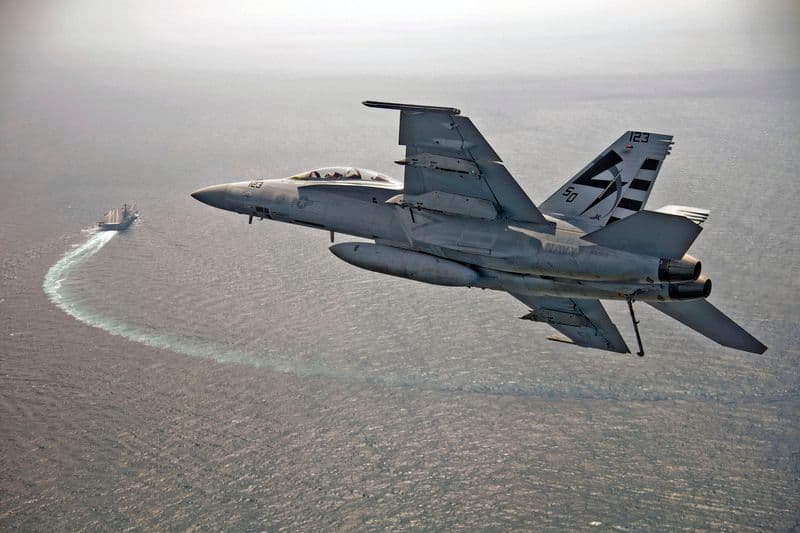
The USS Gerald R. Ford has joined the fleet, but it still won’t be able to launch heavily loaded planes. The electromagnetic aircraft launch system (EMALS) was found early on to have issues launching planes with heavy loads, such as F/A-18s with external fuel tanks. The problem has been identified, and a software fix has been developed, but that fix will not be installed until after the ship’s shakedown period. The EMALS hiccup is a sign of how the Ford was designed to mark several major technological leaps at once, a path that USNI News reported that CNO Admiral John Richardson plans to avoid in the development of future ships. However, the Navy successfully tested the EMALS system yesterday, but it remains to be seen how long before the system is declared fully operational.
As the U.S. Navy launches their version of the next-generation carrier, the UK has launched their newest carrier, the HMS Queen Elizabeth, planning to join the U.S. in Freedom of Navigation Operations (FONOPs) in the South China Sea. News of this development first broke in June but garnered heightened attention this week when, during a speech, UK Foreign Minister Boris Johnson committed both Queen Elizabeth-class flattops to FONOPs beginning in 2021. Johnson later obfuscated the UK’s intentions, however, saying during a Q&A session, “We have not yet quite decided to do [FONOPs] … but they are coming.”
Space Wars
On Thursday, Iran claims to have successfully launched one of its Simorgh (“Phoenix”) rockets into space. The rocket was allegedly delivering an intelligence satellite. If true, this would mark a major military advancement in the realm of intelligence gathering, communications, and geo-location. Perhaps even more worrisome, many suspect that the test could be part of Iran’s efforts towards producing an indigenous ICBM. Coming on the heels of renewed sanctions against Iran by the U.S. for Iran’s continued pursuit of advanced ballistic missiles, Iran vows to put their full power toward ballistic missile technology.
The Fifth Domain
It just got even more expensive to buy NSA source code and other sensitive documents off the dark web. Notorious hacking group ShadowBrokers, which allegedly sold leaked or stolen source code for highly sensitive NSA cyber weapons, launched a monthly subscription service last month, which came with a steep fee. Starting out at $27k a month (in Bitcoin, of course), then raised to $61k, the fee was upped again this week to $92.5k.
SEND RCD YOUR INPUT: Please send your tips, suggestions, and feedback to editors@realcleardefense.com. Make sure to follow us on Twitter at @RCDefenseand follow Blake Baiers @BlakeBaiers

In Pursuit of Nuclear Abolition
By Peter Huessy • RealClearDefense
Innovation Alone Won’t Prepare the U.S. for the Future Battlefield
By Joshua Segal • RealClearDefense
The sUAS Tactical Trifecta
By Bryan T. Woody • RealClearDefense
The Revolutionary War: When Strategic Options Share the Same Weakness
By Henry Yep • RealClearDefense
The Houthis Are Testing the Limits of Collective Defense
By Saima Afzal • RealClearDefense

Who Shoots Down the Drone Over the Shipyard?
By John Ferrari & Dillon Prochnicki • RealClearDefense
Northrop Grumman Breaks Out the Big Guns at AUSA
By Daniel Terrill, Defense News
Army Pursuing Diverse Array of New Anti-Air Interceptors
By Trevithick, The WarZoneWho Shoots Down the Drone Over the Shipyard?
By John Ferrari & Dillon Prochnicki, RCD
F-35C Lands for the First Time on a Ford-Class Aircraft Carrier
By The Aviationist