
Bringing a Warthog to a Streetfight
Last updated 05:38 AM EDT • Read time: 8m
Mine hunting is a slow, unappealing, labor-intensive, and above all risky search and destroy mission. Mine warfare has been a victim of "institutional neglect" and "thirty years of quiet retreat" simply because it has no constituency, service or political.
After the Vietnam War, the Navy established Mine Warfare Command in 1975 only to disestablish it in 2006. The historic Reagan Administration defense buildup only programmed for 27 Avenger-class minesweepers through 1989 even though the Soviet fleet totaled 58 ships.
The current Russian minesweeper fleet totals 45. China reportedly possesses approximately 36 minesweepers.
And fifty to one hundred thousand mines.
The United States had successfully deployed maritime assets to the Persian Gulf in the late Eighties, but the deployments underscored a glaring deficiency in mine warfare capabilities.
In the Nineties, the Navy undertook a "decade-long bout of institutional soul-searching," but the attachment to a carrier-centric force was virtually religious.
Thereafter, the Navy embarked on a period of dysfunctional long-term naval planning that would culminate in the current crisis in the Strait of Hormuz.
In the 1997 Quadrennial Defense Review (QDR), the Department of Defense (DoD) stated the Navy would remain an oceangoing fleet comprised of large and intermediate-size ships. In the background, the Naval Warfare Development Command under Vice Admiral Art Cebrowski had been conducting wargames that demonstrated the utility of a small fast ship in contested littoral regions like the Persian Gulf.
Advocates dubbed it the Streetfighter.
The concept encountered widespread opposition in the Navy but the incoming Secretary of Defense, Donald Rumsfeld, embraced it. Rumsfeld had appointed Cebrowski to his new Office of Force Transformation and the Streetfighter would be a showcase in terms of both military and programmatic innovation.
In the 2001 QDR, DoD designated the Littoral Combat Ship (LCS) the third major Navy procurement initiative alongside destroyers and cruisers.
Unbeknownst to its proponents, the astonishingly rapid ascent from concept to acquisition marked the Streetfighter's high point.
Determined to break new ground, the department awarded the contract for the first two LCS prototypes to two different manufacturers and required the new "seaframe" to be reconfigurable. Leadership expected the competition between two contractors would keep costs down while a modular configuration would fulfill multiple requirements for surface, anti-submarine, and mine warfare in the littorals with a single ship.
Nevertheless, the ambitious launch was immediately sidelined per the nation's military response to the terrorist attacks of September 11, 2001. The department increased budgets for the Army, Marine Corps, and Special Operations Forces while flattening those for the Air Force and Navy. The latter adjusted by decreasing the planned fleet size from 375 to between 313 and 323 ships. The reduction increased the pressure on the LCS program to conform with cost and schedule requirements -- an approximate top line of $220 million for each of the first two seaframes by 2007.
In 2007, however, the LCS program imploded. The dearth of analysis prior to the contract award was exacerbated by the decision to subsequently proceed with production before the design was complete. The inevitable schedule delays increased costs whereupon the price of LCS 1 and LCS 2 rose to $750 and $864 million, respectively.
To overcome substantial internal and congressional opposition, incoming Secretary of the Navy Rab Mabus modified the program in 2010 by contracting for the construction of both seaframes as well as follow-on ships. Mabus then insulated the LCS from congressional opponents by ordering them from shipyards in Alabama and Wisconsin, whose delegations became ardent defenders of the program.
Meanwhile, the LCS continued to underwhelm.
In 2013, the DoD Director of Operational Test & Evaluation (DOT&E) published its now infamous conclusion that the “LCS is not expected to be survivable in that it is not expected to maintain mission capability after taking a significant hit in a hostile combat environment.”
Two consecutive secretaries of defense took aim at the program. In 2014, Secretary Chuck Hagel decreased the planned acquisition from 52 to 32 but ultimately yielded to the Navy's intransigence. In 2016, Secretary Ash Carter attempted the same only to be circumvented by Mabus, who lobbied the program's congressional allies.
In 2016, five LCS broke down for reasons ranging from software failures and fuel spills to an engine malfunction and collision with a tugboat. In 2017, a broken steering cable and wintry weather stranded LCS 9 in Canada for three months. In 2018, not one ship in service deployed. In 2020, the LCS 7 lost electrical power on a return trip to Latin America and had to be towed the remainder.
In August 2022, Navy leadership yielded to reality and announced its intent to retire nine ships because they could not perform anti-submarine missions. Congress objected so the Navy agreed to retire only four. The oldest of the four had been in service less than eight years; the youngest less than five.
In November 2025, the Navy commissioned its last LCS while announcing just this April it would decommission yet another LCS in July 2026.
Just after the launch of Operation Epic Fury against Iran, Hunterbrook Media reported a Navy briefing in June 2025 had outlined more deficiencies -- unreliable unmanned vehicles, critical single-point failures, and an ineffective sonar.
The week before Operation Epic Fury, the Navy retired the last of its Reagan-era Avengers. To address the new mine threat in the Strait of Hormuz, the Navy only had four LCS available, hardly enough to counter the approximately five to six thousand mines possessed by Iran.
It's all irrelevant anyway. The LCS mine countermeasure package is already obsolete. Newer mobile mines require a single platform that can perform all steps in the kill chain: finding, classifying, identifying, and neutralization.
The nearly twenty-five-year myopic attachment to the LCS constitutes a pathetic contrast to the unrelenting effort to retire the almost forty-year-old A-10 close air support (CAS) aircraft.
Unlike the Streetfighter, the A-10 had an inauspicious beginning.
According to historian Robert Coram, the A-10 was "one of the more bizarre acquisition projects ... in that it was developed solely for bureaucratic reasons." Rather than let the Army take over the CAS mission -- and thus the dollars -- the Air Force reluctantly launched the A-X project in 1969.
Led by the legendary Pierre Sprey, the undertaking evinced the tightest design discipline ever implemented on an Air Force project. Grounded in an exhaustive review of close air support history, the design emphasized maneuverability at slow speeds, a fearsome weapons package, and survivability built on redundancy.
Opponents derided it as ugly and nicknamed it the Warthog.
Everyone hated it -- except for Secretary of Defense James Schlesinger and Deputy Secretary of Defense David Packard.
The former endorsed the program and the latter started a prototype program and mandated a fly-off competition. Fairchild Republic's prototype won the competition and the Air Force accepted its first A-10 in 1976. Production ended in 1984 for a total fleet of 713 Warthogs.
Seven years later, the A-10 demonstrated its effectiveness in deadly fashion. Originally excluded from the war plans for Desert Storm, the Warthog flew over 8,000 sorties during the Persian Gulf War in 1991 and only lost six aircraft. Based on conservative estimates, the A-10s "destroy[ed] 987 tanks, 926 artillery pieces, and 501 armored personnel carriers".
Iraqis called it the "Black Death."
The A-10 went on to serve successfully in Kosovo, Afghanistan, and Iraq.
And now Iran.
The A-10 was integral to the successful rescue of a downed pilot on April 5th and a dozen Warthogs are reportedly hunting and killing fast attack watercraft in the Strait of Hormuz.
Prior to the war, the Air Force had scheduled the aircraft for retirement in 2029. On April 20th, the service secretary announced the A10 would continue flying through 2030.
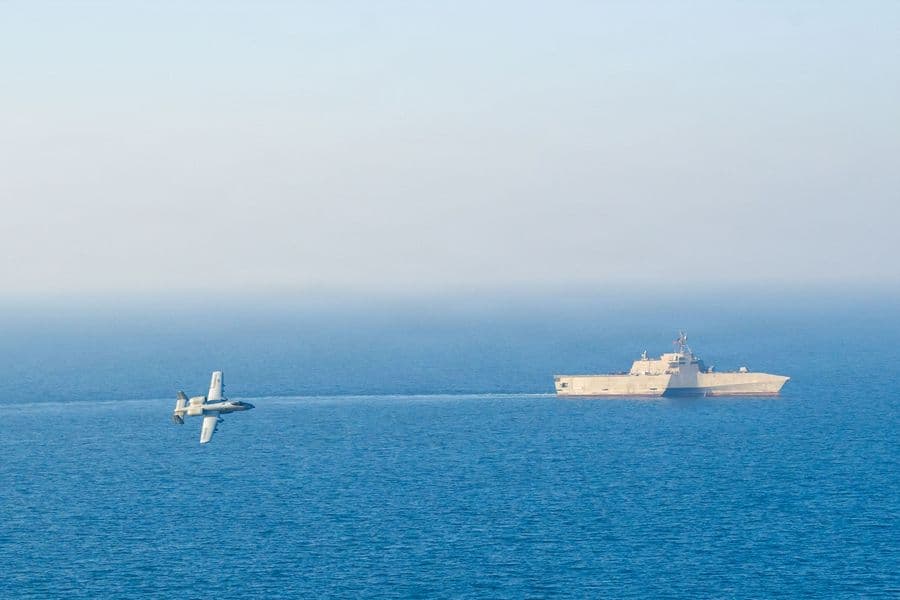
In the ultimate irony, the Warthog flew overwatch protecting an LCS from Iranian small fast boats, one of the original littoral threats that inspired the Streetfighter.
During a December 2004 visit with Army soldiers in Kuwait, Secretary Rumsfeld responded to one Guardsman's complaint about the lack of insufficiently armored vehicles by stating: "As you know, you go to war with the army you have, not the army you might want or wish to have at a later time."
The failure to plan for the ensuing counterinsurgency or provide adequate armor punctured the fiction of a prematurely proclaimed "Mission Accomplished".
Somewhere an administration official is asserting, “you go to a street fight with the navy you have, not the navy you might want or wish to have.”
One would hope shortcomings in planning and equipment would deter the nation's leadership from engaging in a war anywhere, much less the Middle East.
Operation Epic Fury, the LCS, and the A-10 prove one would be wrong.
R. Jordan Prescott is a private contractor working in defense and national security since 2002. He has been published in The American Conservative, The National Interest, Responsible Statecraft, Small Wars Journal, Modern War Institute, 19fortyfive, and RealClearDefense.

Innovation Alone Won’t Prepare the U.S. for the Future Battlefield
By Joshua Segal • RealClearDefense
The sUAS Tactical Trifecta
By Bryan T. Woody • RealClearDefense
The Revolutionary War: When Strategic Options Share the Same Weakness
By Henry Yep • RealClearDefense
The Houthis Are Testing the Limits of Collective Defense
By Saima Afzal • RealClearDefense
Radio Frequencies in the Intelligence Ecosystem
By Craig Brower • RealClearDefense

Who Shoots Down the Drone Over the Shipyard?
By John Ferrari & Dillon Prochnicki • RealClearDefense
Northrop Grumman Breaks Out the Big Guns at AUSA
By Daniel Terrill, Defense News
Army Pursuing Diverse Array of New Anti-Air Interceptors
By Trevithick, The WarZoneWho Shoots Down the Drone Over the Shipyard?
By John Ferrari & Dillon Prochnicki, RCD
F-35C Lands for the First Time on a Ford-Class Aircraft Carrier
By The Aviationist