
More Money for Legacy Yards Won't Solve the Navy's Crisis
Last updated 07:30 AM EDT • Read time: 5m
The recent decision by the Secretary of Defense to effectively terminate the FA-XX Navy aircraft was a bold and decisive move to fixing the Navy, not just because it stops the Navy from spending money on an aircraft it probably does not need, but because it potentially breaks the hold that naval aviators have on the Navy. Now the political leadership within the Defense Department must make another bold and decisive move to change the way the Navy builds ships.
America’s shipbuilding enterprise is at a critical inflection point. Despite pouring more money into legacy naval shipyards, the Navy remains unable to meet even its most modest fleet goals. Testimony from the current Secretary of the Navy, John Phelan, reinforces the need for a 180‑degree pivot. Simply doubling down on yesterday’s industrial base won’t build tomorrow’s effective naval warfighting force.
The new Trump administration has one chance to get this right and that chance is right now. The new congressional funding is a once in a generation opportunity to build a new industrial base, one that invests in scalable, modular, autonomous, software driven ships and submarines. The current political leadership will be remembered, one way or the other, for the decisions they make now.
In a candid June 11, 2025, hearing before the House Armed Services Committee, Secretary Phelan spared no words: “All of our programs are a mess, to be honest,” he said. “We are behind schedule, over budget. Our best‑performing one is six months late and 57 % over budget”. He pointed to problems with the production of Columbia‑class ballistic missile subs, Virginia attack subs, Constellation frigates, Arleigh Burke destroyers, and even amphibious warfare ships. It has been said that “insanity is doing the same thing over and over again and expecting different results.” It is time for the political leadership to take the lead and end the insanity that is rotting away the world’s finest Navy.
Many of today’s challenges come from the Navy’s last pivot to aircraft carriers in the 1930s and 1940s. These carriers, costing over $10B each, are the result of the needs of the manned aircraft they are built for. In today’s environment, they are giant targets that cannot be replaced or in fact built at serious scale. The Navy needs to declare independence from manned aircraft as the first step in the pivot.
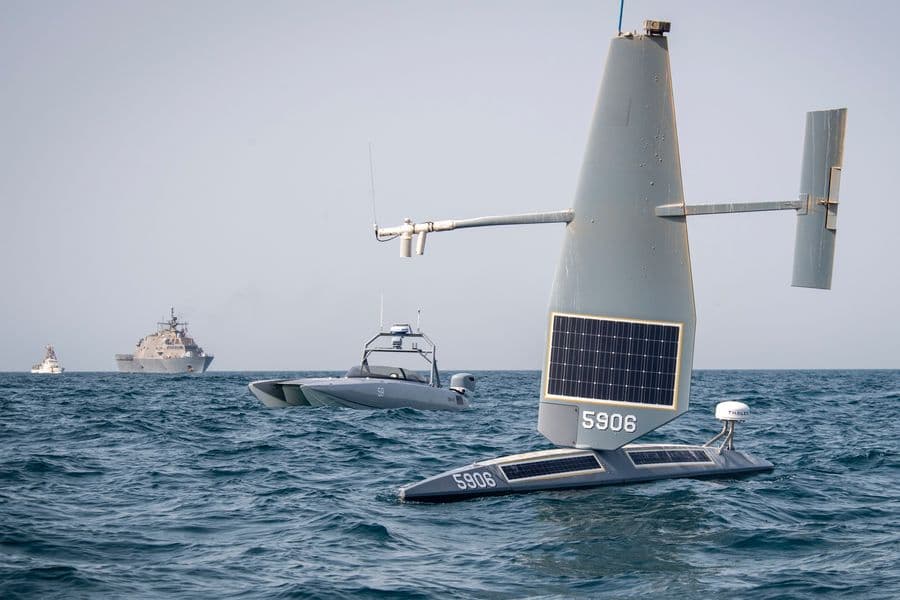
Scalable sea drones offer a warfighting edge and distributed presence at a fraction of the cost and time, all without the burdens of steel‑heavy shipyards that require a workforce that cannot be found. Today’s youth are more likely to flock to, and work for, companies making smaller vessels that are built around autonomy, AI, cyber, electronic warfare, and distributed lethality. The U.S. can leapfrog into commercial production of these unmanned sea vehicles and not lose the commercial manufacturing race like it has done with the production of Aerial drones dominated by the Chinese.
We need to look forward to face the challenges of the future. Legacy yards are burdened by one‑off custom designs, labor inefficiencies, and rigid facilities. Next, building large surface vessels or subs takes years from steel cutting to delivery. Even with rapid funding, the industrial base cannot surge. Phelan acknowledged this in February: “I think what is missing… is a sense of urgency… we’re just going along… waiting for a crisis to happen.” Budgeting more for traditional shipbuilding reduces the incentives for new thinking and ways of doing business. With limited dollars, choosing to invest in the legacy yards is a decision not to invest heavily in new yards.
The current wars in Europe and the Middle East are showing us that quantity matters and that small sized weapons can do outsize damage. Building tens of thousands of mostly smaller and relatively autonomous vessels, many tailored for specific missions, is the future. Automated shipyards, built from the ground up, will enable leaner manufacturing. The shipbuilding revolution needs to learn what others have learned: build the software first, then fit the hardware around it.
This pivot does not require shutting down facilities like those at Newport News or Bath Iron Works. We can use legacy yards to ramp up sub life extensions or refuel nuclear carriers, while pivoting procurement toward sea drones in specialized, agile new-build facilities. The current Navy fleet will be with us for decades and must be maintained.
We also need true competition. Open-yard battles for unmanned vessel contracts that reward accelerated prototyping, schedule, autonomy, and modularity should be the norm. Congress should also mandate that these are dual-use yards where fabrication mirrors commercial modular practices.
Secretary Phelan’s blunt assessment that “all of our programs are a mess” should be a clarion call. Legacy shipyard funding offer only marginal improvement at great cost. A 180‑degree pivot towards mass‑produced, modular, autonomous sea drones would deliver true scalability, speed, and distributed naval capacity.
Major General John G. Ferrari (U.S. Army, ret.)is a nonresident senior fellow at AEI. Ferrari previously served as a director of program analysis and evaluation for the service.

In Pursuit of Nuclear Abolition
By Peter Huessy • RealClearDefense
Innovation Alone Won’t Prepare the U.S. for the Future Battlefield
By Joshua Segal • RealClearDefense
The sUAS Tactical Trifecta
By Bryan T. Woody • RealClearDefense
The Revolutionary War: When Strategic Options Share the Same Weakness
By Henry Yep • RealClearDefense
The Houthis Are Testing the Limits of Collective Defense
By Saima Afzal • RealClearDefense

Who Shoots Down the Drone Over the Shipyard?
By John Ferrari & Dillon Prochnicki • RealClearDefense
Northrop Grumman Breaks Out the Big Guns at AUSA
By Daniel Terrill, Defense News
Army Pursuing Diverse Array of New Anti-Air Interceptors
By Trevithick, The WarZoneWho Shoots Down the Drone Over the Shipyard?
By John Ferrari & Dillon Prochnicki, RCD
F-35C Lands for the First Time on a Ford-Class Aircraft Carrier
By The Aviationist