
Rebuilding Maritime Resilience: Aligning Strategy with Industrial Reality
Last updated 06:39 AM EDT • Read time: 16m
American sea power has always rested on a paradox: the Navy is the visible instrument of national strength, but its true foundation lies in the industrial base that builds, repairs, and sustains it. This industrial base—shipyards, suppliers, skilled labor, and logistics networks—is not merely an economic ecosystem. It is a strategic asset whose health determines whether the United States can deter adversaries, sustain forward presence, and prevail in conflict. Yet today, that foundation is brittle. The Navy’s ability to execute its global missions is increasingly constrained by an industrial base that cannot produce or repair ships at the tempo required by strategy.
The concept of non-surgeable infrastructure is central to understanding the problem. Shipyards cannot be rapidly expanded in a crisis. Skilled labor cannot be conjured overnight. Specialized suppliers cannot be rebuilt once lost.[1] The industrial base is therefore a fixed strategic variable, not a flexible resource. During World War II, the United States produced more than 2,700 Liberty ships in four years, a feat made possible only by the nation's vast industrial depth, redundant suppliers, and a massive skilled workforce.[2] Today, by contrast, the Navy struggles to deliver even a handful of major combatants on schedule. The industrial base has contracted, suppliers have consolidated, and workforce pipelines have thinned.[3]
This erosion has strategic consequences. Modern naval operations assume a fleet that can be repaired, modernized, and expanded at tempo. Ships must be maintained forward, battle damage must be repaired quickly, and losses must be replaced rapidly. Yet the Navy’s current industrial capacity cannot meet these demands. Shipyards are overburdened, maintenance backlogs are chronic, and new construction timelines routinely slip by years.[4] The result is a fleet that is smaller, older, and less ready than strategy requires.
The Indo-Pacific theater magnifies every industrial weakness. Geography imposes long transit times, limited repair options, and a high operational tempo. A fleet that cannot be repaired forward or replaced quickly risks strategic paralysis.[5] The United States cannot assume that ships damaged in conflict will return to service quickly; nor can it assume that new ships will arrive in theater at a pace sufficient to offset losses.[6] In a conflict with a peer adversary—especially China—attrition will be real, and the ability to regenerate combat power will determine strategic outcomes.
China understands this dynamic. It has built the world’s largest shipbuilding industry, producing warships at a pace the United States cannot match.[7] Chinese yards are modern, efficient, and vertically integrated. They benefit from state subsidies, predictable funding, and a vast labor pool. By contrast, the United States relies on a small number of aging shipyards operating at or beyond capacity.[8] This asymmetry creates a dangerous strategic imbalance: China can replace losses more quickly, repair ships faster, and expand its fleet at scale.
The industrial base’s fragility also undermines deterrence. Deterrence depends not only on current capability but also on the adversary’s perception of the United States’ ability to sustain operations over time. If adversaries believe the U.S. cannot quickly replace ships, cannot repair them forward, and cannot sustain prolonged maritime operations, deterrence erodes.[9] The Navy’s own assessments acknowledge that shipyard delays, maintenance backlogs, and industrial fragility directly undermine its ability to deter conflict.[10]
Historical experience reinforces this point. During the Cold War, the United States maintained a robust industrial base capable of producing and repairing ships at scale. This capacity underpinned maritime strategy, enabling the Navy to sustain a global presence, surge forces in a crisis, and maintain technological superiority. Today, that industrial depth has atrophied. The supplier base has shrunk, workforce pipelines have weakened, and shipyards have aged.[11] The Navy’s ability to sustain high-intensity operations is therefore increasingly constrained by industrial reality.
The mismatch between strategy and industrial capacity is stark. The Navy’s global missions—deterrence, forward presence, sea control, and power projection—presuppose a fleet that can be repaired and expanded at tempo. Yet the industrial base needed to sustain such a fleet no longer exists at the necessary scale.[12] This mismatch creates strategic risk: the United States may be unable to sustain maritime operations in a prolonged conflict, replace losses, or maintain forward presence.
The interim conclusion is clear: the United States cannot execute its maritime strategy with its current industrial base. The fleet’s ability to sustain combat operations, deter adversaries, and maintain forward presence depends on industrial capacity that no longer exists at the required scale.[13] The industrial base is therefore not merely an economic concern; it is a strategic vulnerability.
Industrial‑Base Crisis and Strategic Consequences
If Section I establishes the strategic foundations of America’s industrial fragility, Section II examines the operational and structural realities that define the crisis. The naval industrial base is not a single entity but an ecosystem comprising shipyards, suppliers, specialized manufacturers, logistics networks, and workforce pipelines. Its fragility is systemic, not incidental. These weaknesses are interlocking, mutually reinforcing, and strategically consequential.
Supplier Fragility and Critical Components
The modern naval industrial base relies on a small number of highly specialized suppliers whose products are essential to ship construction and repair. Propulsion systems, reduction gears, naval-grade steel, advanced electronics, combat-system components, and specialized coatings are produced by a narrow set of firms operating on thin margins.[14] When even one supplier falters, delays cascade across programs, idling labor and extending timelines by months or years.
This fragility is not hypothetical. The Navy has repeatedly faced multi-year delays because a single supplier failed to deliver reduction gears on time.[15] The same dynamic applies to missile components, radar arrays, and propulsion modules. Supplier consolidation—driven by decades of offshoring, cost-cutting, and market contraction—has reduced redundancy. In many cases, the United States now relies on single-point-of-failure suppliers, and any disruption would halt production across multiple ship classes.
Global supply-chain stresses exacerbate the problem. The Navy increasingly relies on foreign sources for specialized manufacturing, limiting its ability to redirect production during a crisis.[16] This dependence is strategically dangerous. In a conflict with a peer adversary, foreign suppliers may be unwilling or unable to meet U.S. demands. Even friendly nations may prioritize domestic needs or face political constraints on wartime support.
The result is an industrial base that lacks resilience. It cannot absorb shocks, redirect production, or ramp up output. In a high-intensity conflict—especially in the Indo-Pacific—this fragility would translate directly into operational risk.
Workforce Attrition and Training Shortfalls
Workforce shortages are structural, not cyclical. Shipbuilding trades require long apprenticeship pipelines and hands‑on experience that cannot be compressed. Welders, pipefitters, electricians, machinists, and systems integrators must master complex skills over years.[17] Yet demographic retirements, competition from other industries, and post‑COVID labor shifts have thinned the pool of skilled workers.
The Navy’s own assessments show that shipyards routinely operate with fewer workers than needed to meet production schedules.[18] This shortage is compounded by the growing technical sophistication of modern ships. Today’s combatants are systems-integration platforms that demand higher technical skills than previous generations. Without sustained investment in vocational training, apprenticeships, and retention incentives, yards cannot staff the technologically sophisticated work required for future platforms.
Workforce attrition also undermines surge capacity. Even if funding were available, shipyards cannot rapidly scale output without skilled labor. Training pipelines take years, not months.[19] In a crisis, the United States would face the same constraint it faces today: a shortage of workers to meet demand.
Budgetary Volatility and Procurement Fragility
Shipbuilding requires predictable, multi-year funding. Yet U.S. defense budgeting is marked by continuing resolutions, political volatility, and short-term appropriations that undermine long-term planning.[20] When funding is uncertain, firms defer capital investments, slow hiring, and avoid long-lead commitments—actions that reduce surge capacity.
Procurement practices exacerbate the problem. Cost growth and schedule slips fuel political skepticism, which in turn destabilizes funding. Program managers and contractors build in contingencies, further inflating costs.[21] This cycle erodes trust, increases risk, and undermines industrial confidence.
The Navy’s acquisition system also struggles with concurrency—building ships while still designing them. This approach creates technical risk, cost growth, and schedule delays.[22] Breaking this cycle requires acquisition reform, stable funding, and political commitment to long-term industrial investment.
Logistical and Basing Shortfalls in the Indo‑Pacific
Indo-Pacific operations require forward repair capacity, mobile maintenance platforms, and allied industrial cooperation. The current posture relies heavily on CONUS shipyards and a limited number of forward logistics nodes, resulting in long transit times for damaged ships.[23] A destroyer damaged in the South China Sea may need to travel thousands of miles to reach a major repair facility. This delay reduces operational tempo, increases risk, and creates windows of vulnerability.
Allied shipyards could mitigate some risks, but political and capacity constraints limit their utility. Diplomatic arrangements for wartime access are not automatic, and many partners lack industrial depth. Japan and South Korea have capable shipyards, but their ability to support U.S. wartime repair is constrained by domestic priorities and political considerations. Australia’s industrial base is expanding but remains limited.[24]
Without a coherent forward-maintenance plan—prepositioned spares, expeditionary repair units, and allied industrial agreements—the fleet remains vulnerable to operational pauses.[25] In a conflict with China, even brief pauses could shift the balance of power.
Strategic Consequences: Time, Risk, and Deterrence
Industrial fragility creates strategic liabilities. First, time favors the adversary: if the U.S. cannot repair or replace ships quickly, adversaries gain windows of local superiority.[26] Second, risk accumulates: commanders must choose between deploying ships that are inadequately repaired and ceding presence. Third, deterrence erodes when adversaries perceive that the U.S. cannot sustain prolonged operations.[27]
Strategic surprise becomes more likely when policymakers assume industrial capacity that does not exist. In a theater constrained by geography and logistics, such misalignment can produce catastrophic outcomes.[28]
Policy Recommendations
- Commit to multi‑year, predictable shipbuilding budgets to enable long‑term industrial planning.[29]
- Modernize shipyards and expand surge infrastructure through targeted federal investment.[30]
- Strengthen the supplier base via industrial policy, tax incentives, and strategic stockpiles.[31]
- Scale workforce pipelines through apprenticeships, technical education, and retention incentives.[32]
- Develop forward repair capacity and allied industrial cooperation to reduce transit times and increase resilience.[33]
- Reform acquisition practices to reduce cost growth and schedule risk.[34]
Conclusion — Strategy Must Match Industrial Reality
The United States stands at a strategic inflection point. Its maritime strategy assumes a fleet that can be repaired, modernized, and expanded at tempo. Yet the industrial base needed to sustain that fleet has atrophied. Shipyards are non-surgeable infrastructure; suppliers are fragile; workforce pipelines are thin; budgets are unstable; and Indo-Pacific logistics are insufficient for high-intensity conflict. The mismatch between strategy and industrial reality is not merely a bureaucratic problem; it is a strategic vulnerability with profound implications for deterrence, crisis response, and warfighting.
The Navy’s global missions—deterrence, forward presence, sea control, and power projection—depend on a fleet that is ready, resilient, and regenerable. Yet readiness is not simply a function of ship availability; it is a function of industrial capacity. A fleet that cannot be repaired quickly, modernized efficiently, or expanded at tempo cannot deter effectively. The industrial base is therefore a central variable in strategic planning, not an afterthought.
The Indo-Pacific theater magnifies this vulnerability. Geography imposes long transit times, limited repair options, and a high operational tempo. A fleet that cannot be repaired forward risks operational paralysis. A fleet that cannot replace losses risks strategic collapse. A fleet that cannot sustain presence risks deterrence failure. In a conflict with China, a nation with the world’s largest shipbuilding industry, the ability to regenerate combat power will determine strategic outcomes. China’s industrial capacity enables it to replace losses faster, repair ships more quickly, and expand its fleet at scale. The United States cannot match this pace under current conditions.
This asymmetry creates a dangerous strategic imbalance. Deterrence depends not only on current capability but also on the adversary’s perception of the United States’ ability to sustain operations over time. If adversaries believe the U.S. cannot quickly replace ships, cannot repair them forward, and cannot sustain prolonged maritime operations, deterrence erodes. The Navy’s own assessments acknowledge that shipyard delays, maintenance backlogs, and industrial fragility directly undermine its ability to deter conflict.
The industrial base’s fragility also undermines crisis response. In a high-intensity conflict, ships will be damaged, systems will fail, and losses will occur. The ability to quickly repair battle damage, restore combat power, and return ships to the fight will determine operational tempo. Yet the Navy’s current industrial capacity cannot meet these demands. Shipyards are overburdened, maintenance backlogs are chronic, and new construction timelines routinely slip by years. The result is a fleet that is smaller, older, and less ready than strategy requires.
The supplier base is equally fragile. Modern ships rely on highly specialized components produced by a small number of firms. When even one supplier falters, delays cascade across programs, idling labor and extending timelines by months or years. This fragility is incompatible with high-intensity maritime conflict, where rapid repair and replacement are essential. The Navy increasingly depends on foreign sources for specialized manufacturing, limiting its ability to redirect production in a crisis. This dependence is strategically dangerous. In a conflict with a peer adversary, foreign suppliers may be unwilling or unable to meet U.S. demands.
Workforce shortages further constrain capacity. Shipbuilding trades require long apprenticeship pipelines and hands‑on experience that cannot be compressed. Demographic retirements, competition from other industries, and post‑COVID labor shifts have thinned the pool of skilled workers. Without sustained investment in vocational training, apprenticeships, and retention incentives, yards cannot staff the technologically sophisticated work required for future platforms. Workforce attrition also undermines surge capacity. Even if funding were available, shipyards cannot rapidly expand output without skilled labor.
Budgetary volatility compounds these challenges. Shipbuilding requires predictable, multi-year funding. Yet U.S. defense budgeting is marked by continuing resolutions, political volatility, and short-term appropriations that undermine long-term planning. When funding is uncertain, firms defer capital investments, slow hiring, and avoid long-lead commitments—actions that erode surge capacity. Procurement practices exacerbate the problem. Cost growth and schedule slips fuel political skepticism, which in turn destabilizes funding. Breaking this cycle requires acquisition reform, stable funding, and political commitment to long-term industrial investment.
Logistical and basing shortfalls in the Indo-Pacific further undermine resilience. The current posture relies heavily on CONUS shipyards and a limited number of forward logistics nodes, leading to long transit times for damaged ships. Allied shipyards could mitigate some risks, but political and capacity constraints limit their utility. Diplomatic arrangements for wartime access are not automatic, and many partners lack industrial depth. Without a coherent plan for forward maintenance—prepositioned spares, expeditionary repair units, and allied industrial agreements—the fleet remains vulnerable to operational pauses. In a conflict with China, even brief pauses could shift the balance of power.
The strategic consequences are clear. Industrial fragility creates strategic liabilities. Time favors the adversary. Risk accumulates. Deterrence erodes. Strategic surprise becomes more likely when policymakers assume industrial capacity that does not exist. In a theater constrained by geography and logistics, such misalignment can lead to catastrophic outcomes.
Rebuilding maritime resilience requires a whole-of-government effort: predictable funding, industrial modernization, workforce investment, supplier stabilization, forward logistics, and acquisition reform. These are not optional; they are prerequisites for credible deterrence and effective warfighting. The United States cannot deter, compete, or prevail in the Indo-Pacific unless it aligns its grand strategy with industrial reality. The fleet’s future, and America’s ability to shape the international system, depends on rebuilding the industrial foundations of sea power now, before a crisis forces a reckoning.
James M. Deitch served as the Motor Transport Operations Chief for 6th Motor Transport Battalion, 1st Fleet Service Combat Support Group during Operation Desert Storm from 1990 to 1991. He served in the Marine Corps from 1984 to 1996.
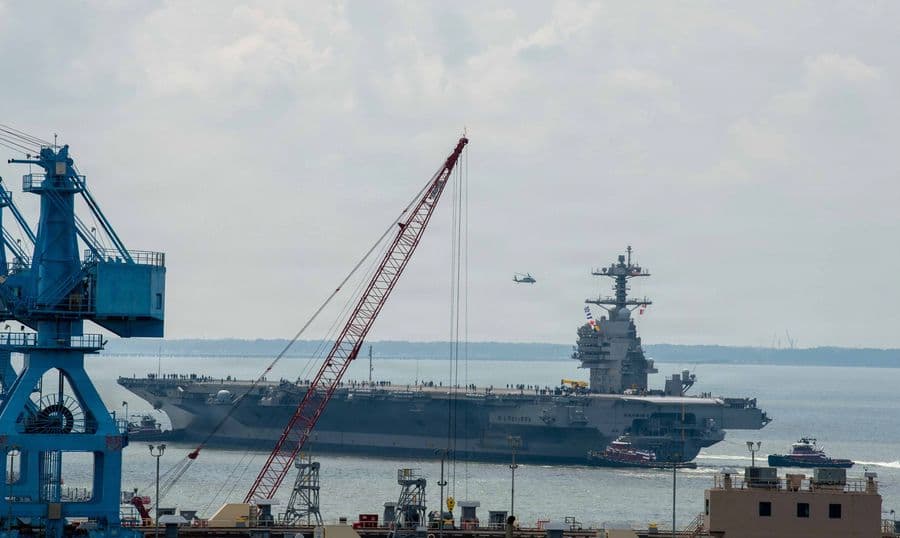
image: NEWPORT NEWS, Va. (Aug. 12, 2026) Pre-Commissioning Unit (PCU) John F. Kennedy (CVN 79) departs from Newport News Shipbuilding for Acceptance Trials at sea in Newport News, Virginia, August 12, 2026. Acceptance Trials is a series of crew-led events designed to demonstrate to the U.S. Navy’s Board of Inspection and Survey that the ship is constructed in accordance with contract specifications, and that the crew is adequately trained to conducted operations at sea. (U.S. Navy photo by Mass Communication Specialist Seaman Morgan Altom)
notes:
[1] Henry H. Carroll, Cynthia R. Cook, Seamus P. Daniels, and Oliver B. Buntin. “Evaluating Pathways for U.S. Shipbuilding Cooperation with Allies.” CSIS, Center for Strategic and International Studies. August 10, 2026.
[2] David Axe. “The U.S. Navy has a Big Shipyard Problem.” National Interest, historical analysis of U.S. wartime shipbuilding. July 31, 2021.
[3] Loren Thompson, “U.S. Shipbuilding Is at Its Lowest Ebb Ever,” Forbes, July 23, 2021.
[4] The Economist, “America’s Lack of Shipbuilding Prowess is a Problem for its Navy,” August 6, 2026.
[5] Andrew Wooley. “Float, Move, and Fight. How the U.S. Navy Lost the Shipbuilding Race.” Foreign Policy. October 10, 2021.
[6] Jerry Hendrix. “The Age of American Naval Dominance is Over.” The Atlantic. March 13, 2023.
[7] Shelby S. Oakley. “U.S. Navy Shipbuilding Consistently Over Budget and Delayed Despite Billions Invested in Industry.” GAO (Government Accountability Office. April 8, 2025.
[8] Isaac Seits. “The U.S. Navy Is Broken.” National Security Journal. Oct. 31, 2025.
[9] CSIS, “Shipbuilding.”
[10] Thompson. “U.S. Shipbuilding Is at Its Lowest Ebb Ever.” Forbes. July 23, 2021.
[11] 1st Lt. Jared Simonelli. “From Shipyards Comes Seapower: Revitalizing Naval Shipbuilding,” Small Wars Journal. April 7, 2026.
[12] Josh Luckenbaugh. “Lack of Shipyard Capacity Putting Unsustainable Strain on Navy,” National Defense. 2023.
[13] Simonelli. “Revitalizing U.S. Naval Shipbuilding.” 2026.
[14] GAO, “Shipbuilding Consistently Over Budget.”
[15] USNI Proceedings, “The United States Must Improve Its Shipbuilding Capacity,” 2024.
[16] The Economist, “Shipbuilding Prowess.”
[17] Arnav Rao. “How America Lost Control of the Seas.” The Atlantic. May 28, 2025.
[18] National Security Journal, “The U.S. Navy Is Broken.”
[19] CSIS and USNI analyses on funding predictability.
[20] CSIS and USNI analyses on funding predictability.
[21] National Defense Magazine and Small Wars Journal on yard modernization.
[22] Forbes analysis on supplier concentration.
[23] CSIS and National Defense Magazine on workforce pipelines.
[24] National Defense Magazine and Small Wars Journal on yard modernization.
[25] Small Wars Journal, “Revitalizing U.S. Naval Shipbuilding.”
[26] GAO, “U.S. Navy Shipbuilding Consistently Over Budget and Delayed.”
[27] Seavy, Major Jeffrey L., “The United States Must Improve Its Shipbuilding Capacity,” Vol. 150/2/1/1452, USNI Proceedings, 2024.
[28] The Economist, “America’s Lack of Shipbuilding Prowess,” 2026.
[29] The Atlantic, “U.S. Navy and Oceanic Trade,” 2023.
[30] National Security Journal, “The U.S. Navy Is Broken.”
[31] Foreign Policy, “The U.S. Navy’s Shipbuilding Failure,” 2021.
[32] CSIS, “Shipbuilding,” Center for Strategic and International Studies.
[33] The Atlantic, “Oceanic Trade and Naval Power.”
[34] GAO, “U.S. Navy Shipbuilding Consistently Over Budget and Delayed.” USNI Proceedings, “The United States Must Improve Its Shipbuilding Capacity,” 2024.

Innovation Alone Won’t Prepare the U.S. for the Future Battlefield
By Joshua Segal • RealClearDefenseThe sUAS Tactical Trifecta
By Bryan T. Woody • RealClearDefense
The Revolutionary War: When Strategic Options Share the Same Weakness
By Henry Yep • RealClearDefense
The Houthis Are Testing the Limits of Collective Defense
By Saima Afzal • RealClearDefense
Radio Frequencies in the Intelligence Ecosystem
By Craig Brower • RealClearDefense