
Russia Test-Fires Four Submarine Launched Nuclear ICBMs
Last updated 04:08 AM EST • Read time: 3m
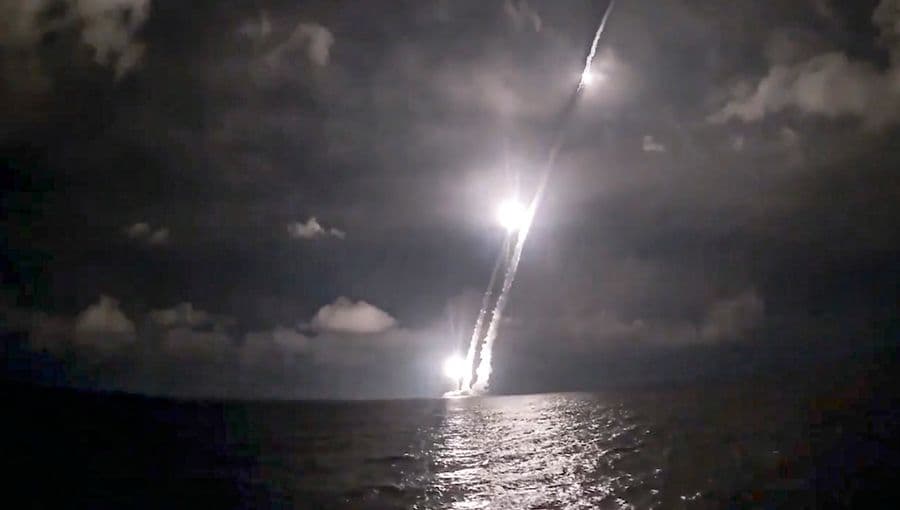
MOSCOW (AP) — A Russian nuclear submarine on Saturday successfully test-fired four intercontinental ballistic missiles in a show of readiness of Moscow’s nuclear forces amid tension with the U.S.
The Defense Ministry said that the Vladimir Monomakh submarine of the Pacific Fleet launched four Bulava missiles in quick succession from an underwater position in the Sea of Okhotsk. Their dummy warheads hit their designated targets on the Chiza shooting range in the Arkhangelsk region in northwestern Russia more than 5,500 kilometers (over 3,400 miles) away, the ministry said in a statement.
The Vladimir Monomakh is one of the new Borei-class nuclear submarines that carry 16 Bulava missiles each and are intended to serve as the core of the naval component of the nation’s nuclear forces for decades to come. Another submarine of the same type performed a similar launch of four Bulava missiles in 2018 — a costly demonstration of the efficiency of the country’s nuclear deterrent mimicking the conditions of a major nuclear conflict.
In a report to President Vladimir Putin, Defense Minister Sergei Shoigu said that Saturday’s launch wrapped up large-scale drills of Russia’s strategic nuclear forces that began Wednesday. As part of those maneuvers, another Russian nuclear submarine also performed a practice launch of an intercontinental ballistic missile from the Barents Sea, a ground-based ICBM was launched from the Plesetsk facility in northwestern Russia and Tu-160 and Tu-95 strategic bombers fired cruise missiles at test targets at an Arctic range.
Russia has expanded its military drills in recent years amid tensions with the West as relations have sunk to post-Cold War lows after Moscow’s 2014 annexation of Ukraine’s Crimean Peninsula.
The series of missile launches comes less than two months before the New START U.S.-Russian arms control treaty expires in early February. Moscow and Washington have discussed the possibility of its extension, but so far have failed to overcome their differences.
New START was signed in 2010 by U.S. President Barack Obama and Russian President Dmitry Medvedev. It limits each country to no more than 1,550 deployed nuclear warheads and 700 deployed missiles and bombers, and envisages sweeping on-site inspections to verify compliance.
After both Moscow and Washington withdrew from the 1987 Intermediate-Range Nuclear Forces Treaty last year, New START is the only remaining nuclear arms control deal between the two countries still standing.
Arms control advocates have warned that its expiration would remove any checks on U.S. and Russian nuclear forces, in a blow to global stability.
© copyright 2020 The Associated Press. All rights reserved.

In Pursuit of Nuclear Abolition
By Peter Huessy • RealClearDefense
Innovation Alone Won’t Prepare the U.S. for the Future Battlefield
By Joshua Segal • RealClearDefense
The sUAS Tactical Trifecta
By Bryan T. Woody • RealClearDefense
The Revolutionary War: When Strategic Options Share the Same Weakness
By Henry Yep • RealClearDefense
The Houthis Are Testing the Limits of Collective Defense
By Saima Afzal • RealClearDefense

Who Shoots Down the Drone Over the Shipyard?
By John Ferrari & Dillon Prochnicki • RealClearDefense
Northrop Grumman Breaks Out the Big Guns at AUSA
By Daniel Terrill, Defense News
Army Pursuing Diverse Array of New Anti-Air Interceptors
By Trevithick, The WarZoneWho Shoots Down the Drone Over the Shipyard?
By John Ferrari & Dillon Prochnicki, RCD
F-35C Lands for the First Time on a Ford-Class Aircraft Carrier
By The Aviationist