
The Magazine Depth and Fear of Loss Crises
Last updated 09:42 AM EDT • Read time: 18m
The Unused Shield: The Case for Forward-Deployed Aegis Destroyers in Gulf Air and Missile Defense
The Unanswered Question
There are typically more than one hundred US Navy ships and submarines deployed worldwide on any given day. Yet, despite an ongoing maritime conflict in the Middle East, the United States generally maintains fewer than five warships inside the Arabian Gulf at any one time. Those vessels are usually Littoral Combat Ships (LCS), with guided-missile destroyers (DDGs) appearing only on temporary transits. This does not reflect the total US naval presence in the region; a substantial force of cruisers, destroyers, submarines, amphibious ships, and carrier strike groups operates just outside the Gulf.
The question is therefore unavoidable: why are Arleigh Burke-class guided-missile destroyers, equipped with Standard Missiles and among the world's most capable integrated air and missile defense platforms, not routinely stationed inside the Gulf – particularly now - to help defend Saudi Arabia, Kuwait, Bahrain, Qatar, Jordan, and the United Arab Emirates? After all, these ships possess exactly the capabilities required to counter the threats Iran has spent decades developing: ballistic missiles, land-attack cruise missiles, and one-way attack drones.
The answer is not that the ships lack the capability. Quite the opposite: the very capabilities that make an Aegis destroyer valuable also make it an extraordinarily expensive and potentially vulnerable asset to place inside the Gulf.
The Power of Aegis
These ships’ capability and capacity is not merely theoretical, either. Rather, it has already been demonstrated in combat.
On the night of 13–14 April 2024, Iran launched its largest direct attack against Israel, employing more than 300 airborne weapons, including ballistic missiles, cruise missiles, and one-way attack drones. The attack was designed as a saturation strike, presenting multiple simultaneous threats intended to overwhelm Israel's layered air defense system.[i] The coalition response demonstrated the effectiveness of an integrated air and missile defense architecture. US Navy destroyers USS Arleigh Burke (DDG 51) and USS Carney (DDG 64), operating in the Eastern Mediterranean, fired SM-3 interceptors against Iranian ballistic missiles - the first confirmed combat use of the SM-3 interceptor.[ii] Israeli Arrow, David's Sling, and Iron Dome systems, together with US, British, French, and Jordanian aircraft, engaged additional ballistic missiles, cruise missiles, and drones. Ultimately, the overwhelming majority of Iran's weapons were intercepted before reaching their intended targets.[iii]
Several important conclusions emerge from this engagement. First, Aegis-equipped destroyers have demonstrated their ability to defeat Iranian ballistic missiles using Standard Missile interceptors under actual combat conditions. Second, these destroyers were successfully integrated into an allied air defense systems, sharing sensor data, and contributing to a broader defensive network. Finally, the value of an Aegis destroyer extends far beyond the missiles contained within its launch cells. Its radar, command system, and network connectivity multiply the effectiveness of every defensive asset operating in company with it.
Consequently, the operational question for the Arabian Gulf therefore becomes straightforward: if Aegis destroyers proved instrumental in defending Israel from positions in the Eastern Mediterranean, why should the same capability not be positioned closer to our Arabian allies as well as US military installations throughout the Gulf?
What Arleigh Burke Brings to the Fight
The answer begins with understanding what an Arleigh Burke-class destroyer actually provides.
The Arleigh Burke is arguably the world's most capable integrated air and missile defense warship. At its core is the AN/SPY Air and Missile Defense Radar, a next-generation sensor designed to detect, discriminate, and track ballistic missiles, cruise missiles, aircraft, and unmanned aerial systems simultaneously. Combined with the Aegis Combat System, the ship becomes a mobile regional air defense node capable of protecting not only itself, but also friendly forces and territory over a wide area.[iv] A single DDG provides more than “point” defense of the sort provided by Patriot. Rather, the ship provides “area” air defense over a much wider region.
Against Iranian ballistic missiles, the destroyer's principal weapons are members of the Standard Missile family. Iran possesses a large inventory of short- and medium-range ballistic missiles, including the Fateh-110, Zolfaghar, Dezful, Qiam-1, Emad, Ghadr, and Kheibar Shekan. These systems are designed to strike regional targets, including military bases, energy infrastructure, and population centers throughout the Gulf.[v]
Aegis-equipped destroyers can engage these threats through multiple layers. The SM-3 interceptor is designed primarily for ballistic missile defense during the midcourse phase, including engagements outside the atmosphere. The SM-6 provides additional capability against terminal ballistic missile threats while also serving as a defense against aircraft and cruise missiles.[vi]
The destroyer is similarly capable against Iran's cruise missile inventory. Systems such as the Soumar, Hoveyzeh, and Paveh are designed to fly at low altitude, complicating detection, and engagement. These weapons present a different challenge from ballistic missiles because they approach the target in a relatively flat trajectory rather than following a predictable ballistic arc. Nevertheless, the combination of SPY detection, Aegis fire control, and SM-6 intercept capability provides a powerful defense against such threats.[vii]
Iran's extensive use of one-way attack drones introduces another layer of complexity. The Shahed family of unmanned aircraft is inexpensive, relatively simple, and frequently employed in large numbers. While individually less threatening than a ballistic missile, these systems can impose significant defensive burdens when launched simultaneously with other weapons. A destroyer's ability to track numerous targets and allocate appropriate interceptors makes it particularly valuable in this type of multi-axis engagement.
The destroyer's greatest advantage, however, is that it does not defend only itself. Through Aegis and the Cooperative Engagement Capability, a DDG becomes another sensor and shooter within a regional integrated air and missile defense network. A destroyer positioned in the northern Arabian Gulf could contribute directly to the defense of Bahrain, Kuwait, Qatar, eastern Saudi Arabia, and US bases throughout the region. It would complement Patriot and THAAD batteries ashore, airborne early warning aircraft, and allied radar systems, creating a layered defense architecture stronger than any individual component operating alone.[viii]
So Why Aren’t They in the Gulf?
There is, however, an important distinction between the April 2024 engagement and operations inside the Arabian Gulf. USS Arleigh Burke (DDG 51) and USS Carney (DDG 64) conducted their intercepts from the relative freedom of the Eastern Mediterranean, not from the confined and heavily contested waters of the Gulf. A destroyer operating inside the Gulf would face greater risks from coastal anti-ship missiles, ballistic missiles, drones, naval mines, submarines, and swarming fast attack craft.
Indeed, an Arleigh Burke destroyer stationed in the relatively small Arabian Gulf would be the most alluring target imaginable for Iran. Not only would the unique electronic signal of the ship allow an enemy to consistently and precisely detect and track the ship, but it seems impossible to overstate the political capital to be gained by successfully striking one of these ships, regardless of the cost to effect that strike. The destroyer would become the magnet of Iranian attention, and it seems inevitable that every weapon from small boat to ballistic missile would be employed to achieve even the smallest damage to the ship.
Moreover, defending herself, nearby allies, and regional bases could require the expenditure of large numbers of interceptors in a short period. A Flight IIA DDG carries ninety-six Mk 41 Vertical Launch System cells, but those cells must be divided among Standard Missiles, Tomahawk land-attack missiles, ASROC antisubmarine weapons, and other munitions. Consequently, only a portion of the ship's magazine can be dedicated to air and missile defense.[ix] And, since the Navy does not currently possess an operational capability to reload Vertical Launch System cells at sea, once a destroyer expends a significant portion of its Standard Missile inventory, it must withdraw to a port capable of rearming. Bahrain provides such a facility, but even a short replenishment period temporarily removes one of the Navy's most capable air-defense platforms from the fight.
The Dilemma
First, it is entirely unclear that the ordnance to reload is available. There is growing public evidence that current operations are being constrained by the availability of certain interceptors and other precision munitions. This applies to Patriot and THAAD effectors and Tomahawk cruise missiles. As for Standard Missiles, here too, there is evidence of shortages. The Navy's FY2027 budget request calls for 540 SM-6s, compared with 166 funded for FY2026 – a very large increase. USNI News describes SM-6 as one of the missiles being consumed in the current Middle East operations.[x] In short, it is entirely possible that the Navy needs to husband these missiles in a way that doesn’t allow for the free expenditure that would be seen were shooters to be positioned in the Gulf.
Second, it is becoming increasingly unclear that even if the weapons are available that they could easily be loaded in the most likely port, Manama, Bahrain.[xi]
Third, the loss of a modern guided-missile destroyer would represent not only a military setback but also a major political and strategic shock.
Still, while the constrained and frankly dangerous geography of the Gulf unquestionably exacerbated the tactical problem, it does not eliminate the value of forward-deployed air and missile defense. In fact, the proximity of Gulf allies and US military installations to Iranian launch sites increases the importance of having capable sensors and interceptors positioned near the threat. So far, multiple GCC allies oil facilities have been struck and damaged by Iran. The presence of DDGs in the Gulf could have had a salutary effect in defending our allies.
The question is therefore not whether operating a DDG in the Gulf entails greater risk to those ships but whether the strategic benefits of defending critical allies and bases outweigh that risk.
The Larger Operational Problem
This raises several important military-technical and military-operational issues, specifically in the geopolitical context of success or failure in this war, but also more broadly.
First, if destroyer operations in the Persian Gulf are necessary to suppress Iran's missile and drone forces, reopen the Strait of Hormuz, and restore regional stability, the risk is plainly worth accepting. The operational question is therefore not whether the Navy should accept the risk, but how to manage it.
Second, the Strait of Hormuz demonstrates that the modern chokepoint fight is not a Navy-only problem. The longstanding proliferation of ballistic and precision-guided munitions, combined with increasingly sophisticated drone weapons, has brought the missile-and-drone threat squarely into the near-shore, straits, and chokepoint environment. For the Navy, this is not a mission set that can be avoided. Sea control in these waters is a direct manifestation of the Navy's fundamental purpose of preserving freedom of the seas. The unresolved Houthi confrontation in the Red Sea has already demonstrated how relatively inexpensive shore-based missiles and drones can impose significant costs on naval and commercial traffic. The Strait of Hormuz now provides an even more consequential example.
But the answer cannot be naval power alone. The Iranian and Houthi approach itself demonstrates why. Operational control of a chokepoint is not determined solely at sea; it depends upon the ability to find, track, suppress, and destroy missile and drone forces dispersed across the surrounding land, air, and maritime environment. Opening the Strait of Hormuz therefore presents a textbook opportunity for joint operations: Army air and missile defense and long-range fires; Air Force time-sensitive targeting and strike; Marine Corps expeditionary sensing and fires; Navy Aegis ships, carrier aviation, electronic warfare, and maritime strike; and allied capabilities all contributing to a common operational objective.
This is the essential lesson. The Navy must provide the maritime forces necessary to establish and maintain sea control, but it should not be expected to accomplish the entire task by itself. The very nature of the threat makes this an inherently joint and coalition operation. Indeed, distributing the operational burden across the services and allies is not merely desirable; it is necessary if the United States is to sustain operations in a missile- and drone-saturated chokepoint over time.
Third, the limited availability of advanced missile interceptors is a longstanding black mark in the US defense acquisition record, repeated across not only munitions, but components, supplies, materiel, and force structure. The rise of China and the broader anti-democratic Eurasian bloc, the increasingly clear reality of great-power competition, the proliferation of both high-end and low-end missile and drone threats, and the PGM revolution have all been clear demand signals—yet they have consistently gone unmet.
Fourth, the continued likelihood of third-party and proxy wars in the world’s littorals underscores the requirement for robust manufacturing, shipbuilding, and full supply bins. This is a hard reality, so far confounded by the faulty imperative of “just-in-time” supplies chains at the expense of readiness and operational sustainability and flexibility.
Fifth, these developments show that we are already well into a cycle of defense expansion. Yet our national security rhetoric and defense-budget debates have not fully caught up with that reality. The Gulf illustrates the consequences: the United States may possess the technology to defeat the threat, but not yet the inventories, industrial capacity, or force structure required to sustain that capability at scale.
It is becoming clear that we have been caught short. In one important respect, we have moved beyond the frustrating “SCUD hunt” problem of finding and striking mobile and concealed targets in the Iranian hinterland. Our sensing, targeting, and strike systems have demonstrated that they can find and defeat those targets. The more immediate problem is different: we have not provided enough interceptors, missiles, and other expendable weapons to sustain the fight. The technology works. The magazine depth does not.
What is emerging in the Persian Gulf - and, in a different form, in the Black Sea - is a new kind of Littoral Strike Complex: a geographically constrained battlespace in which persistent sensing, shore-based missiles, unmanned systems, aircraft, electronic warfare, and distributed naval fires interact continuously.[xii]
Currently, there are many Navy issues, requirements, and capabilities involved that affect both operations and planning. The carrier force and its air wings remain integral to this kind of operation, but their limited numbers reinforce the larger point: the United States cannot expect a small number of exquisite platforms to carry the entire operational burden.
However, this is an all-Service and coalition issue, not only because it can be, but because it must be, which has the added virtue of distributing the operational load appropriately.
In this sort of operational scenario, US and allied command, control, communications, computers, cyber, intelligence, surveillance, reconnaissance, and targeting (C5ISRT) capabilities provide a substantial comparative advantage, creating a wide range of options for suppressing Iranian attacks. We have been discussing this sort of operational advantage since US Navy Admirals Cebrowski and Owens envisioned it at the outset of the post-Cold War period: an overwhelming combination of offensive and defensive capabilities, including Army air defenders and MLRS, Precision Strike Missile (PrSM), attack helicopters; Air Force Time Sensitive Targeting (TST); Navy shipborne and offensive counter-air EW and kinetic air defense, plus carrier air wing combat air patrol (CAP) and TST; USMC expeditionary advanced base operations and TST; and the full range of Israeli Defense Force air power and deployable Iron Dome capabilities.[xiii]
BLUE C5ISRT is a key comparative advantage. In third-party and proxy conflicts, where US and allied sensing, communications, targeting, and battle-management capabilities can substantially exceed those available to the adversary, this advantage can help compensate for some numerical and munitions disadvantages. But it cannot eliminate the underlying requirement for adequate magazines and sustained production.
The first operational mission is to protect friends and allies on the other side of the SOH from Iranian ballistic and drone attacks. Self-interested friends and allies obviously have a role in this, and the US should start getting used to exporting defensive systems to them in quantity, with the clear expectation that the US C5ISRT “Overwatch” comparative advantage (US systems, operational data, and targeting provided – as is being done in Ukraine) will be extended to them.
Once established, this defensive umbrella can then be extended to the waterway itself, and then further (in its offensive incarnation) into and over Iran, forcing offensive counter-air/missile interactions to defeat IRGC rocket and drone forces.
The reinforced air-to ground offensive to disrupt resupply/manufacture of IRGC drones and BMs (as 8th Air Force did to defeat the Luftwaffe) would be an important part of the overall operational campaign.
This puts the Navy's Aegis ships where they may be most valuable: not simply as missile launchers, but as highly capable C5ISR and battle-management nodes supporting a distributed joint fires network. The Aegis combat system is the central comparative advantage; SM-2, SM-6, SM-3, and other weapons are its principal kinetic enablers.
It also is increasingly obvious that “narrow seas” firing platforms could be unmanned, with the AEGIS DDGs providing C5ISRT and targeting.
Conclusion
The sum of these realities raises a broader strategic question. Is the current posture driven primarily by limited interceptor inventories? Is it an effort to minimize the risk of losing one of the Navy's most capable surface combatants? Or is it a combination of both? Whatever the answer, the decision not to forward-deploy additional Aegis destroyers inside the Gulf appears to reflect a conscious assessment of risk, logistics, and force preservation - not a lack of capability.
One conclusion, however, appears increasingly difficult to dismiss. Iran does not evaluate the costs and benefits of conflict through the same strategic lens as most Western governments. Its approach bears comparison to North Vietnam during the Vietnam War: a willingness to absorb losses that would likely prove politically or strategically unacceptable to Western democracies. Rather than seeking parity in casualties or material destruction, Tehran appears prepared to endure sustained punishment in the expectation that time, persistence, and political endurance will ultimately erode the resolve of its adversaries.
The United States therefore faces a difficult asymmetry. Iran may be willing to expend enormous quantities of missiles, drones, boats, and other weapons simply for the opportunity to damage or destroy an American Aegis destroyer. The destruction of a single DDG would have effects far beyond the tactical loss of one ship: it would impose a major political and strategic cost on Washington while consuming enormous Iranian resources in the attempt. Tehran may therefore regard the destruction of an Aegis destroyer as a strategic victory even if the attack itself is militarily costly.
Which is why there are not DDGs in the Gulf.
CAPT Eyer is a retired Surface Warfare Officer who served on active duty in the Navy for 27 years. He deployed in seven cruisers and commanded three Aegis cruisers: USS Thomas S. Gates (CG 51), USS Shiloh (CG 67), and USS Chancellorsville (CG 62).
CDR Giarra is a retired Navy pilot and Navy designated strategic planner. He is the President of Global Strategies & Transformation.
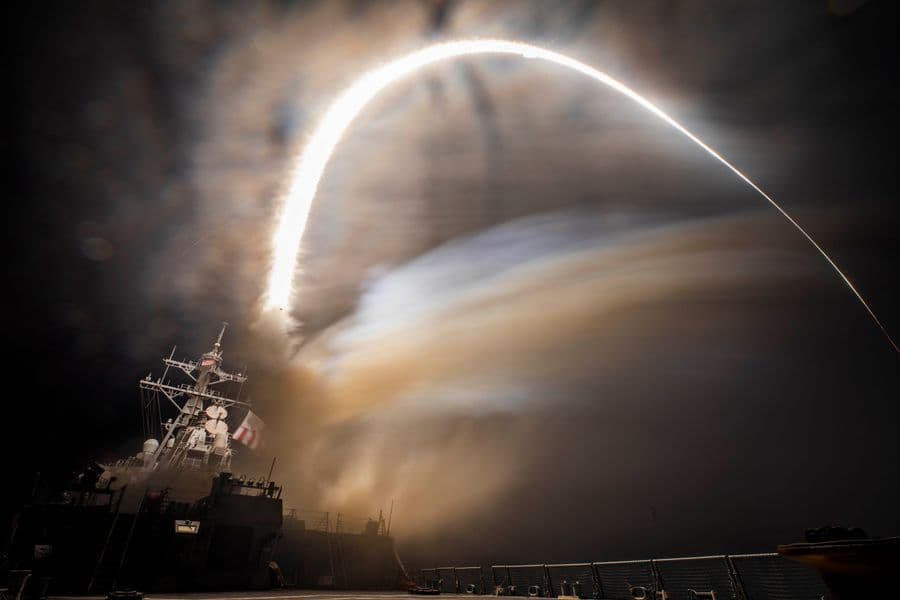
image: (Feb. 3, 2024) The guided-missile destroyer USS Carney (DDG 64) launches land attack missiles while operating in the U.S. Naval Central Command area of operations, Feb. 3, 2024. As part of the USS Dwight D. Eisenhower Carrier Strike Group, Carney is deployed to the U.S. 5th Fleet area of operations to support maritime security and stability in the Middle East. (Official U.S. Navy photo)
notes:
[i] US Department of Defense, “Israel, US Partners Neutralize Iranian Airborne Attacks,” April 2024.
[ii] Megan Eckstein, “SM-3 Ballistic Missile Interceptor Used for First Time in Combat, Officials Confirm,” US Naval Institute News, April 2024.
[iii] US Central Command, “CENTCOM Forces Participate in Defense Against Iranian Attack on Israel,” April 2024.
[iv] US Navy, “DDG 51 Arleigh Burke Class Guided Missile Destroyer,” Naval Surface Forces fact sheet.
[v] International Institute for Strategic Studies, The Military Balance; Missile Defense Advocacy Alliance, Iranian Missile Threat assessments.
[vi] US Navy, Standard Missile program documentation; Missile Defense Agency, Aegis Ballistic Missile Defense program descriptions.
[vii] Congressional Research Service, Iran’s Missiles and Unmanned Aerial Systems: A Threat Assessment, updated editions.
[viii] US Navy, Cooperative Engagement Capability program documentation.
[ix] Congressional Research Service, Navy DDG-51 and DDG-1000 Destroyer Programs: Background and Issues for Congress.
[x] Sam LaGrone, “New Navy Budget Wants $3B for New Tomahawks, $4.3B for SM-6s,” USNI News, April 6, 2026.
[xi] Rania R. Abushamala, “Iran’s IRGC Says It Attacked US Military Facilities in Bahrain, Kuwait,” Anadolu Agency, July 20, 2026. The IRGC claimed that strikes on Salman Port destroyed structures used to prepare Task Force 59 vessels and caused heavy damage to vessels there; the report did not independently verify the Iranian claims.
[xii] See ADM Chares A. Richard, US Navy (Ret.) and Dr. John Robinson, Ph.D, SEA POWER 2025, University of Virginia, 2025: “When the events in the Red Sea are included, there are strong indications that the emerging technologies that enable the LSC are impacting the power balance between states, as well as the power dynamic between state and non-state actors. The LSC is only possible with stable network connectivity and theater-level ISR; however, in the Black Sea, both were provided to Ukraine by third-party state and commercial actors. This dynamic introduces new non-state actors into strategic interactions but also complicates international relations. In one sense, the LSC structure is a scalable and exportable military good that great powers may share with allies, partners, and client states. From a US perspective, while extended nuclear deterrence is the ultimate military good of this kind, the ability to provide an LSC construct to other states at scale may prove significant in the future.”
[xiii] This summary of operational assets is meant to be a thumbnail sketch, and should not be construed as complete.

Innovation Alone Won’t Prepare the U.S. for the Future Battlefield
By Joshua Segal • RealClearDefenseThe sUAS Tactical Trifecta
By Bryan T. Woody • RealClearDefense
The Revolutionary War: When Strategic Options Share the Same Weakness
By Henry Yep • RealClearDefense
The Houthis Are Testing the Limits of Collective Defense
By Saima Afzal • RealClearDefense
Radio Frequencies in the Intelligence Ecosystem
By Craig Brower • RealClearDefense

Who Shoots Down the Drone Over the Shipyard?
By John Ferrari & Dillon Prochnicki • RealClearDefense
Northrop Grumman Breaks Out the Big Guns at AUSA
By Daniel Terrill, Defense News
Army Pursuing Diverse Array of New Anti-Air Interceptors
By Trevithick, The WarZoneWho Shoots Down the Drone Over the Shipyard?
By John Ferrari & Dillon Prochnicki, RCD
F-35C Lands for the First Time on a Ford-Class Aircraft Carrier
By The Aviationist