
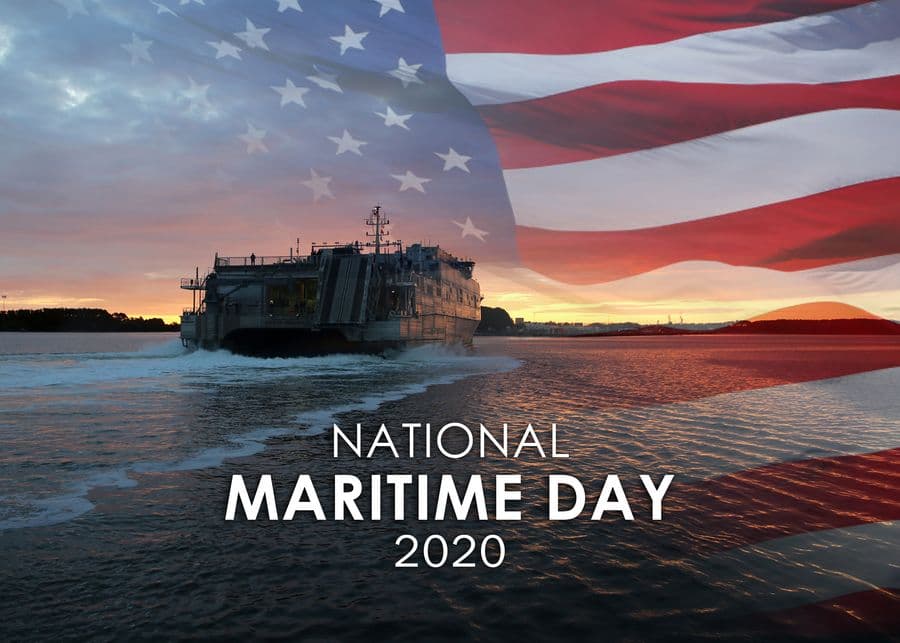
The Merchant Marine and U.S. Strategy
Last updated 06:59 PM EST • Read time: 7m
How to Revitalize the U.S. Merchant Fleet Before a Great Power War
Supplying an attacking and defending force has been an issue since the decade-long Trojan War. In more than 3,000 years, this has not changed. The U.S. continues to benefit from unrestricted resupply access in the Ukraine War. However, future Eurasian conflicts will not resemble Ukraine. The U.S. requires the capabilities to win the next war, not fight the last. This demands, in turn, a Merchant Marine capable of sustaining the U.S. and its allies through prolonged combat.
The Ukraine War marks the beginning of armed Eurasian dispute between the American-led coalition and the authoritarian entente of Russia, Iran, and China. Prior to 24 February, the U.S.’ adversaries poked and probed, but refrained from a direct challenge to the Eurasian military balance. Even as Russia and Iran displaced the U.S. in the Middle East, there remained few direct conflicts between the U.S., Russia, and Iran. The exceptions were remarkable instances of the shadow war bubbling to the surface. The 2017 and 2018 U.S. airstrikes in Syria, 2018 Battle of Khasham, and 2020 Soleimani Assassination, broke the norm of below-threshold intelligence and proxy conflict.
The earlier Gulf and Iraq Wars defined hostile military strategy throughout the 1990s and 2000s because they demonstrated the threat that the U.S. could pose when allowed time to establish massive nearby arsenals. In 1990-1991, the U.S. built up a million-man coalition, including nearly 3,000 aircraft, in neighboring Saudi Arabia, and invaded Iraq after an extended air campaign that gained absolute American air supremacy. In 2003, a far lighter force toppled Saddam’s regime, but only after an air campaign and, once again, a buildup in neighboring Saudi Arabia.
The lesson was clear. The U.S. Armed Forces were extraordinarily lethal, even without concentrating in overwhelming traditional numbers. But U.S. forces had to build up over time in the combat zone, while a U.S. offensive required significant air-land preparation. America could be defeated if it could be kept at arm’s length, unable to access a regional staging point. Hence America’s adversaries turned towards long-range weapons and political disruption to bar U.S. regional access, with the result termed anti-access area denial or hybrid warfare by U.S. planners.
The Ukraine War will define adversary strategy in the 2020s and 2030s as the Iraq Wars defined adversary strategy from the 1990s to the 2010s. For an autarkic enemy the Ukraine War’s central lesson is that the West cannot be allowed to transport decisive force to a combat zone unimpeded. Russia could interdict American arms shipments in Western Ukraine if it felt comfortable penetrating Ukrainian airspace for targeting purposes or if it could stage an offensive towards Lviv. But geographical and materiel constraints make in-country interdiction difficult, and even if Russia waged this campaign, it would risk a more active Western response, for example a No-Fly Zone that covered supply shipments to Ukrainian forces. Escalatory risks therefore deter this action, allowing the U.S. and Europe to serve as a rear area for Ukrainian forces effectively immune to Russian attack.
This is an unacceptable strategic situation even if Russia achieves the minimal objective of establishing a land corridor to Crimea. China surely recognizes the danger that allowing long-term U.S. support to its Indo-Pacific targets poses. No major power seeks to fight and win a long war – endurance is a weapon of the weak, the nationalist and insurgent. And U.S. supply access to a Chinese target, namely Taiwan but also potentially Vietnam, guarantees a long war. A war over Taiwan will thus involve immediate attempts to interdict U.S.-Taiwanese sea lines of communication and supply as China strikes ports and warships and, equally relevant, pushes air and naval forces into the western Philippine Sea to stage a Taiwan blockade. Similarly, a Chinese preemptive strike on Vietnam would involve attacks on Vietnamese ports and a screening force farther south to prevent supply through the Malacca or Lombok Straits.
Resupplying Taiwan during a major conflict, whether to support Taiwanese, U.S., or Japanese forces on the main island, requires military forces. The U.S. Navy must break a PLA blockade, likely engaging in a major fleet action to destroy a PLA blocking force. But a major war, as Ukraine has demonstrated, will require an immense amount of materiel. A sea war, as any Indo-Pacific War must necessarily be, requires an immense amount of seaborne shipping to carry that materiel.
It is here that the U.S. Merchant Marine becomes a crucial and wholly underappreciated aspect of national power. Throughout the Cold War, the Merchant Marine sustained U.S. deployments to the Eurasian rimland. Some 250-plus U.S. merchant ships were used to maintain American supplies in Korea. A combination of 175 National Defense Reserve Fleet transports, crewed by merchant mariners under the U.S. Maritime Administration, along with U.S.-flagged merchant ships transported nearly all the materiel to U.S. forces in Vietnam. It took 230 ships to sustain the American 1990-1991 buildup in Saudi Arabia prior to the Gulf War. And during the Iraq and Afghanistan Wars, MARAD’s Ready Reserve Force, also crewed by commercial mariners, transported a quarter of all equipment to theater during major combat operations. Because of its geography, any Indo-Pacific conflict will require a major merchant fleet to sustain U.S. and allied combat operations alongside the Navy and Air Force required to defend this logistical system.
The issue is, since the Second World War, the U.S. Merchant Marine has not been recognized as a key element of American national power. Military Sealift Command has enough ships, both active and under the Ready Reserve Force, for peacetime operations and a brief surge. But beyond that, the only guaranteed U.S. spare capacity comes from the Maritime Security Program’s 60 Congressionally-supported ships. There is no longer a domestic U.S. commercial shipbuilding industry. The Merchant Mariner force is aging and shrinking due to a lack of competitive salaries and a limited number of commission paths, given the lack of funding for the U.S. Merchant Marine Academy and State Maritime Academies. In a long-term confrontation, attrition will degrade the U.S. merchant fleet, mariners will be severely overstretched, and the U.S. will need to choose between transporting civilian goods and military equipment as the CCP leverages its dominant international shipping position and forces the U.S. to rely upon overwhelmingly U.S.-flagged ships.
The solution is as clear as it is difficult. Three steps are necessary to revitalize the Merchant Marine as an American strategic capacity.
First, the U.S. should reestablish the U.S. Maritime Commission. Modern MARAD’s predecessor, U.S. MARCOM was inaugurated in 1936, and tasked with designing a merchant fleet that could sustain the U.S. military in a Eurasian great-power war and training the mariners to crew these ships. MARCOM was established two years before the 1938 Naval Act, less known than the 1940 Two-Ocean Navy Act but equally crucial to ensuring U.S. naval industrial capabilities in December 1941, when Japan attacked Pearl Harbor and brought the U.S. into the World War. A revitalized MARCOM would serve as the central executive agency responsible for American merchant marine expansion.
Second, the U.S. should consider a major shipbuilding subsidy system for U.S. shipyards. This would entail a target of some 100-plus new merchant ships, staged over five years, and executed through a new MARCOM. The objective would be to provide U.S. industry with an incentive to expand capacity rapidly and produce merchant ships at scale. These ships could then be U.S.-flagged merchantmen, crewed by U.S. merchant mariners with a service obligation, and used for U.S. strategic purposes.
Third, and most critically, Congress should authorize an expansion of the Merchant Marine training system and encourage the states to modify the practices of the Maritime Academies. The U.S. Merchant Marine Academy is the only educational institution in the U.S. devoted to producing qualified Merchant Mariners with service obligations, and produces only 250 graduates a year at most, and has not reached its statutory enrollment limits since the World War. A major funding injection is needed to ensure that the USMMA can produce merchant mariners to crew new ships. The six State Maritime Academies should also be incentivized to expand class size and, if possible, increase Merchant Marine retention.
Seth Cropsey is the founder and president of Yorktown Institute. He served as a naval officer and as deputy Undersecretary of the Navy and is the author of Mayday and Seablindness.

Iranian Cyber Operations
By Michael Groen • RealClearDefense
Reflecting on an Epic Horse Campaign in the Mountains of Afghanistan
By Brian Glyn Williams • RealClearDefense
The Godfather of American Foreign Policy Realism Speaks to Today’s World
By Francis P. Sempa • RealClearDefense
In Pursuit of Nuclear Abolition
By Peter Huessy • RealClearDefense
Innovation Alone Won’t Prepare the U.S. for the Future Battlefield
By Joshua Segal • RealClearDefense

26th MEU – U.S. Needs Crisis Response MAGTF
By Marine Corps Compass Points
The Influence of History on a Sea Power
By CDR Salamander
Navy Civilianizes Six Former Flag Billets, Reduces Six to Captains
By Mongilio, USNI N.
Raytheon's $8B Contract for Strategic Comms Terminal Modernization
By M+A El
America’s Maritime Moment Will Not Wait
By CDR Salamander