
What the USS Pueblo Incident Can Teach Marines about the LSM
Last updated 09:37 PM EDT • Read time: 9m
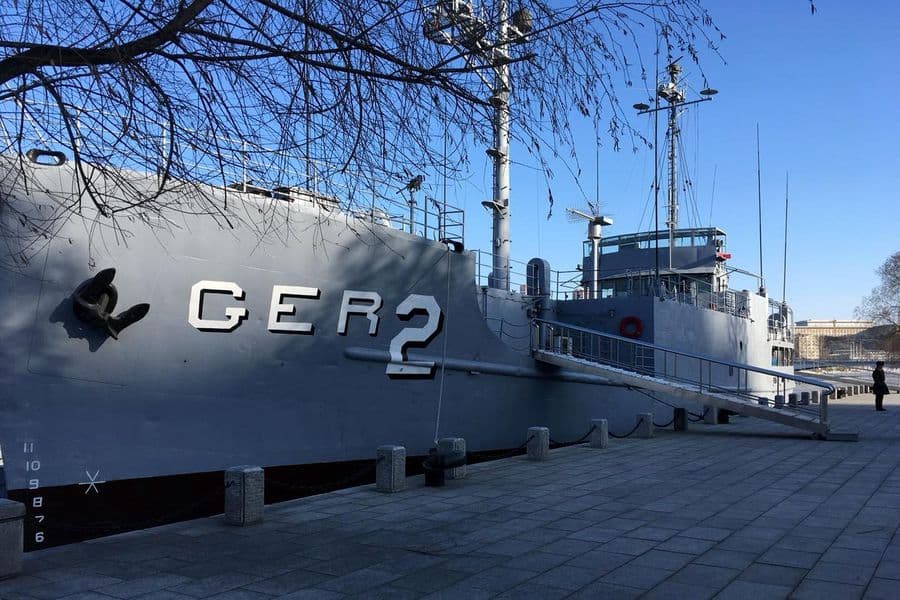
Photo: In this Wednesday, Jan. 24, 2018, photo, a North Korean military security guard keeps watch over the USS Pueblo in Pyongyang, North Korea. The Pueblo, an American spy ship, was attacked and captured by North Korea 50 years ago this week. The iconic spy ship, on display in Pyongyang, is the only commissioned US Navy ship held by a foreign government. (AP Photo/Eric Talmadge)
What the USS Pueblo Incident Can Teach Marines about the LSM (formerly LAW)
Much ink has been spilled over the survivability of the proposed Landing Ship Medium (LSM) in the event of armed conflict with the People’s Republic of China (PRC) in the Pacific. Much less consideration has been given to the potential vulnerability of the LSM during “gray zone” activities—when the LSM is envisioned to be actively involved in shuttling Marine stand-in forces around the theater to complicate PRC intelligence collection and targeting efforts. Here the 1968 case of the USS Pueblo may be instructive, especially in light of the increasing sea-space volatility probable during the LSM’s 20-year service life.
Marine Corps officers advocating that the LSM be a commercial-style ship designed to blend in with commercial ships and to run and hide once the shooting starts would do well to study this long-forgotten incident. Should they choose to do so, they might discover that this cautionary tale has much to teach them. What they might term a relic of the Cold War could help ground their operational concepts and ship design to the harsh realities arising from peer competitor “gray zone” competition.
First, a quick overview for those not familiar with the USS Pueblo incident.
The USS Pueblo, formerly a light cargo ship (FS-344) converted to signals intelligence gathering, was seized off the coast of North Korea on 23 January 1968. The lightly armed ship was located and seized by the combined action of two North Korean fishing trawlers, two SO-1 Soviet-style submarine chasers, four torpedo boats, and two MIG-21 fighters. In the ensuing engagement, Fireman Duane Hodges was killed while destroying classified material, and the remaining 82 sailors, Marines, and civilians were taken captive along with significant amounts of highly classified material. The crew’s imprisonment and brutal treatment became a major international incident increasing Cold War tensions between the United States and Soviet Union. The 11-month ordeal ended after two signed confessions by the Pueblo’s skipper, Lieutenant Commander Lloyd M. Bucher, and a written apology by the US government. The USS Pueblo remains held by North Korea and is located in a canal adjacent to Fatherland Liberation War Museum.
Detailed study of the Pueblo Incident can provide a variety of insights ranging from intelligence gathering to Cold War gray zone operations. Since our interest is ship design as it impacts employment, we’ll confine our points to those areas relevant to the current LSM program. The Navy and Marine Corps want LSMs to be relatively simple and inexpensive ships with the following design features, as cited in the Congressional Research Service report (comparable Pueblo data in parentheses):
- Length of 200 to 400 feet (Pueblo: 177 feet)
- Draft of 12 feet (Pueblo: 9 feet)
- Crew of about 70 sailors (Pueblo: 83)
- Capacity for carrying 50 Marines and 648 short tons (about 579 long tons) of equipment
- Transit speed of 14 knots (Pueblo: 12.7 knots)
- Cruising range of 3,500 nautical miles
- Two 30mm guns and six .50-caliber guns for self-defense (Pueblo: two M2 Browning .50 caliber guns)
- 20-year service life.
Let’s turn now to those characteristics that the envisaged LSM shares with the Pueblo, characteristics that led to its tragic seizure. We begin by considering three interrelated factors relevant to the survivability of single-ship operations in potentially hostile waters: Speed, armament, and signature.
From an operational perspective, speed is relative: it is relative to the speeds of natural elements (storms/tides), friendly forces (naval task forces), and enemy forces.
The Russian built, modified SO-1 class submarine chaser that chased the USS Pueblo down was capable of approximately 20 knots. The Pueblo, capable of only 12.7 knots, was quickly overtaken. And as it became clear that North Koreans intended to seize the ship, it was outmaneuvered. The slow speed of the Pueblo relative to arriving North Korean assets had two fatal consequences: first, the Pueblo was unable to break contact and escape, and second, friendly air support, woefully unprepared, did not have time to respond.
At 14 knots, the envisaged LSM is about as slow as the decades-old Pueblo. It is posited to operate in the First Island Chain in an area that includes many PRC systems capable of greater speed. Chinese Coast Guard vessels sent to patrol contested islands in the South China Sea include the Zhaotou-class patrol cutter and Type 056 corvettes capable of 25 knots. People’s Liberation Army Navy (PLAN) ships range from conventional attack submarines (e.g., Type 39 at 22 knots) to a multitude of submarine chasers (e.g., Type 0371S at 28 knots) and gun boats (e.g., Type 062I at 25 knots).
The inevitable conclusion is that the envisioned LSM’s speed relative to PRC surface and sub-surface ships makes it every bit as vulnerable to seizure as the Pueblo was to North Korean assets over 56 years ago.
Armament provides the means to counter relevant enemy capabilities; it is essential to self-defense. Moreover, it is similar to speed in that it can buy time to break contact or time to enable alert forces to respond.
The Pueblo was armed with two M2 Browning .50 caliber machine guns. Her crew was largely unfamiliar with the weapons. Both guns were secured under canvas in locations exposed to enemy view and fire. In the lead-up to enemy fire and seizure, they were not put into action, in part due to Commander Bucher’s interpretation of higher command’s guidance to avoid provocative actions. (More on this gray zone issue below).
The North Korean SO-1 submarine chasers were armed with 57mm guns and machine guns; the four torpedo boats were armed with machine guns. Commander Bucher, himself wounded in legs by 57mm shell splinters, reported multiple engagement by the 57mm automatic cannon, torpedo boat machine guns, and one missile from a MIG-21.
The LSM is envisaged to have two 30mm guns and six .50 caliber machine guns for armament. While that weapons suite is much more capable than the Pueblo’s and hopefully the crews will be much better trained, it is significantly out-gunned and out-ranged by PRC ships cited above. It is highly probable that any engagement would end quite quickly and as a decisive PRC victory.
We now turn to the issue of signature. Marine advocates have trumpeted that the envisaged LSM would “look like commercial a ship,” implying that it would be difficult to find and track. PRC’s considerable and capable overhead capabilities make that assertion highly questionable.
Further, while beyond the scope of this short paper, the PRC’s Maritime Militia and Fishing Fleet, the world’s largest fishing fleet, has the capability to not only track the very limited numbers of LSMs but to accompany and harass them throughout their deployments. For much greater depth and detail, see Oceana’s “China Fishing Footprint CIMSEC’s “No Ordinary Boats: Cracking the Code on China’s Spratly Maritime Militias”; and the Military Review’s “China’s Maritime Militia and Fishing Fleets: A Primer for Operational Staffs and Tactical Leaders”
Bottom Line: The PRC possesses the capabilities to find, track, neutralize, seize, and/or destroy the envisaged LSM whenever they choose. The assertion that LSMs will be able to operate throughout the theater without Chinese knowledge of their movements is wishful thinking.
The Pueblo Incident provides much-needed context for “grey zone” operations conducted either during Cold War scenarios or in the lead-up to open peer war. Pueblo’s belated and ineffectual response to North Korea’s actions to seize it were the result of several factors: (1) higher command guidance to avoid provoking North Korea, (2) a previously established pattern of North Korean nonviolent harassment, and (3) a similar pattern of nonviolent harassment of sister ship Banner in the Atlantic by the Soviets.
It takes no great effort to imagine US forces either becoming similarly conditioned to harassing behaviors or being constrained by rules of engagement that provide decisive advantages to PRC forces, their many surrogates, or other emergent adversaries. One need only consider the factors and constraints attendant to the multitude of drone attacks on US ships.
Finally, these vulnerabilities make the LSM “easy game’ for any state or non-state actor willing to venture into the Indo-Pacific to create an incident during the LSM’s 20-year life cycle. Recently, the Russian and PRC ships have begun operating together. North Korea is always a wild card, and who can accurately forecast Iranian-sponsored activities in its increasingly volatile nearby sea space?
The LSM, rather than “complicating PRC targeting efforts” might actually act to complicate and constrain joint/naval commanders tasked with providing constant alert and quick response capabilities to protect it. Worse, it may “tether” mobile striking forces to LSM operating areas, creating more sea-space gaps to be exploited by adversaries.
Unlike so many war games, wars don’t just start. The eminent historian Barbara Tuchman once wrote, “History is the unfolding of miscalculations” … a phrase that was later modified to read, “War is the unfolding of miscalculations.”
The LSM as envisaged is a disastrous accident/incident waiting to happen. Rather than being the means by which the Marine Corps may deter future conflict, it is just as likely to precipitate the war we don’t want.
Brigadier General Keith T. Holcomb (USMC, ret.) is a former USMC Fellow at the Center for Strategic and International Studies. His last assignment was as Director of the Training and Education Division, U.S. Marine Corps Combat Development Command.
Captain Carl O. Schuster (U.S. Navy, ret.) is a career naval officer who served on a variety of US and allied warships before transferring to intelligence at mid-career. He has extensive experience as a planner at the amphibious group to theater command level and finished his career as the director of operations at then US Pacific Command’s Joint Intelligence Center.

In Pursuit of Nuclear Abolition
By Peter Huessy • RealClearDefense
Innovation Alone Won’t Prepare the U.S. for the Future Battlefield
By Joshua Segal • RealClearDefense
The sUAS Tactical Trifecta
By Bryan T. Woody • RealClearDefense
The Revolutionary War: When Strategic Options Share the Same Weakness
By Henry Yep • RealClearDefense
The Houthis Are Testing the Limits of Collective Defense
By Saima Afzal • RealClearDefense

Who Shoots Down the Drone Over the Shipyard?
By John Ferrari & Dillon Prochnicki • RealClearDefense
Northrop Grumman Breaks Out the Big Guns at AUSA
By Daniel Terrill, Defense News
Army Pursuing Diverse Array of New Anti-Air Interceptors
By Trevithick, The WarZoneWho Shoots Down the Drone Over the Shipyard?
By John Ferrari & Dillon Prochnicki, RCD
F-35C Lands for the First Time on a Ford-Class Aircraft Carrier
By The Aviationist