
Seeking a New Normal on the Korean Peninsula
Last updated 06:34 AM EDT • Read time: 5m
Trump is right to want to reform the U.S.-ROK Alliance
President Donald Trump recently sent a Truth Social post calling for a significant reduction in U.S.-South Korean military exercises. Trump linked the move to his friendly relationship with North Korean leader Kim Jong Un and Seoul’s refusal to get involved in the Iran war.
Naturally, this was taken as a grave affront by the Washington foreign policy establishment.
It’s unclear whether Trump’s message is intended to convey a new approach to alliances in the Pacific or just express his frustration over the ongoing war in the Persian Gulf. Whatever the case, his remarks are an opportunity to weigh the costs and benefits of an alliance that seems increasingly antiquated and in need of reform.
It wasn’t that long ago when Secretary of Defense Pete Hegseth touted the U.S. military relationship with South Korea as an illustration of successful burden-sharing. Hegseth praised the government of President Lee Jae Myung for raising defense spending and said other U.S. allies and partners in the region need to follow this example. Earlier in 2026, a senior Pentagon official called South Korea a “model ally.”
Advocates of the alliance say it amounts to even more than increased military spending and a shared dedication to deterring North Korean aggression. South Korea excels in certain industrial sectors where the U.S. has recently demonstrated weakness. For example, the country recently purchased a shipyard in Philadelphia with the aim of injecting new dynamism into American ship fabrication, including for naval vessels. And with Taiwan’s prized semiconductor manufacturing under ever-increasing threat from China, South Korea’s own vibrant microchip industry provides a valued reserve capacity.
Despite these possibilities, America also incurs many costs through this relationship. It’s almost certain that North Korea would not be aiming ICBMs at American cities if the alliance didn’t exist. Even a non-nuclear war on the Korean Peninsula would have devastating costs, including heavy losses for American forces, tens of thousands of whom are stationed there.
Thankfully, Pyongyang is already deterred from initiating such a catastrophic war by Seoul’s superiority across nearly all domains of national strength: population size, social cohesion, soft power, economic development, and military technology. These advantages will hold irrespective of any changes to the U.S.-ROK alliance. Meanwhile, the alliance likely costs the American taxpayer $5–6 billion per year, nominally to keep in check a country that’s already deterred.
What about South Korea’s role in the developing U.S.-China strategic rivalry? This complex subject is often addressed crudely by American officials, as when the commander of U.S. Forces Korea stated that as seen from China, South Korea represents a “dagger in the heart of Asia.” Overall, a strong South Korea likely does play some role in curbing Chinese regional ambitions, but Seoul has been wisely leery of getting involved in any prospective Taiwan scenario, a caution Washington would be smart to exercise.
So why did Trump make the statement he did? Trump is likely bitter that none of America’s closest allies, including South Korea, have volunteered to send military forces to open the Strait of Hormuz. Yet it’s difficult to imagine why Seoul (or other U.S. allies) would support such an endeavor when Washington’s war against Iran is so unpopular at home and abroad with little prospect for strategic success.
An optimistic interpretation is that the president is trying to find a way back to his erstwhile role as peacemaker by reenergizing his outreach to North Korea’s leader Kim Jong-un. That would be a welcome initiative, even in the South Korean capital. If Washington can set aside the issue of denuclearization, it could perhaps even hope to relaunch the Six Party Talks with a different focus, for example, prioritizing Arctic shipping, an issue likely to benefit all states in the region as well as the U.S.
Still, there is no way to completely finesse the nuclear issue. Will Seoul ultimately decide to build its own nuclear weapons arsenal? Trump’s latest decree on the Korean issue is certain to underline the arguments of defense analysts in Seoul—which have ample public support—in arguing for just that.
There is a middle passage here for U.S. policy. The U.S. can further reduce its troops based in South Korea, minimizing its costs and risks too. In any case, major U.S. firepower in any scenario would come from naval and air forces anyhow that could quickly be surged into the region similarly to the present Middle East conflict. Yet, the alliance’s basic form can be maintained intact, albeit more narrowly restricted to a more realistic focus on deterring North Korean first use of nuclear weaponry. Such a third way would obviate South Korean nuclear weapons aspirations and thus prevent a destabilizing regional nuclear “cascade” of proliferation.
At the same time, the whole region will benefit from attempts to engage and even “socialize” Pyongyang, so that Kim Jong-un has less incentive to cause disruptions. Trump could yet recoup his desired peacemaker legacy, at least in part, if he succeeds in the long overdue normalization of relations with North Korea.
Lyle Goldstein is director of the Asia Program at Defense Priorities.
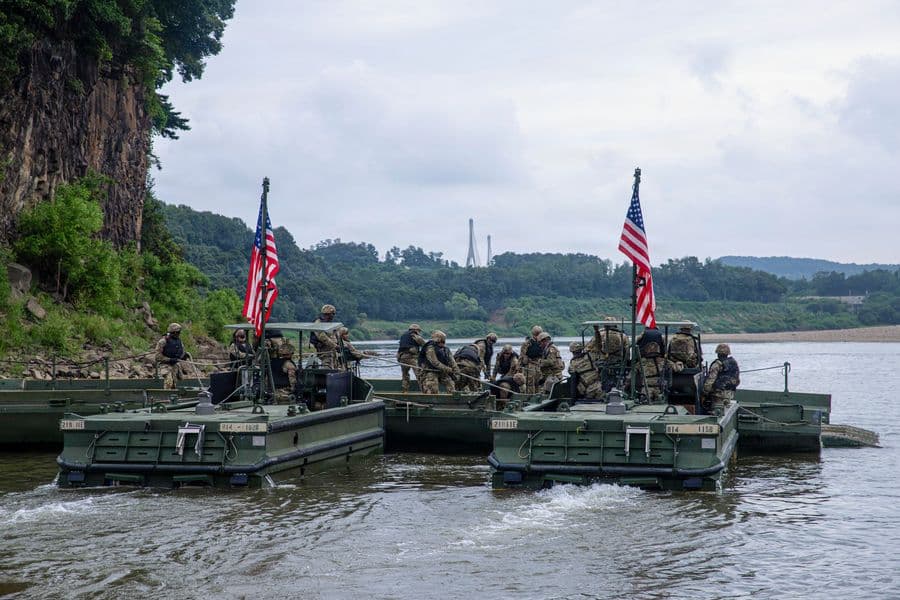
image: U.S. Army Soldiers assigned to 11th Engineer Battalion, 2d Infantry Division/ROK-U.S. Combined Division, attach two Improved Ribbon Bridge sections together during the wet gap crossing exercise near Yeoncheon, South Korea, Aug. 26, 2026. Bridging across complex terrain keeps the force moving, overcoming obstacles to preserve momentum, extend combat power and maintain freedom of maneuver across the battlefield. (U.S. Army photo by KCpl. Seung Pyo Shin)

In Pursuit of Nuclear Abolition
By Peter Huessy • RealClearDefense
Innovation Alone Won’t Prepare the U.S. for the Future Battlefield
By Joshua Segal • RealClearDefense
The sUAS Tactical Trifecta
By Bryan T. Woody • RealClearDefense
The Revolutionary War: When Strategic Options Share the Same Weakness
By Henry Yep • RealClearDefense
The Houthis Are Testing the Limits of Collective Defense
By Saima Afzal • RealClearDefense

Who Shoots Down the Drone Over the Shipyard?
By John Ferrari & Dillon Prochnicki • RealClearDefense
Northrop Grumman Breaks Out the Big Guns at AUSA
By Daniel Terrill, Defense News
Army Pursuing Diverse Array of New Anti-Air Interceptors
By Trevithick, The WarZoneWho Shoots Down the Drone Over the Shipyard?
By John Ferrari & Dillon Prochnicki, RCD
F-35C Lands for the First Time on a Ford-Class Aircraft Carrier
By The Aviationist