
What's Behind Seoul's Olive Branch to Pyongyang?
Last updated 06:22 AM EDT • Read time: 5m
On the 81st anniversary of Korea’s liberation from Japanese colonial rule, South Korean President Lee Jae Myung called for a formal conclusion of the Korean War and peaceful ties between Seoul and Pyongyang. President Lee’s peace offering to Pyongyang is being hailed as a massive step towards regional de-escalation and peaceful coexistence. But the important question: what influenced the South Korean leader to extend an olive Branch to Pyongyang at this point?
Faltering U.S. Security Guarantees
The U.S.-Israel War on Iran has exposed the illusion of U.S. security guarantees to its allies, both in the Middle East and the Indo-Pacific. The GCC states are looking towards Pakistan and Turkey for security and a nuclear umbrella, as demonstrated by the Mecca Agreement and Kuwait’s bilateral Defence Cooperation Agreement with Pakistan. The GCC states are realizing that the American security guarantees failed to protect them from either Iranian retaliation or Israeli expansionist designs.
Like America’s Gulf allies, its Indo-Pacific allies are reaching a similar realization. In order to replenish lost batteries and interceptors during the Middle East War, the Trump administration moved its Terminal High Altitude Area Defense (THAAD) system from the Korean Peninsula to the Middle East. It also relocated thousands of Marines and the USS Tripoli, an amphibious assault ship previously based in Japan, to the Middle East, demonstrating its preference for Israel’s defense over its Indo-Pacific allies.
Rising Uncertainty in South Korea
South Korea has been historically dependent on the U.S.-ROK alliance for its security protection since the Korean War. Seoul’s concern about North Korea is amplified under Trump’s unpredictable era i.e., whether the U.S. is going to defend South Korea militarily and politically during a major crisis. This uncertainty becomes evident when North Korea is advancing its nuclear capabilities, and U.S.-China rivalry is reshaping South Korea’s position in the emerging security architecture of the region.
Under such uncertainty, the diversion of force posture has heightened concerns among the Indo-Pacific allies, especially South Korea. Seoul’s concerns are growing due to American indifference towards its Indo-Pacific commitments and the unreliability of American security assurances. The America First Doctrine of President Trump is resulting in Seoul looking for alternative mechanisms to protect its security. South Korea is grappling with the reality that the Trump administration may not prioritize Seoul’s defense in case of a confrontation with either North Korea or China.
South Korea’s deterrence architecture relies on American extended deterrence and U.S. forces on the peninsula. Trump’s recent decision to cancel joint military exercises and the deployment of THAAD missiles to the Middle East raises questions about the credibility of the alliance commitments. Washington views the U.S.-ROK alliance as an Indo-Pacific framework rather than an alliance to deter North Korea, giving rise to a strategic dilemma. Seoul is entrapped in U.S.-China strategic rivalry; it is expected to support the U.S. against China while being ambiguous about its security against North Korea.
U.S. National Defense Strategy and Indo-Pacific Retrenchment
The Trump administration’s National Defense Strategy released earlier this year indicates the pursuit of selective retrenchment in the Indo-Pacific. President Trump’s rhetoric of increased burden sharing by its allies has created concerns among U.S. allies who perceive this policy as American abandonment of its allies, leaving them at the whim of China’s expanding sphere of influence. The National Defense Strategy clearly outlines the replacement of conflict with China in the Indo-Pacific with economic competition for a greater share in the global value chains.
Trump’s reliance on tariffs depicts the same approach to coerce its biggest competitor – China – through economic strangulation rather than direct military confrontation. However, this policy of economic competition and tariffs leaves American Indo-Pacific allies exposed to China’s growing economic prowess and military might. U.S. Indo-Pacific allies are forced to seek intra-regional cooperation or reconciliation with China and its allies, including North Korea. QUAD members are vying to fill the growing vacuum by enhancing cooperation among themselves, as illustrated by the Japan-Australia military deal and the Modi-Takaichi Summit. In this transitioning strategic environment, South Korea also needs to make a choice: either follow Japan’s assertive path or Taiwan’s reconciliatory path.
Seoul Follows Taiwan’s Reconciliation Path
Although Seoul and Taiwan operate in different security environments, both face the same challenge of intensifying U.S.-China rivalry. For Seoul, it has become necessary to balance relations with the United States and emphasize diplomatic engagement with North Korea and China.
Despite having a security relationship with the U.S., Taiwan cannot escape the strategic dilemma posed by China. The escalating regional tensions have reinforced the importance of diplomatic dialogue, cross-strait relations, and restraint. Taiwan’s opposition leader, the Kuomintang’s leader Cheng Li-Wun, visited China for six days, describing it as a “journey of peace.” The visit highlighted the importance of dialogue and management of cross-Strait differences. Taiwan’s reconciliation path emphasizes the concept of strategic balancing and the importance of peace dialogue.
For Seoul, it is high time to limit its reliance on an external security guarantor and prefer diplomatic dialogues to deal with immediate neighborhood threats. America’s uncertain alliance commitments in the Korean Peninsula create an opportunity for Seoul to follow Taiwan’s conciliatory path and seek diplomatic outreach with North Korea. By extending an olive branch to Pyongyang, Seoul is diversifying its strategic options in an uncertain Indo-Pacific environment.
Hamza Zaman holds an M.Phil. degree in International Relations from Quaid-i-Azam University, Islamabad, Pakistan. He works as an Assistant Research Associate at the Islamabad Policy Research Institute, Pakistan.
Syeda Aimen Riaz holds a degree in International Relations from Quaid-i-Azam University, Islamabad. Her research interests include geopolitics, regional security and energy security, with a particular focus on the Indo-Pacific region.
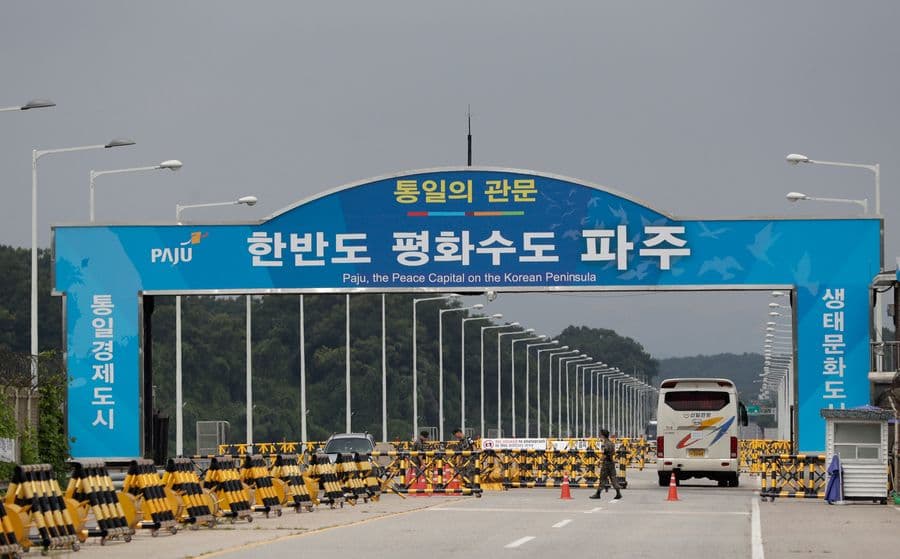
image: South Korean soldiers walk at the Unification Bridge, which leads to the Panmunjom in the Demilitarized Zone (DMZ), in Paju, South Korea, Sunday, June 30, 2019. U.S. President Donald Trump said Sunday he believes North Korean leader Kim Jong Un wants to meet for a handshake at the DMZ separating the North and South, a day after issuing the unprecedented invitation and expressing willingness to cross the border for what would be a history-making photo op. (AP Photo/Lee Jin-man)

In Pursuit of Nuclear Abolition
By Peter Huessy • RealClearDefense
Innovation Alone Won’t Prepare the U.S. for the Future Battlefield
By Joshua Segal • RealClearDefense
The sUAS Tactical Trifecta
By Bryan T. Woody • RealClearDefense
The Revolutionary War: When Strategic Options Share the Same Weakness
By Henry Yep • RealClearDefense
The Houthis Are Testing the Limits of Collective Defense
By Saima Afzal • RealClearDefense

Who Shoots Down the Drone Over the Shipyard?
By John Ferrari & Dillon Prochnicki • RealClearDefense
Northrop Grumman Breaks Out the Big Guns at AUSA
By Daniel Terrill, Defense News
Army Pursuing Diverse Array of New Anti-Air Interceptors
By Trevithick, The WarZoneWho Shoots Down the Drone Over the Shipyard?
By John Ferrari & Dillon Prochnicki, RCD
F-35C Lands for the First Time on a Ford-Class Aircraft Carrier
By The Aviationist