
Belarus as Russia's Spear
Multiple Threat Vectors to NATO and Europe
Last updated 06:26 AM EDT • Read time: 11m
Multiple Threat Vectors to NATO and Europe
Introduction
Belarus ceased to be an independent vector of regional security long ago. Formally, this process began on 8 December 1999 with the signing of the Union State Treaty, and later intensified through subsequent integration phases, including the 2021 package of 28 road maps. In practice, it concluded after the political crisis of 2020, when Russian influence over Belarus’s security institutions, foreign‑policy decision‑making, and information environment became decisive. From that moment, Belarus has functioned not as an autonomous actor, but as an integrated component of Russia’s state‑military system.
This transformation has direct implications for Europe’s security. The Kaliningrad region, despite its strategic role, remains an enclave with constrained logistics and vulnerable infrastructure. Belarus, by contrast, provides Russia with territory free of such limitations: space for force deployment, operational activity, expanded intelligence collection, and the creation of pressure points against Poland and Lithuania.
This is precisely why the previous article, “Russia’s Phantom Pains of the Soviet Empire as a Source of Systemic Threats to the West” (Real Clear Defense, August 21, 2026), did not examine Belarus as a separate region. It is no longer an autonomous unit of analysis. Its role is different: it has become a platform through which Russia shapes military activity, manages escalation, and generates new threat scenarios along NATO’s eastern flank.
This article focuses on those scenarios — the ones made possible by Belarus’s full integration into Russia’s strategic architecture.
Chapter 1. Comprehensive Absorption
Belarus represents a unique post‑Soviet case: its political trajectory after 1994 and the framework of the Union State led to the loss of strategic autonomy. Following the signing of the Union State Treaty, Belarus began gradually losing independence across key sectors — from defense to information policy. By the early 2000s, joint governance bodies had already been established, including the Permanent Committee of the Union State, along with mechanisms for coordinating security institutions.
Russia’s Political and Security Control over Belarus
After the 2020 crisis, Moscow gained direct access to Belarus’s security structures. This manifested in the coordination of operations between the Belarusian KGB and Russia’s FSB, including the exchange of operational information on Ukraine, Poland, and Lithuania; in the presence of Russian advisors within Belarus’s Ministry of Internal Affairs who worked on protest‑control measures; in the transition of Belarus’s armed forces to Russian standards of planning and operational command; and in the presence of Russian instructors working with special‑operations units and air‑defense forces. This is not an abstract form of integration, but the practical incorporation of Belarus’s security institutions into Russia’s vertical chain of control.
Military Infrastructure and Operational Integration
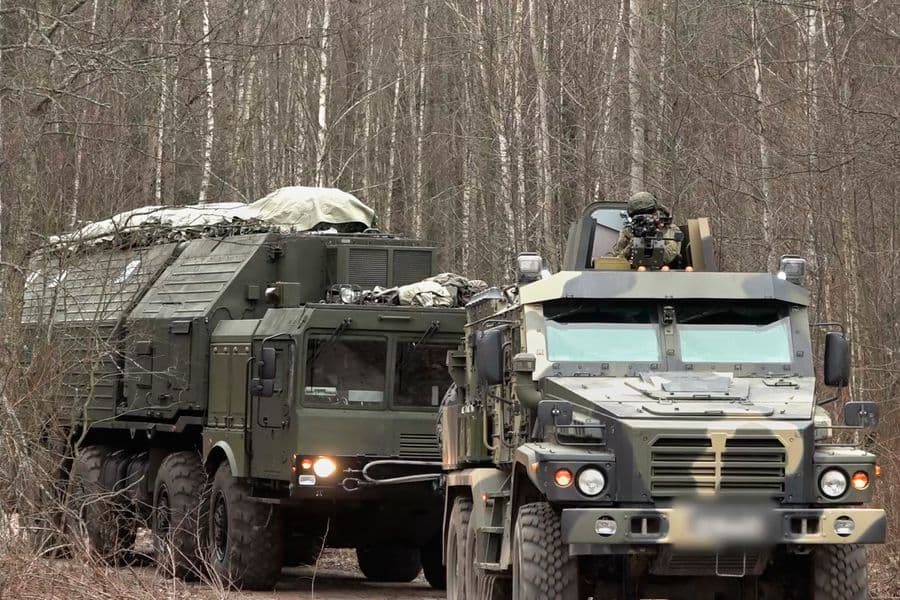
Belarus’s security architecture is fully embedded in Russia’s military system. The “Zapad” exercises (2009, 2013, 2017, 2021) consistently rehearsed offensive actions against Poland and Lithuania. The airfields in Lida, Baranovichi, and Machulishchi were modernized for Russian Su‑30SM and Su‑34 aircraft, as well as Mi‑8AMTSh helicopters. Belarus’s air‑defense network is integrated into Russia’s detection and command system, including joint control of facilities and real‑time data exchange. Russian Iskander‑M missile systems are deployed in Belarus and are capable of striking NATO targets. Tactical nuclear weapons have been stationed at the Osipovichi base, creating Russia’s first nuclear forward position on the western axis. Belarus has become territory from which Russia can conduct operations without political constraints.
Economic Dependence as an Instrument of Control
Belarus’s economic dependence on Russia has concrete, measurable parameters. Annual oil‑and‑gas subsidies amount to four to five billion dollars in concealed support through preferential pricing. The total debt owed to Russia and the Eurasian Development Bank exceeds eight billion dollars, with a significant portion formed through Russian state loans provided to stabilize the budget and refinance previous obligations. These loans not only sustain Minsk’s solvency but also create a debt architecture that makes Belarus vulnerable to financial pressure from Moscow. More than forty percent of Belarusian exports go to Russia, and over fifty percent of critically important goods are imported from Russia. Major enterprises — BelAZ, MAZ, Grodno Azot, and Naftan — cannot survive without the Russian market and contribute to equipping the Russian military with transport platforms for weapons and components used in the production of dual‑use materials. Belarus’s economic dependence on Russia has a stable systemic character and produces a condition of de facto non‑autonomy.
Information Integration
Belarus is fully embedded in Russia’s information space. Russian television channels are broadcast without restrictions, Belarusian state media use Russian methodological materials, joint information campaigns are conducted against Poland and Lithuania, and narratives on Ukraine, NATO, and the EU are unified. Belarus does not produce its own foreign‑policy worldview — it transmits Russia’s.
Chapter 2. Scenarios of Probing NATO on the Eastern Flank
Belarus is no longer a buffer; it has become an operational segment of Russia’s military system. The integration of the two states’ armed forces, the deployment of Russian missile systems, the expansion of surveillance infrastructure, and increased activity in border areas create conditions under which actions originating from Belarusian territory form part of Russia’s strategy of pressure against NATO. Probing is a key element of this strategy: Russia tests the limits of tolerance, observes the reaction, and establishes a new normal of threat activity. Presented below are five scenarios based on factual data and Russian practices already observed in other regions.
Scenario 1: Airspace Probing Along NATO’s Borders
Systematic approaches by Russian and Belarusian aircraft to the borders of Polish and Lithuanian airspace create a persistent state of tension. In the Baltic region, such episodes have been recorded repeatedly: Russian aircraft flew without activated transponders and approached NATO airspace, forcing NATO to scramble fighters for interception. Transferring this model to the Belarusian axis would generate constant pressure on NATO air‑defense forces, increase the number of intercepts, and reduce reaction time. This raises the probability of an incident arising not from intent, but from navigational error or misjudgment of distance.
Scenario 2: Deployment of Intelligence and Surveillance Assets
Belarus provides Russia with the opportunity to deploy additional radiotechnical and electro‑optical surveillance systems oriented toward Polish and Lithuanian territory. This does not require an incursion and does not violate international norms, but it creates a continuous monitoring regime over NATO infrastructure, troop movements, and logistical routes. The establishment of a persistent surveillance system alters the strategic environment on NATO’s eastern flank, creating an asymmetric advantage in data collection and improving the quality of Russia’s operational preparation.
Scenario 3: Gradual Entrenchment of Russian Forces in Belarus
The growing presence of Russian contingents under the guise of exercises, rotations, and joint training creates a model in which temporary deployments evolve into permanent basing. Russia has already used this practice in other regions, where “exercises” became a mechanism for force entrenchment. For NATO, this alters the balance of forces: Belarus ceases to be an autonomous actor and becomes a platform for hosting Russian units capable of operating in immediate proximity to the Polish and Lithuanian borders. This increases the density of military activity and generates additional pressure on NATO infrastructure.
Scenario 4: Demonstrative Missile Drills Using the 9M723 Oreshnik
The deployment of Russian 9K720 Iskander‑M operational‑tactical missile systems in Belarus creates the possibility of demonstrative missile drills conducted in close proximity to NATO’s borders. The key risk factor is the 9M723 Oreshnik missile, a modification of the system’s baseline munition.
The missile has a range of up to five hundred kilometers and uses a combined guidance system that includes an inertial navigation unit with satellite‑data correction. However, its practical accuracy has proven significantly lower. By Putin’s own admission, three launches of the 9M723 Oreshnik against Ukraine failed to reach their intended targets and instead struck secondary civilian structures. This public acknowledgment of limited accuracy creates an opportunity for Russia to attribute future incidents to technical deviations, complicating assessments of intent during a crisis. This episode demonstrates the gap between the system’s propagandistic, declared characteristics and the actual results of combat employment.
Technical compatibility of the munition means that Belarus is capable of employing the full spectrum of missiles within the 9K720 Iskander‑M system, including the 9M723 Oreshnik modification. Given the missile’s real‑world accuracy, even demonstrative training launches carry the risk of trajectory deviation and unintended border crossing. For Poland, this risk is higher than for Lithuania: the minimum launch distance makes the Lithuanian axis less suitable for training shots, as in several areas the distance to Lithuanian territory is below the threshold required to form an optimal ballistic trajectory. The emergence of such an incident — even without striking significant targets — would be viewed by NATO as the use of missile weapons in close proximity to its territory and would create a zone of strategic uncertainty.
Scenario 5: Increased Electronic Warfare Activity in Border Areas
Russia has already employed electronic‑warfare systems to disrupt navigation and communications in regions where NATO forces are present: GPS interference linked to Russian EW systems has been recorded in the Baltic region, the Arctic, Norway, and Finland. Transferring this practice to the Belarusian axis creates the risk of impacting civilian aircraft navigation and air‑traffic‑management systems in Polish and Lithuanian airports. This becomes not only a technical issue but a political one: any disruption of navigation near NATO’s borders will be interpreted as a deliberate action requiring a response. For the United States, this introduces a new level of threat associated with the potential destabilization of civilian infrastructure without formally crossing the border.
Scenario 6: Broad‑Spectrum Migration Pressure on Pan‑European Stability
Belarus retains the capability to destabilize Western Europe through controlled migration flows used as an instrument of pressure against NATO and the EU. The events of the 2021 migration crisis — and subsequent incidents — demonstrated that Minsk can organize irregular migrant routes and create artificial entry points into Poland and Lithuania. The recent discovery of another underground tunnel on Polish territory shows that this practice is not an isolated episode but a persistent mechanism of hybrid activity that can be reactivated at any time.
Migration pressure generates a multi‑layered threat environment. For NATO, it forces a reallocation of resources toward reinforced border security, reducing readiness on other operational axes and imposing additional strain on rapid‑response elements. For the EU, the consequences manifest as increased social tension, localized protests, episodes of inter‑ethnic friction, and political fragmentation among member states. These crises erode internal consensus, complicate decision‑making, and reduce the Union’s ability to maintain a unified posture toward Russia.
This vector does not require overt military activity to produce strategic effects. By enabling irregular flows through Belarusian territory, Russia gains an indirect but effective tool for shaping the operational environment on NATO’s eastern flank. The resulting instability forces Western institutions to respond to a crisis initiated not by Russia’s direct actions, but by an allied state operating within an integrated system of coordination.
Conclusion
Belarus remains territory on which Russia’s military activity gains expanded operational latitude. The integration of security institutions, the deployment of missile systems, the modernization of airfields, the establishment of joint surveillance systems, and the conduct of combined exercises create a stable operational environment in which actions originating from Belarusian territory become part of Russia’s practice of exerting pressure on NATO’s eastern flank. The scenarios examined demonstrate that this environment can generate risks arising not only from military‑technical factors and geographic conditions, but also from hybrid instruments that exploit social and political vulnerabilities within NATO and the EU.
Against this backdrop, a factor emerges that previously held no strategic significance: the political behavior of Aleksandr Lukashenko. His attempts to establish contact with the West through the release of detainees, including an expectation of personal engagement with Donald Trump, indicate an effort to create an alternative channel of external legitimization. These steps have not altered Belarus’s structural dependence on Russia, but they have revealed the presence of Minsk’s own interests, which may come into conflict with Russia’s plans.
This political line continues in his recent statements. While remaining Putin’s closest ally, Lukashenko has begun speaking critically about the war in Ukraine, questioning both its necessity and the rationale for its initiation. Such a rhetorical shift creates conditions under which the positions of Minsk and Moscow may diverge. At this point, an additional risk emerges: any signs of instability in the relationship between the two allied states could push Moscow toward hard decisions regarding the Lukashenko regime, including taking control of strategically significant facilities in Belarus, followed by internal and external escalation. Against the backdrop of deep integration, any events occurring on Belarusian territory continue to be perceived as elements of Russia’s strategy, even when their political origin lies in Minsk.
Thus, Belarus generates a new type of risk for NATO’s eastern flank. It arises from the combination of Russia’s operational activity and Belarus’s political dynamics, which do not always align with Russia’s interests. As a result, an environment emerges in which the development of threats may follow different lines: from Russian activity to initiatives originating in Minsk, from technical deviations in weapon performance to episodes arising amid the political maneuvering of Belarus’s leadership. For the United States and NATO, this means the need to account not only for Russia’s strategy, but also for the possibility of unsynchronized impulses from Belarus’s leadership occurring within an already integrated military system.
Sergey E. Ivashchenko is a strategic analyst working at the intersection of escalation dynamics, information strategy, and long‑range strategic forecasting.

Innovation Alone Won’t Prepare the U.S. for the Future Battlefield
By Joshua Segal • RealClearDefense
The sUAS Tactical Trifecta
By Bryan T. Woody • RealClearDefense
The Revolutionary War: When Strategic Options Share the Same Weakness
By Henry Yep • RealClearDefense
The Houthis Are Testing the Limits of Collective Defense
By Saima Afzal • RealClearDefense
Radio Frequencies in the Intelligence Ecosystem
By Craig Brower • RealClearDefense

Who Shoots Down the Drone Over the Shipyard?
By John Ferrari & Dillon Prochnicki • RealClearDefense
Northrop Grumman Breaks Out the Big Guns at AUSA
By Daniel Terrill, Defense News
Army Pursuing Diverse Array of New Anti-Air Interceptors
By Trevithick, The WarZoneWho Shoots Down the Drone Over the Shipyard?
By John Ferrari & Dillon Prochnicki, RCD
F-35C Lands for the First Time on a Ford-Class Aircraft Carrier
By The Aviationist