
The Adversary Across the Table
Last updated 06:55 AM EDT • Read time: 12m
What decades in the field taught me about trust, judgment, and the risks of engagement
The first Russians I ever met were supposed to be my adversaries.
I was fifteen years old when I climbed the gangway of a Soviet merchant vessel tied up at a New York pier. The Soviet Union was suffering from a grain shortage, and American grain was being loaded aboard Soviet ships for transport home. My father worked for the company responsible for helping manage the arrival and departure of those vessels, and from time to time I accompanied him.
Once aboard, he quietly explained that one of the senior officers was probably connected to the KGB, there in part to make sure none of the crew defected while the vessel was in an American port. This was the Cold War. These people were the enemy.
And yet, sitting in the captain's stateroom with Soviet officers, listening to unfamiliar Russian words and being offered a small glass of vodka, I remember thinking something remarkably simple: they seemed normal.
They were friendly. They laughed. They looked different from one another—some fair-haired and light-skinned, others darker—which prompted my father to explain that the Soviet Union contained many nationalities and peoples. They were communists. Their government was America's principal geopolitical adversary. But the people sitting across the table from me did not seem particularly frightening.
A few years later, I encountered another side of the Soviet Union. As a midshipman and later a naval officer, I watched Soviet ships and intelligence-gathering trawlers operating at sea. There were occasions when American and Soviet vessels maneuvered uncomfortably close to one another, playing a dangerous form of maritime cat and mouse in which a miscalculation could have had serious consequences.
The Soviets were no abstraction then. They were capable, global, and potentially dangerous adversaries. Both impressions stayed with me because both were true.
An adversary can be dangerous without being inhuman.
I did not recognize it at the time, but that distinction would matter throughout much of my professional life.
Over the decades that followed, as an FBI special agent, Legal Attaché, law enforcement advisor and later an international security official, I worked in very different places and circumstances—with criminals and corrupt officials, intelligence officers and police investigators, diplomats and border guards, and representatives of governments whose interests often differed sharply from our own.
There was no single lesson in how to deal with them. If anything, I gradually learned that there couldn't be. The difficult part was not deciding whether to talk to an adversary. It was deciding whom to talk to, when to talk, what to say, what not to say, when to listen, when to take a risk, and when distrust itself had become an obstacle to accomplishing the mission.
Those judgments came slowly. I learned some things by getting them right and undoubtedly others by getting them wrong. I learned by watching people, occasionally misreading them, and sometimes being surprised by them. I learned while working alone, when there was no supervisor standing beside me and no policy manual capable of providing the answer. And sometimes, admittedly, I was lucky.
Years after those first encounters with Soviet sailors, I found myself investigating the theft of diamonds, gold, and other valuables from the Russian government in a case centered in California.
The Soviet Union had collapsed, but functioning relationships between American and Russian law enforcement institutions had barely begun to develop. The FBI had little experience working major criminal investigations jointly with Russian authorities. My own supervisor in San Jose was skeptical. Everyone in Russia was corrupt, he essentially told me. I would never find anyone there to work with. Why waste my time?
He was hardly alone in holding that view. The investigation eventually led me to make contact with an official at the Russian Consulate in San Francisco—a representative of the SVR, Russia's foreign intelligence service, and successor to part of the former KGB apparatus. From the perspective of some within the FBI, this was precisely the person I should not have been talking to. The counterintelligence side of the Bureau objected strongly and wanted the contact stopped.
Their concerns were not irrational. Intelligence officers are trained to recruit, manipulate, and deceive. The institutional caution was understandable. But from my perspective as the case agent, the problem was more immediate.
Russian government property appeared to be disappearing from Russia and showing up in California. If I was ever going to establish what had been stolen, who owned it and how it had left the country, I eventually had to communicate with someone on the Russian side.
So, I continued—not because I trusted Russian intelligence. I didn't. I continued because the investigation required something more complicated than either trust or distrust. It required judgment.
Then luck intervened. A former FBI colleague who had trained Russian police officers happened to know an investigator working the Golden ADA case in Moscow. A connection was made. A newly established FBI Legal Attaché office in Moscow became involved. Eventually, Russian investigators pursuing the same criminal organization traveled to San Francisco.
Suddenly, a theoretical question about cooperation with Russia became a very practical one. The Russian investigators were sitting across the table from us, and we faced another decision: How much should we show them?
The cautious approach would have been understandable: protect our investigative information, reveal little, ask questions, obtain whatever the Russians were willing to provide and send them home.
Instead, we opened our files.
Not indiscriminately. Not because we had suddenly decided the Russians were trustworthy. And certainly not because decades of institutional suspicion had vanished. It was a calculated risk. But somebody had to take the first one.
The Russians responded. Face-to-face conversations became professional cooperation. Information began moving in both directions. Over time, something resembling trust developed—not trust between governments or institutions, but trust among individual investigators pursuing the same criminals. We discovered that despite having grown up and worked inside completely different political and legal systems, we understood one another surprisingly well.
We were cops working a case. That common professional identity did not erase our differences. Nor did it guarantee that every Russian official we encountered was honest or that cooperation would succeed. It created something much narrower: a space in which two sides with reasons to distrust one another could nevertheless work together.
That was enough.
There was another lesson buried inside that investigation. Talking to an adversary does not always mean doing much talking.
At one point, I met privately with a senior San Francisco police official whom I had reason to distrust and who had connections to the company at the center of our investigation. I could have confronted him. I could have tried to demonstrate how much I knew. I could have asked clever questions designed to trap an experienced detective.
Instead, I listened.
Experienced investigators eventually learn that winning a conversation is usually irrelevant. People reveal things when they talk. They reveal what concerns them, what they avoid, what they exaggerate and sometimes what they desperately want you to believe. There are moments when it is useful to be underestimated. Ego gets in the way of that. Understanding another person requires patience, observation and occasionally the discipline to remain silent.
Years later, working in Central Asia, I encountered a different version of the same problem. Along the Tajik-Afghan border, I visited cross-border markets where communities separated by an international frontier were permitted to meet and trade.
The Tajik and Afghan border officials responsible for those markets did not necessarily trust one another. They had good reasons not to. Afghanistan was unstable. Narcotics moved through the region. Weapons trafficking, terrorism and human trafficking were persistent concerns. The same markets intended to bring communities together could potentially be exploited by criminals or extremists.
Yet the markets operated. The officials on both sides had accepted something that can be difficult for governments—and individuals—to accept: eliminating all risk was impossible.
Closing the border carried consequences. Opening it without controls carried different ones. So, they found a space between the two. They cooperated cautiously. They watched. They adjusted. They accepted a degree of uncertainty because ordinary people living along the border needed to exchange goods, maintain relationships, and carry on with their lives.
Watching those markets function changed my thinking. We often assume that trust must come before cooperation.
Sometimes it doesn't.
Sometimes limited cooperation begins precisely because trust is absent.
While heading border-security programs for the Organization for Security and Co-operation in Europe, I saw the principle at work again. After the Taliban returned to power in Afghanistan, Uzbek authorities confronted a difficult problem along their border. They had profound security concerns about developments inside Afghanistan. At the same time, humanitarian goods needed to move, legitimate commerce mattered and communities could not simply be sealed away from one another indefinitely.
Absolute trust was impossible. Absolute isolation was impractical. The answer lay somewhere between them.
Uzbek authorities developed controlled mechanisms for cross-border activity. We helped with technical equipment and specialized training designed to identify foreign terrorist fighters, traffickers and others who might attempt to exploit legitimate crossings. The objective was not to eliminate risk. It was to understand it, reduce it and manage what remained.
By then, the lesson that had begun aboard a Soviet ship decades earlier had become clearer to me.
Dealing effectively with an adversary is not an act of goodwill. It is a professional skill. It requires knowledge and preparation. Cultural understanding matters. Language matters. History matters. So do patience, skepticism and humility.
One has to understand the other side without romanticizing it; recognize deception without assuming that everything is a lie; protect one's own interests without becoming incapable of recognizing where interests overlap. And one has to become comfortable with something institutions often dislike intensely: uncertainty.
There is rarely enough information. Motives are seldom completely clear. Trust is almost never absolute. At some point, someone has to make a judgment.
Sometimes that judgment will be wrong. That possibility cannot be engineered out of human interaction. Experience can improve judgment, but it cannot eliminate risk. Nor can intelligence, technology or bureaucracy substitute entirely for the individual sitting across a table deciding whether the person opposite him is someone with whom limited business can be done.
That is why talking to adversaries is easy to advocate and extraordinarily difficult to do well.
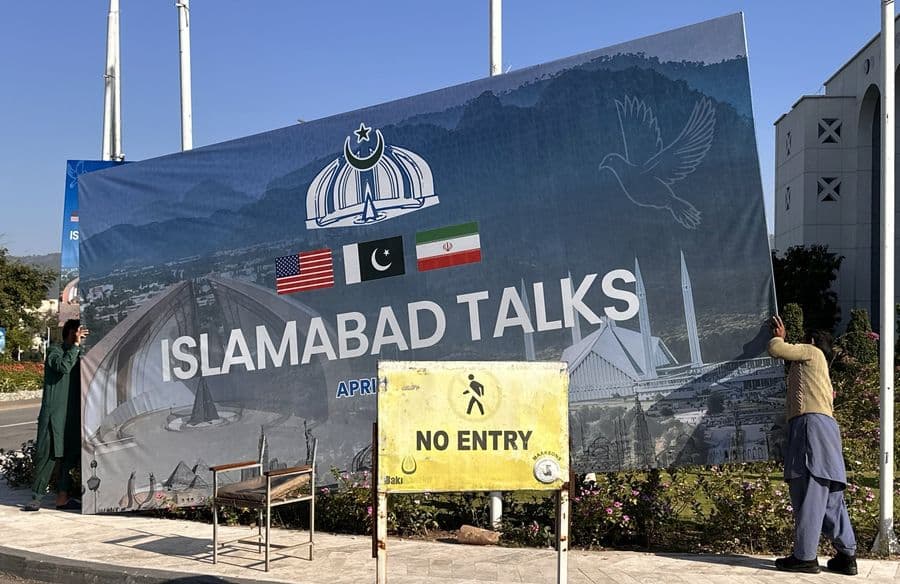
The distinction matters today. The wars involving Russia and Ukraine, and Iran and the United States, have again raised questions about whether governments should communicate with adversaries whose actions they find unacceptable.
The answer is not simply that they should “talk.” Talking by itself accomplishes little.
The harder question is whether governments retain the knowledge, experience, channels and people capable of engaging adversaries without either demonizing them or being deceived by them.
Washington does not need to trust Moscow to communicate with it. Nor does communication require accepting Russia's actions in Ukraine or abandoning support for Ukraine. The same applies to Iran. The United States does not need to trust Tehran, minimize the threat it poses or overlook the dangers to American forces and commercial shipping in and around the Persian Gulf in order to maintain channels of communication.
If anything, danger increases the premium on judgment.
I learned something about that long ago at sea. Ships operating in confined or contested waters cannot simply refuse to communicate because the vessel approaching belongs to an adversary. Course, speed and intentions still matter. A misunderstood maneuver can become a collision. A misinterpreted action between military forces can become something considerably worse.
The Strait of Hormuz remains an unforgiving example. I navigated those waters as a young merchant marine officer decades ago. They remain among the most strategically consequential in the world. Governments may threaten one another. Military forces may confront one another. Diplomats may fail repeatedly. But geography does not change because governments stop talking, and neither does the danger.
Ukraine presents a different version of the problem. Wars ultimately produce questions that military power alone cannot answer: prisoners, civilians, borders, security arrangements, movement, commerce and eventually the conditions under which people on opposite sides of a conflict must somehow coexist.
Communication guarantees none of those outcomes. An adversary may lie. He may manipulate. He may exploit negotiations to gain time. He may interpret restraint as weakness. And sometimes engagement simply fails.
Knowing those things is not an argument against communication. It is part of knowing how to communicate.
The object is not necessarily to make an adversary a friend. It is not even necessarily to create trust. Sometimes success means understanding him better. Sometimes it means discovering a narrow area where interests coincide. Sometimes it means preventing a misunderstanding. Sometimes it means learning that cooperation is impossible. And occasionally, one side takes a calculated risk, the other responds, and something neither expected becomes possible.
I experienced each of those outcomes at different times and in very different places. Experience did not provide a formula. What it provided was judgment—the kind acquired slowly, by listening, watching, making mistakes, questioning one's own assumptions and learning to live with uncertainty. There is no shortcut to acquiring it. One has to travel that road.
There was no formula. There still isn't. There is rarely enough information. Motives are seldom completely clear. Trust is almost never absolute. Eventually, one may find oneself sitting across the table from an adversary, with no policy manual capable of providing the answer and no way of knowing with certainty what will happen next.
At some point, someone has to make a judgment—and make the first move.
Dennis T. Cosgrove is a former FBI Special Agent and Legal Attaché, and former Head of the Border Security and Management Unit at the Organization for Security and Co-operation in Europe in Vienna. He worked extensively in Central Asia, the former Soviet Union, and the Balkans in a variety of law enforcement, diplomatic, and international security roles, including numerous assignments with U.S. Embassies overseas. He writes on geopolitics, transnational threats and strategic affairs, and is the author of two published books with a third currently in progress.
image: Marine Two, with Vice President JD Vance aboard, arrives, Friday, April 10, 2026, at Joint Base Andrews, Md., where Vance will board Air Force Two, seal right, and departure to Pakistan, for talks on Iran. (AP Photo/Jacquelyn Martin, pool)

In Pursuit of Nuclear Abolition
By Peter Huessy • RealClearDefense
Innovation Alone Won’t Prepare the U.S. for the Future Battlefield
By Joshua Segal • RealClearDefense
The sUAS Tactical Trifecta
By Bryan T. Woody • RealClearDefense
The Revolutionary War: When Strategic Options Share the Same Weakness
By Henry Yep • RealClearDefense
The Houthis Are Testing the Limits of Collective Defense
By Saima Afzal • RealClearDefense

Who Shoots Down the Drone Over the Shipyard?
By John Ferrari & Dillon Prochnicki • RealClearDefense
Northrop Grumman Breaks Out the Big Guns at AUSA
By Daniel Terrill, Defense News
Army Pursuing Diverse Array of New Anti-Air Interceptors
By Trevithick, The WarZoneWho Shoots Down the Drone Over the Shipyard?
By John Ferrari & Dillon Prochnicki, RCD
F-35C Lands for the First Time on a Ford-Class Aircraft Carrier
By The Aviationist