
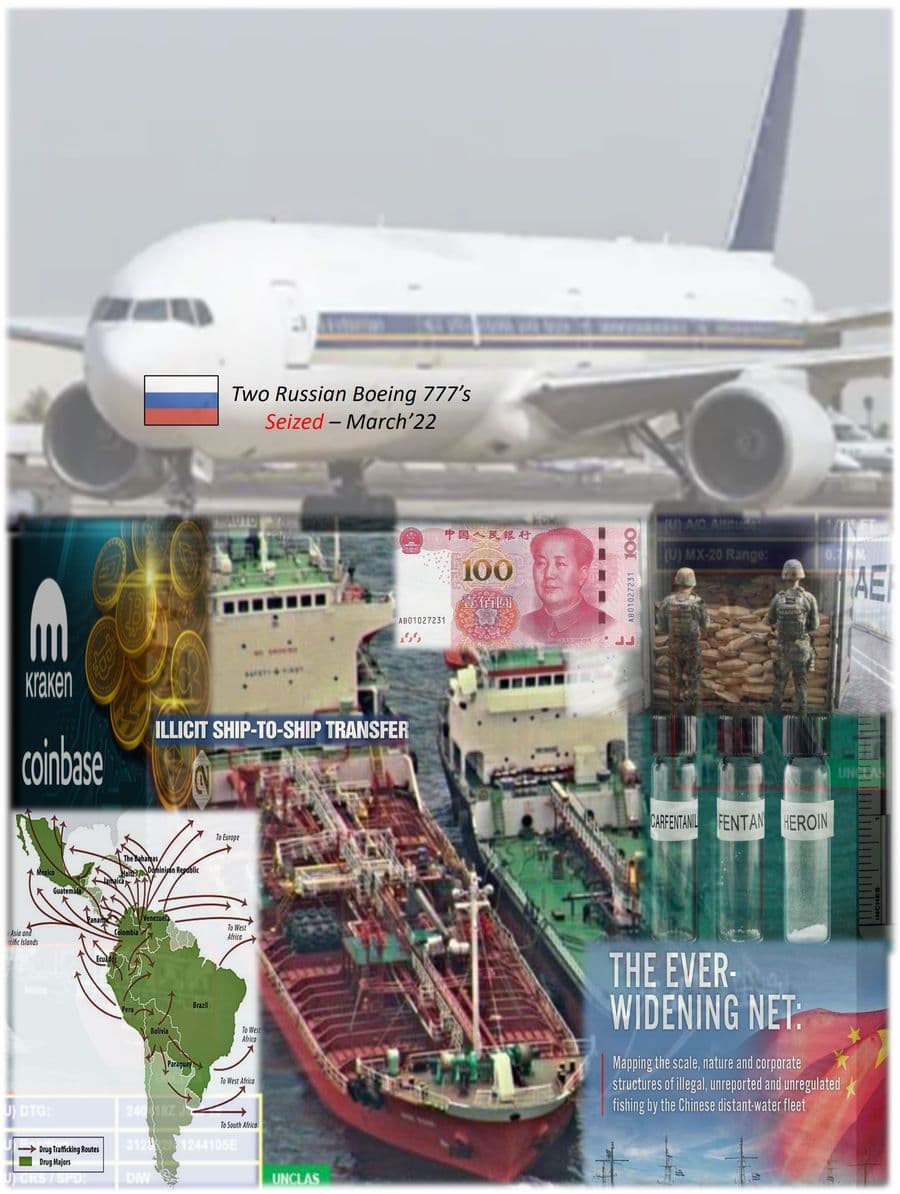
Counter Threat Finance – A Powerful Capability if Properly Resourced
Last updated 06:36 AM EDT • Read time: 10m
Introduction
Counter Threat Finance is an Irregular Warfare activity that, if properly resourced can be a powerful capability for Commanders across the Joint Force and across the spectrum of conflict. This capability can impose costs on our adversaries, particularly in the competitive space short of armed conflict. Counter Threat Finance can be used against the national security threats articulated in the National Defense Strategy and help deter their malign activities. But to do so, Counter Threat Finance must be resourced and developed beyond its current Counter Drug appropriation. Until this occurs, the Department’s Counter Threat Finance capability will continue to be suboptimized and marginalized. In the meantime, our adversaries are not waiting.
Counter Threat Finance as an Irregular Warfare Activity
This paper addresses Counter Threat Finance (CTF) as an Irregular Warfare (IW) activity that directly supports the objectives of the President and the Secretary of Defense as expressed in the 2022 National Security Strategy (NSS) and the 2018 and 2022 National Defense Strategies (NDS). It highlights the need to properly resource this capability as when fully developed beyond what is currently resourced through a counter drug (CD) appropriation, CTF can be a powerful capability for Commanders across the Joint Force in use against the national security threats identified in the NSS and the NDS.
CTF refers to the activities and actions taken by the Joint Force Commander to deny, disrupt, destroy, or defeat the generation, storage, movement, and/or use of assets to fund activities that support a threat network’s ability to negatively affect the Joint Force Commander’s ability to attain the desired endstate. CTF helps to shape the informational, virtual, and other population-focused arenas of competition and conflict.
Like all military activities, DOD CTF has authorities that allow for the conduct of operations in conflict. CTF can operate directly against a threat by supporting kinetic activity as part of traditional warfare environments that include kill – capture of financers or other leadership, strikes against drug laboratories, and other interdiction activities such as supporting our interagency partners in developing and applying trade embargoes, sanctions, the freezing of capital assets, and the restriction of capital flows. But DOD CTF also operates across the full spectrum of conflict and is particularly useful in the competitive space short of armed conflict where most other DOD assets cannot operate. It is here where CTF can maximize its deterrent effects.
Operating in the grey zone below the level of armed conflict, CTF supports law enforcement partners, helping to expand the competitive space and creating dilemmas for our strategic adversaries such as China and Russia. These activities allow DOD to blunt adversary assaults, frustrate their objectives, impose additional costs using asymmetric means, and ultimately lead to our adversaries’ concession or defeat. Working with the broader suite of IW activities, Allies, partners, and U.S. forces, CTF helps to expand the competitive space throughout contested zones below the level of armed conflict by exposing malign behavior such as predatory financing, countering influence campaigns supporting terrorist groups, and imposing increasing transactional costs.
A review of the Command and Control of the Information Environment (C2IE) database yields the below unclassified table. The data reflects a summary of the CTF efforts of the CCMDs from 1 June 2022 to 1 June 2023. The table highlights the total number of CTF related operations, activities, and investments (OAI), indicates those supported interagency partners with the most requests for support, the most prominent sub-categorization or target type of OAIs, and CCMDs with the highest number of OAIs.
DOD CTF Operations, Activities, and Investments
Notes: More information on § 284 and § 1022 is found in the next section of this paper. DEA = Drug Enforcement Administration, FBI = Federal Bureau of Investigation, HSI = Homeland Security Investigations, OFAC = Office of Foreign Assets Control, CN = Counter Narcotics, CTOC = Counter Transnational Organized Crime, CP = Counter Proliferation
While the level of effort depicted in the table is substantial in the Counter Drug (CD) sphere, that level of effort has not been replicated in other mission areas. CCMDs are focused on NDS threats such as China and Russia and deterring their malign activities. For DOD CTF to be a more powerful tool in deterring and defeating those NDS threats DOD must expand its CTF capability beyond what is currently resourced through CD appropriations.
Counter Drug Resourced Counter Threat Finance
The current DOD CTF capability (personnel who are trained, organized, and equipped) is almost exclusively resourced through a CD appropriation, “Drug Interdiction and Counter-Drug Activities”. Within this appropriation is Project Code (PC) 9301 “Counter Threat Finance”, which is used to fund civilian and contractor personnel in support of global CTF activities. This PC is centrally managed by the Deputy Assistant Secretary of Defense (DASD) for Counter Narcotics and Stabilization Policy (CNSP) and funds official travel, supplies, and other CTF administrative expenses. The table below shows the approximately level of funding and CTF manning taken from the fiscal year 2023 President’s Budget April 2022.
Drug Interdiction and Counter-Drug Activities Fiscal Year 2023 President’s Budget
In the fall of 2022 OSD P&R initiated an assessment of DOD’s CTF readiness. This assessment has still not been released; however, the draft report indicates that there are approximately 200 CTF practitioners within DOD, and “Nearly all DOD CTF personnel are funded by CNSP as part of DOD’s CD and CTOC activities …”. The report goes on to indicate there are several issues with tracking CTF practitioners, hence the difficulty in presenting definitive numbers.
The CTF manpower resourced by this CD appropriation must follow the associated CD authorities. Title 10 U.S.C. § 284 is the principal authority for CD and Counter Transnational Organized Crime (CTOC) support to federal government departments and agencies, and to U.S. law enforcement agencies. Additionally, the 2004 National Defense Authorization Act (NDAA) § 1022 as amended which authorizes CD funded Counter Terrorism (CT), CTOC, and CTF support to law enforcement agencies.
During the first two decades of this century, this arrangement of CD resourced CTF served DOD and the CCMDs well as DOD’s focus was on Counter Violent Extremist Organizations (CVEO) missions. These threats were generally non-state actors who relied partially on drug-enabled networks for financing.
States such as China, Russia, Iran and North Korea, do not require drug networks for financing which marginalizes the effectiveness of CD-funded CTF. Compounding this dynamic, in recent years as authorities and funding streams have changed or been rescinded, with increased scrutiny from Congress, and with DOD’s focus shifting from CVEO to competition, CD funded CTF is not serving DOD (and specifically the CCMDs) as well as required.
DOD’s CD program and it’s CTF capability is more aligned with the National Drug Control Strategy than with the NDS. The National Drug Control Strategy contains a focus area, “Disrupting illicit finance networks to commercially disrupt drug trafficking operations …” and this is where DASD CNSP is placing its priority and directing the efforts of CD CTF. CCMD priorities, conversely, are aligned with the NDS and generally prioritize competition over CD. The current DOD CTF enterprise has two separate and distinct claimants, but it is not organized to serve both.
Predominately CD funded and managed, DOD CTF is increasingly restricted to supporting law enforcement CD efforts with little ability support to DOD’s Competition requirements. In order to expand CTF beyond what is currently resourced with CD funds, DOD should develop a formal proposal for senior leadership approval. The outline of this proposal must maximize CTF effectiveness and broaden the range of threats DOD’s CTF capability can address to better support the CCMDs.
DoD Should Properly Resource Counter Threat Finance
There are several challenges with expanding DOD CTF beyond what is currently resourced by CD. DOD CTF currently lacks a proponent like organization charged with overseeing the day-to-day health and welfare of CTF, it lacks a vision statement and other supporting guidance documents outside of DOD Directive 5205.14 “DOD Counter Threat Finance (CTF) Policy”. There is no CTF Joint Operating Concept, nor is CTF adequately incorporated into any other Joint Operating Concept.
DOD has a defined process for developing capability as part of the Manual for the Operation of the Joint Capabilities Integration and Development System (JCIDS). In this scenario, JCIDS would suggest that a Joint Doctrine, Organization, Training, Materiel, Leader Development, Personnel, Facilities and Policy (DOTMLPF-P) Change Recommendation (DCR) would be appropriate as the purpose of a DCR is to propose non-materiel capability solutions.
DASD CNSP, as the DOD CTF Policy lead, with support from USSOCOM, as the designated DOD CTF lead component for synchronizing DOD CTF activities, are the likely candidates for the role of capability sponsor. They should consider developing a CTF Joint DCR for submission to the Joint Requirements Oversight Council (JROC).
The Joint DCR should include requirements for the Joint Force to articulate CTF requirements and for the Services to develop capabilities to meet those requirements. The Joint DCR should also include a nomination for a CTF Proponent or similar organization to oversee the development of CTF across the DOTMLPF-P areas. The proponent should develop the supporting CTF vision that charts the pathway to the future, a strategy that articulates the ways and means to achieve that vision or end state, and plans that operationalize the strategy and complement the further development of the CTF capability. These actions would further drive requirements for updated Directives, Instructions, Joint Doctrine, and various strategic guidance and planning documents. Finally, the Joint DCR should address the funding required to implement and sustain these actions.
Developing a Joint DCR will of course take time and much analysis. If the JROC approves a CTF Joint DCR, it will take years for the Department to develop the required capability. Until this occurs, DOD CTF will continue to be suboptimized and marginalized in terms of its ability to support CCMDs in their prosecution of NDS threats.
Conclusion
Counter Threat Finance is an Irregular Warfare activity that, if properly resourced can be a powerful capability for Commanders across the Joint Force and across the spectrum of conflict. This capability can impose costs on our adversaries, particularly in the competitive space short of armed conflict. Counter Threat Finance can be used against the national security threats articulated in the National Defense Strategy and help deter their malign activities. But to do so, Counter Threat Finance must be resourced and developed beyond its current Counter Drug appropriation. Until this occurs, the Department’s Counter Threat Finance capability will continue to be suboptimized and marginalized. In the meantime, our adversaries are not waiting.
Charles Barham is a retired U.S. Army Colonel with 29 years of service. He has also served for over ten years as a Department of the Army, and Department of the Air Force civilian employee and currently serves as a Counter Threat Finance Integration and Synchronization Staff Officer.
The views expressed in this article are the author’s and do not reflect the views of U.S. Special Operations Command or the Department of Defense.
In Pursuit of Nuclear Abolition
By Peter Huessy • RealClearDefense
Innovation Alone Won’t Prepare the U.S. for the Future Battlefield
By Joshua Segal • RealClearDefense
The sUAS Tactical Trifecta
By Bryan T. Woody • RealClearDefense
The Revolutionary War: When Strategic Options Share the Same Weakness
By Henry Yep • RealClearDefense
The Houthis Are Testing the Limits of Collective Defense
By Saima Afzal • RealClearDefense
Navy Civilianizes Six Former Flag Billets, Reduces Six to Captains
By Mongilio, USNI N.
Raytheon's $8B Contract for Strategic Comms Terminal Modernization
By M+A El
America’s Maritime Moment Will Not Wait
By CDR Salamander
Armor Up?
By Marine Corps Compass Points
Who Shoots Down the Drone Over the Shipyard?
By John Ferrari & Dillon Prochnicki • RealClearDefense