
Building a Responsible Counterspace Campaign
Last updated 07:42 AM EDT • Read time: 5m
At this year's Defense News Conference in September, General Michael Guetlein, the vice chief of space operations, drew attention to the Space Force's theory of success known as "Competitive Endurance." The concept was outlined in a January, 2024 white paper and founded upon three core tenets: (1) avoid operational surprise in space, (2) deny first-mover advantage in space, and (3) undertake responsible counterspace campaigning. The Space Force's efforts to build better space domain awareness and more resilient satellite constellations have contributed substantially to the first two pillars of the strategy. It is the last — responsible counterspace campaigning — that requires the most work to become a reality.
The Space Force's white paper on competitive endurance frames responsible counterspace campaigning as actions by military space forces to "preserve U.S. advantages by campaigning through competition without incentivizing rivals to escalate to destructive military activities in space." At its core, then, responsible counterspace campaigning is a problem of deterrence.
The biggest issue confronting a space deterrence strategy is that the U.S. relies far more on space than its rivals. In 2023, the number of satellites operated by the United States (6,219), a NATO ally (1,176), or a major non-NATO ally (268) dwarfed those operated by Russia and China (206 and 744 respectively). China did recently surpass 1,000 satellites in orbit according to Major General Gregory J. Gagnon, the Space Force's intelligence chief, but even then, there remains a major imbalance in space capabilities and dependence between the U.S. and its allies against its rivals. This imbalance incentivizes escalation in space by the U.S.'s rivals since conflict is more likely to hurt the U.S. than the one escalating. Acting Assistant Secretary of Defense for Space Policy Dr. Vipin Narang gave one example of the problem at an event held by the Center for a New American Security. In discussing Russia's development of a nuclear-armed anti-satellite weapon, Dr. Narang stated that Russia's desire for such a capability was driven by the desire for an asymmetric advantage over the United States, which it would be able to obtain through such a weapon given that Russia is less reliant on space than the U.S. Hesitation to escalate to conflict in outer space likely increases the more dependent a country is on the domain (for example, China may be more threatened by counterspace capabilities than Russia given its greater dependence on space). Nonetheless, the imbalance between the U.S. and its allies against China and Russia is great enough that adversaries are very likely to view escalation in space as being to their advantage.
Due to the imbalance in dependence on space, deterring escalation in the domain must begin with a clear setting of red lines together with an expressed willingness to resort to non-space-based responses to the crossing of those lines. The setting of red lines on escalation in space is one area where the U.S. has fallen short. While it has criticized the proliferation of nuclear-armed anti-satellite weapons and stated its desire to see space used for peaceful purposes, it has not articulated any clear thresholds at which it would be willing to respond with force to certain actions.
A mixed strategy employing elements of both denial and punishment is the best means of enforcing red lines once they are set. Adversaries must perceive that they will both be denied the benefits of escalation in space and that any escalation will be met with a response that impacts things important to them. Space Force efforts to build more resilient satellite constellations contribute to denial. Because of the imbalance in dependence on space, the threat of punishment would be best built through surface capabilities.
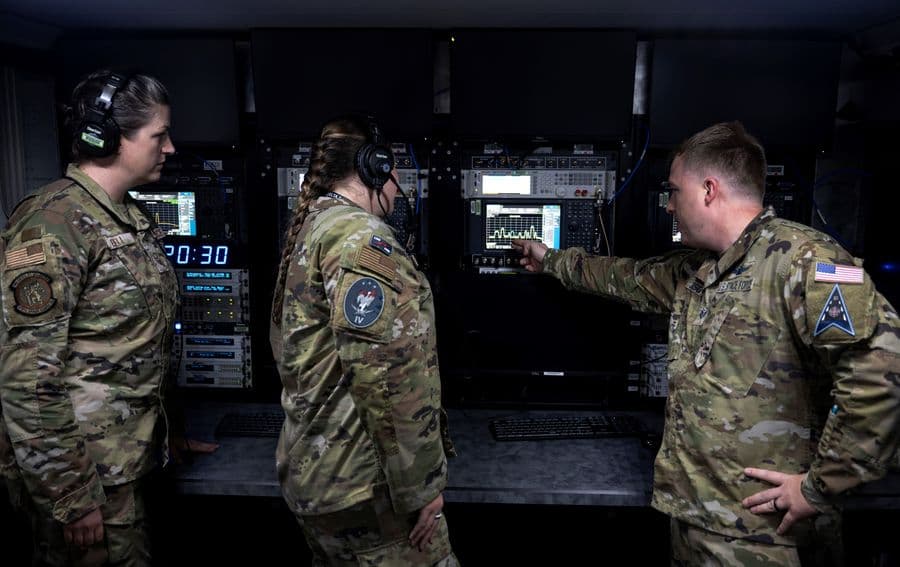
At lower levels of escalation, the Space Force could spotlight malign behavior. The Space Force already fields Bounty Hunter, a system capable of locating the sources of electromagnetic interference against friendly satellites. If EM techniques were used by adversaries against U.S. or allied satellites, information on where the interference originated could be publicly released, showing the world China and Russia's provocative actions. Bounty Hunter could also be integrated with strike warfare assets in order to actually target EM interference against satellites. The Space Force could exercise Bounty Hunter information sharing with the other services in order to demonstrate such a capability. It should also work to improve its ability to locate other types of ground-based counterspace capabilities, such as direct ascent anti-satellite weapons. As with Bounty Hunter, such information could be shared with other services in order to target them. At still broader levels of escalation, the U.S. could respond to irresponsible counterspace activities by striking adversary critical infrastructure on the ground, causing proportional losses to what would occur if the U.S. or its allies lost access to space.
Responsible counterspace campaigning is a problem of deterrence. It begins at a policy level with the setting of clear red lines regarding various forms of escalation in space. Once these lines are set, the Space Force and other services must work to be capable of enforcing these lines, both by denying adversaries the benefit of crossing them and by punishing such escalation. Due to the imbalance in dependence on space capabilities between the U.S. and its adversaries, the U.S. must be capable of flexibly responding to various forms of counterspace escalation on the ground.
Luke Widenhouse is a research assistant at the Yorktown Institute and senior at St. John's College in Annapolis, MD

Washington Cannot Ignore Afghanistan’s Weapons Legacy
By Saima Afzal • RealClearDefense
Moral Injury at One O'Clock
By Jeff Hood • RealClearDefense
The Mirror-Life Trap: When Deterrence Must Prevent Invention
By Lawrence J. Kaiser • RealClearDefense
The Pentagon’s AI Agents Could Complete the Mission and Still Leak Secrets
By Burak Oktenli • RealClearDefense
A Passage to the Middle East: India as a Mediator and Security Partner
By Irina Tsukerman • RealClearDefense

U.S. Intel Confirms This Is China’s Secret Spaceplane
By Joseph Trevithick, The WarZone
Navy Sees 10-year High For Class A Aviation, Afloat Mishaps
By H. Mongilio, USNI News
U.S. Navy To Install AI Vessel Detection System on Five Destroyers
By The Defense Post
U.S. Navy’s CHAOS Program
By Dylan Malyasov, Defence Blog
Two U.S. Navy Carriers Ready to Operate New MQ-25A Tankers
By Global Defense News