
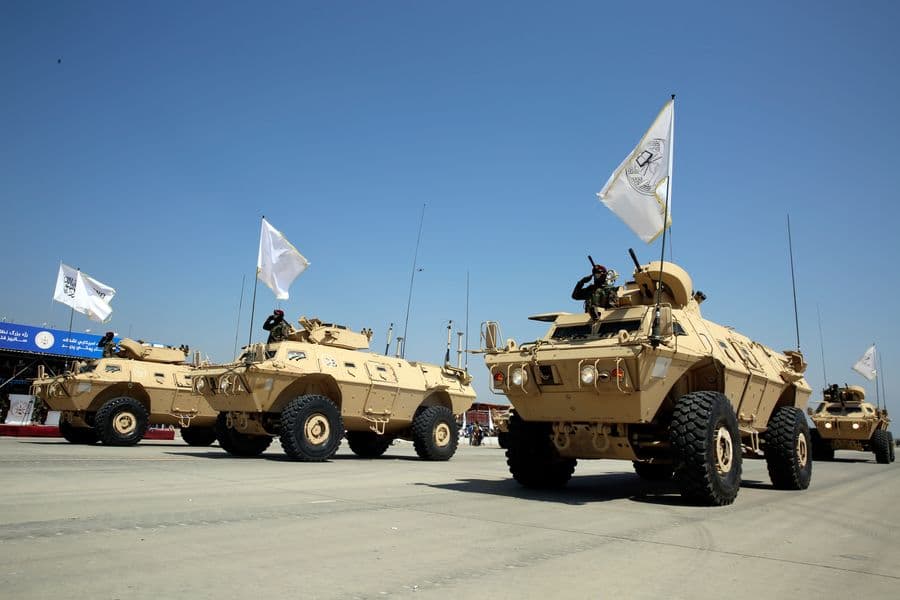
Taliban Military Vehicles are display during a military parade to mark the third anniversary of the withdrawal of U.S.-led troops from Afghanistan, in Bagram Air Base in the Parwan Province of Afghanistan, Wednesday, Aug. 14, 2024. (AP Photo/Siddiqullah Alizai)
Washington Cannot Ignore Afghanistan’s Weapons Legacy
Last updated 06:53 AM EDT • Read time: 6m
A war may end with a military withdrawal, but its weapons can continue fighting long after the soldiers have gone. Five years after the United States withdrew from Afghanistan, American-supplied rifles, night-vision devices, and other military equipment have appeared in the hands of militants attacking Pakistan. Weapons intended to strengthen Afghan security forces are now improving the capabilities of armed groups operating across the border. America's longest war ended in 2021, but its security consequences did not.
Washington cannot reverse its withdrawal, but it can address the weapons proliferation that followed. Tracing American-origin arms, strengthening counterterrorism intelligence cooperation with Pakistan, and disrupting trafficking networks offer a practical response. These measures would not require another military intervention. They would help contain a threat that affects regional stability and American counterterrorism interests.
The Weapons That Outlived the War
The scale of the problem is substantial. According to the Special Inspector General for Afghanistan Reconstruction (SIGAR), approximately $7.12 billion worth of US-funded military equipment supplied to the former Afghan National Defense and Security Forces remained in Afghanistan when the Taliban took power in August 2021. Pentagon estimates included more than 300,000 weapons, over 40,000 military vehicles, and 78 aircraft. Much of this equipment was in uncertain operational condition, and weaknesses in inventory records complicated efforts to establish its final disposition.
The movement of some weapons into militant hands is documented. An April 2025 Washington Post investigation traced 63 weapons recovered from militants in Pakistan to American military supplies originally delivered to Afghan forces. Among them was an M4A1 rifle recovered following the March 2025 Jaffar Express hijacking in Balochistan, carried out by the Balochistan Liberation Army (BLA). The investigation established a connection between former Afghan military supplies and weapons recovered from militant operations in Pakistan.
United Nations findings point to another channel of proliferation. Security Council Monitoring Team report S/2024/92 documented reports that Taliban commanders supplied Tehrik-e-Taliban Pakistan (TTP) with advanced weapons, including M24 sniper rifles, M4 carbines equipped with ACOG scopes, and M16A4 rifles fitted with thermal sights.
These findings suggest that the problem extends beyond uncontrolled black markets. Reported transfers involving Taliban commanders, alongside illicit arms trading, have created multiple pathways through which militant groups can acquire sophisticated equipment.
How Advanced Weapons Have Changed the Battlefield
The significance of these weapons lies not simply in their numbers but in the operational capabilities they provide.
Night-vision devices, thermal optics, and advanced rifles enable militants to observe troop movements, identify targets in darkness, and conduct attacks with greater precision. Such equipment can reduce the advantages security forces traditionally enjoy during nighttime operations.
The UN Monitoring Team specifically identified night-vision capabilities as contributing to the lethality of TTP attacks against Pakistani security personnel. This has made counterterrorism operations more demanding, particularly in areas where militants exploit difficult terrain and cross-border mobility.
Weapons, however, are only part of the problem. Their impact increases when combined with sanctuaries, recruitment networks, and logistical support.
Since the Taliban returned to power, successive UN reports have documented the activities of TTP, Al-Qaeda-linked organizations, and Islamic State Khorasan Province (ISIL-K) in Afghanistan. Pakistan accuses the Taliban authorities of allowing TTP to operate from Afghan territory, while Kabul denies supporting cross-border terrorism.
The combination presents a serious challenge. Advanced equipment increases militants' ability to carry out attacks, while permissive operating environments enable organizations to recruit, regroup, train, and plan operations.
Why Pakistan's Crisis Matters to Washington
Pakistan's deteriorating security situation illustrates the wider implications.
According to the Pak Institute for Peace Studies, Pakistan recorded 699 terrorist attacks in 2025, an increase of 34 percent over the previous year. These attacks killed at least 1,034 people and injured 1,366. Security and law enforcement personnel accounted for more than 42 percent of the fatalities.
The violence has also intensified tensions between Islamabad and Kabul. Military confrontations in 2026 demonstrated how disputes over militant sanctuaries can escalate beyond cross-border terrorism into direct interstate conflict.
American-origin weapons are not the sole cause of Pakistan's militant resurgence. Domestic extremist networks, political grievances, and Pakistan's complicated history with Afghan armed groups remain relevant. Nor does recovering an American-made rifle necessarily establish direct Taliban involvement in a particular attack. Nevertheless, the availability of sophisticated weapons has strengthened some militant organizations' operational capabilities.
For Washington, instability in a nuclear-armed country bordering Afghanistan is not a distant concern. Escalating violence could undermine regional stability, complicate counterterrorism cooperation, and provide transnational militant networks with opportunities to expand.
The problem also exposes a vulnerability in American military assistance. Washington spent billions equipping Afghan security forces, but their institutional collapse left substantial inventories outside effective oversight. Future US security partnerships could face similar consequences if equipment accountability and contingency planning remain inadequate.
Washington Needs a Realistic Post-Withdrawal Strategy
Recovering every American-supplied weapon remaining in Afghanistan is unrealistic. Washington no longer controls Afghan territory, and another military intervention would impose significant political and strategic costs. A narrower approach is more practical.
The immediate priority should be a structured US-Pakistan weapons-tracing initiative. American defense authorities retain historical procurement and transfer records, while Pakistani security agencies possess recovered weapons and information concerning their seizure.
A coordinated mechanism involving the Department of Defense and relevant law-enforcement agencies could compare serial numbers, document chains of custody, and identify recurring patterns of diversion. Agreed verification procedures would be essential to distinguish weapons transferred by individuals from those acquired through illicit markets.
The initiative should produce actionable intelligence rather than another inventory exercise. Verified evidence identifying trafficking routes, intermediaries, or recurring sources of diverted equipment could support criminal investigations, targeted sanctions, and coordinated enforcement.
Such cooperation would face limitations. Incomplete Afghan inventories, missing records, and repeated resale through informal markets would make comprehensive tracing impossible. Even partial findings, however, could help identify networks that remain active.
Washington should also coordinate with regional partners to investigate illicit arms financing and disrupt trafficking networks. Targeted measures against identifiable facilitators would offer a more focused approach than broad economic restrictions on Afghanistan.
Engagement with Taliban authorities should emphasize verifiable counterterrorism commitments. Restrictions on militant movement, prevention of weapons transfers, and action against cross-border militant infrastructure should inform diplomatic discussions. Washington's limited leverage requires realistic expectations and independently assessed compliance.
Pakistan also has responsibilities. Effective cooperation requires credible evidence sharing, action against domestic militant infrastructure, and attention to the political conditions sustaining violence.
The wider lesson is that military assistance cannot be separated from long-term equipment accountability. Future US security partnerships require monitoring arrangements and contingency planning that anticipate the possible collapse of recipient institutions.
The United States left Afghanistan in August 2021, but some of the weapons it supplied continue to shape conflicts beyond Afghan territory. Pakistan is confronting those consequences today.
Washington does not need to return to Afghanistan's battlefield. It needs to prevent the weapons legacy of its longest war from becoming a continuing source of regional instability.
Saima Afzal is a researcher specializing in South Asian security, counterterrorism, and broader geopolitical dynamics across the Middle East, Afghanistan, and the Indo-Pacific. Her work examines strategic affairs and evolving patterns of regional conflict. She is currently a Research Scholar at Justus Liebig University, Germany.
Washington Cannot Ignore Afghanistan’s Weapons Legacy
By Saima Afzal • RealClearDefense
Moral Injury at One O'Clock
By Jeff Hood • RealClearDefense
The Mirror-Life Trap: When Deterrence Must Prevent Invention
By Lawrence J. Kaiser • RealClearDefense
The Pentagon’s AI Agents Could Complete the Mission and Still Leak Secrets
By Burak Oktenli • RealClearDefense
A Passage to the Middle East: India as a Mediator and Security Partner
By Irina Tsukerman • RealClearDefense

U.S. Intel Confirms This Is China’s Secret Spaceplane
By Joseph Trevithick, The WarZone
Navy Sees 10-year High For Class A Aviation, Afloat Mishaps
By H. Mongilio, USNI News
U.S. Navy To Install AI Vessel Detection System on Five Destroyers
By The Defense Post
U.S. Navy’s CHAOS Program
By Dylan Malyasov, Defence Blog
Two U.S. Navy Carriers Ready to Operate New MQ-25A Tankers
By Global Defense News