
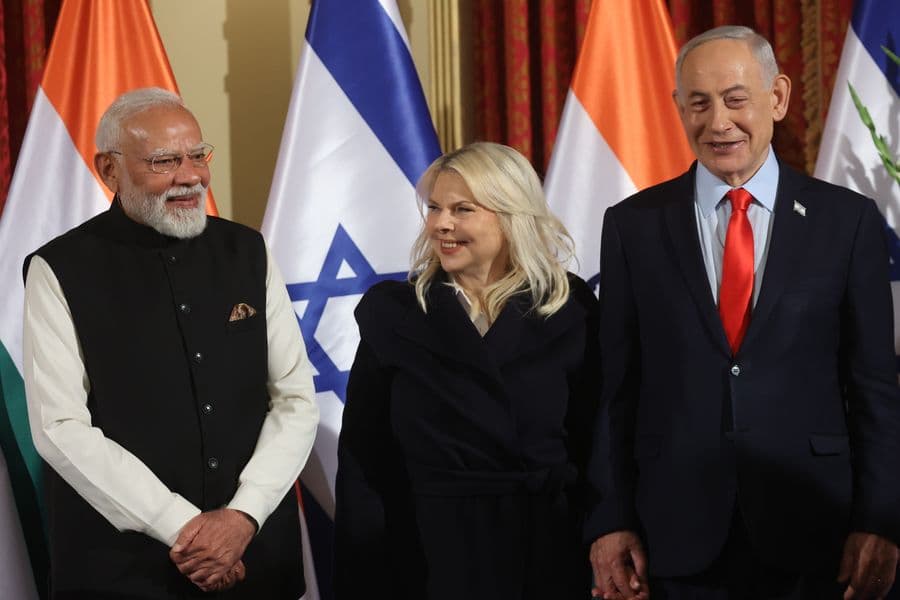
Israel's Prime Minister Benjamin Netanyahu, right, his wife Sara and his Indian counterpart Narendra Modi pose for a family photo during their joint press conference in Jerusalem, Thursday, Feb. 26, 2026. (Gil Cohen Magen/Pool Photo via AP)
A Passage to the Middle East: India as a Mediator and Security Partner
Last updated 04:58 AM EDT • Read time: 7m
The India-Shaped Hole in the Middle East
India has spent years developing relationships with governments that frequently disagree over Middle Eastern security. It works closely with Israel on defense and intelligence, trades extensively with Saudi Arabia and the UAE, and maintains a channel to Tehran through Chabahar. Its expanding European partnerships add another set of governments with an interest in what New Delhi does next. With shipping under threat at Hormuz and Bab el-Mandeb, India has reasons to pursue a larger role in maritime security and diplomacy. That role could extend to testing competing Gaza proposals, resisting campaigns to isolate Israel, and renegotiating the India-Middle East-Europe Economic Corridor around financing and political commitments that actually exist.
Two Chokepoints, One Indian Problem
Threats around Hormuz endanger the Gulf energy supplies that Indian refineries rely on. Houthi attacks around Bab el-Mandeb make Indian exports to Europe more expensive when shipping companies divert vessels around Africa. Insurance premiums and delivery delays reach manufacturers negotiating contracts with European buyers. Saudi Arabia can move oil west through its East-West Pipeline to Yanbu, but insecurity in the Red Sea also threatens shipping from that port. India cannot count on one threatened passage as a dependable alternative to the other.
Indian warships have already helped merchant vessels in the western Indian Ocean. New Delhi could expand maritime intelligence exchanges with Riyadh and Abu Dhabi, coordinate escorts when threats warrant them, and use its P-8I surveillance aircraft to help identify suspicious shipping movements. It could press Tehran over attacks affecting Indian crews and cargo while working with Gulf partners on protecting port facilities and oil shipments. Continued attacks would also force a discussion of stronger collective measures to defend commercial navigation.
The Pressure Campaign Against Israel Could Reach India
Pro-Iranian and Islamist campaigns have pressed governments and businesses to cut ties with Israel. The same pressure tactics can target Indian defense contracts, university partnerships, and infrastructure projects involving Israeli companies. Kashmir offers activists and extremist networks another grievance to connect with the Gaza war, including through claims portraying Indian-Israeli cooperation as hostility toward Muslims.
India is much harder to isolate than Israel. Gulf economies depend on Indian workers and trade, while European firms have substantial interests in the Indian market. New Delhi can use those relationships to keep Israeli technology and commercial partners involved in projects that Gulf and European governments still want to pursue. Indian-led ventures could provide a politically acceptable meeting ground for investors who remain reluctant to advertise direct cooperation with Israel. Participating governments would still need to approve those arrangements openly and comply with their own legal commitments.
India also has reason to investigate Hamas's contacts with Pakistani terrorist organizations. In February 2025, Hamas representative Khaled Qaddoumi attended a Rawalakot gathering alongside figures linked to Lashkar-e-Taiba and Jaish-e-Mohammed. Indian intelligence has raised concerns about possible transfers of operational experience for use in Kashmir. The extent of any cooperation remains unclear, but investigators have reason to examine individual contacts, funding channels, and any exchange of technical expertise.
What India Could Actually Do in Gaza
Hamas remains entrenched in Gaza's local networks and institutions. Its influence over armed personnel, patronage, and ideological education cannot be eliminated through a reconstruction announcement. Trump's Board of Peace has no evident financing or enforcement capacity sufficient to deliver the sweeping plans being discussed. Gulf donors are unlikely to fund another reconstruction effort without protection against diversion and renewed destruction.
Netanyahu's government has its own explaining to do. It demands Hamas's disarmament while offering no sufficiently detailed public plan for removing its remaining networks, dealing with other armed groups, or building a Palestinian administration capable of resisting extremist intimidation. Repeated objections to proposals invite scrutiny when Jerusalem offers no workable alternative. India could ask Israeli officials to identify achievable security benchmarks and explain which Palestinian institutions could meet them.
New Delhi's longstanding positive engagement with Palestinians and its trusted intelligence relationship with Israel make it a credible interlocutor for both. Indian diplomats could challenge Palestinian representatives over Hamas's grip on schools and local administration, question Gulf donors about realistic funding commitments, and ask Washington who would pay for its promises. Independent Indian specialists could help verify claims of weapons diversion or tunnel construction without forcing Israel to reveal sensitive sources.
Reform of education and religious programming would require Palestinian professionals able to work without terrorist intimidation. India could support training and independent curriculum review, with funding released only when locally administered programs meet agreed standards. It could also press Israel to explain how its own operations would avoid destroying the institutions expected to replace Hamas's control.
Iran, Yemen, and the Aden Connection
India's continuing relationship with Tehran allows it to raise attacks on shipping directly, even as it protects its interests at Chabahar. Saudi and Emirati authorities could share maritime intelligence with Indian counterparts on suspected weapons shipments. Aden's historic trading connections with India offer another opening for work with legitimate Yemeni authorities on port security. Contacts between Houthi and Al-Shabaab networks across the Gulf of Aden warrant scrutiny because trafficking routes and technical exchanges can threaten the same waters used by Indian commerce.
Rebuild IMEC Before Trying to Sell It Again
The original IMEC proposal was unrealistic before the Gaza war. Riyadh showed little willingness to shoulder the enormous infrastructure bill, and Saudi-Israeli normalization was never assured. Saudi Arabia and the UAE were already competing to attract logistics investment and control regional trade routes. Egypt objected to a corridor that could draw traffic away from the Suez Canal, while Bahrain resented being excluded despite its connections with Saudi Arabia and its normalization agreement with Israel.
India could negotiate a modified corridor built from independently financed projects with demonstrable commercial demand. Saudi and Emirati ports could connect to rail investments without requiring either government to subsidize the other's ambitions. Egypt could participate through Suez-related logistics and Mediterranean connections, while Bahrain could contribute financing and access to its existing transport networks. The parties would have to agree on customs rules and freight access before promising a seamless route.
Israel could contribute technology and logistics expertise through Indian-led partnerships where Gulf governments consent, without making Saudi normalization a precondition for the whole undertaking. European investors could back individual segments rather than waiting for a grand corridor to materialize. A revised IMEC would also need port protection and contingency routes because infrastructure on the Arabian Peninsula remains exposed to regional attacks. I2U2 could support selected projects involving India, Israel, the UAE, and the United States where financing and political approval are available.
What India Would Gain
India's already close intelligence cooperation with Israel could become a foundation for broader work with American and European agencies. Indian maritime surveillance across the Arabian Sea and Gulf of Aden would complement Western collection on suspicious shipping, while European investigations into financing and procurement networks could help India track threats linked to Pakistan. Washington could expand operational information sharing with Indian forces protecting commercial traffic.
Indian engineering firms could compete for Gulf rail and port contracts, and exporters would benefit from more predictable access to European customers. New Delhi could also secure a larger voice in European discussions about Iranian threats and regional security. A credible role in Gaza negotiations would increase the value of Indian diplomacy to both Israel and Palestinian institutions, particularly when Washington's proposals lack funding or political support.
Conclusion: A Role India Can Actually Deliver
New Delhi should begin with maritime arrangements that protect Indian crews and cargo, then use its Gulf and European partnerships to negotiate specific infrastructure projects. In Gaza, it should demand credible funding and measurable security commitments from every participant, including Israel. A modified IMEC could proceed through agreed commercial segments while India keeps Israeli expertise connected to Gulf and European investment. Indian officials would have to confront Iranian threats to shipping, Palestinian institutional capture by Hamas, and Israeli obstruction whenever the evidence warrants it. Those are the decisions through which India could convert its existing relationships into influence over outcomes that directly affect its own security.
Irina Tsukerman is a U.S. national security lawyer, geopolitical analyst, President of Scarab Rising, Inc., a security and geopolitical risk strategic advisory, and Board Member of The Washington Outsider Center for Information Warfare.

A Passage to the Middle East: India as a Mediator and Security Partner
By Irina Tsukerman • RealClearDefense
South China Sea is Key to Invigorate Positive U.S.–Malaysia Relations
By Brent D. Sadler • RealClearDefense
The Necropolitics of the Wasteland
By Yunus Emre Tumen • RealClearDefense
AI, Robotics, and Marines
By Gary Anderson • RealClearDefense
The Emerging SQUAD
By Muhammad Shoaib • RealClearDefense
AI, Robotics, and Marines
By Gary Anderson • RealClearDefense
AUKUS Partners Test Autonomous Maritime Systems
By Jangoulun Singsit, Naval Tech
AUKUS: USS Colorado Announced as First Submarine for SRF – West
By USNI News
Navy, Marine Corps Simulate Ship Strikes From Air and Land
By Alex Wilson, S&S
Air National Guard To Stand Up a New Special Tactics Squadron
By Patty Nieberg, T&P