
Robot Dogs Could Change Counterterrorism Ops
Last updated 06:37 AM EDT • Read time: 6m
The West needs to reinvent counterterrorism. While most nations gain sympathy when they’re attacked, Israel lost support in the two years after the deadliest attack since its founding. This should be a wakeup call for Western policymakers. The military campaigns that drove the Taliban out of Afghanistan and defeated ISIS’ caliphate would not be tolerated today. The public is no longer so willing to overlook the humanitarian cost of counterterrorism.
It’s not merely a political inconvenience that Israel’s aims are perceived as genocidal — this perception fuels recruitment for jihadists. Last year, former Secretary of State Antony Blinken announced that the U.S. believed “Hamas had recruited almost as many fighters as it had lost.” The takeaway is that, beyond the moral imperative, better protecting civilians is a strategic necessity.
Meeting this challenge will depend on technology.
Picture a government at war with a jihadist organization. Its intelligence located a home where they believe a terrorist is hiding, possibly surrounded by innocent members of his family. The government sees three options.
First, they can settle for letting the terrorist live. With no risk of getting soldiers or civilians killed, this should be the least controversial outcome, but it fails to address the jihadist group’s threat to national security. Complacency can allow buildups for large-scale attacks and also incentivizes further use of whichever tactics drove the government toward inaction, like human shields.
Alternatively, the government can keep its soldiers out of danger by bombing or shelling the house. This approach has serious costs, including minimal chances of verifying the target’s identity, and maximum chances that members of his family — and their home — will be caught in the crossfire.
Lastly, troops can kick down the door, search each room, and shoot or use grenades as needed. Here, the government is more likely to ensure they’re targeting the right man and can better protect nearby civilians and property. Still, split-second decisions can easily cost innocent lives, and this method will inevitably get soldiers killed.
Now, let’s walk through a less conventional option: a single soldier approaches the house wearing a bomb-disposal suit that covers every inch of his body. Using a rifle would be impractical in so much armor. Instead, he carries a bulletproof shield. He opens the front door with his free hand. Several quadcopters enter and scan the room. A man woken by the noise comes downstairs, sees the drones, and hurries back the way he came. Seeing that the first floor is empty, the drones fly upstairs until they reach another door. The soldier follows and opens it.
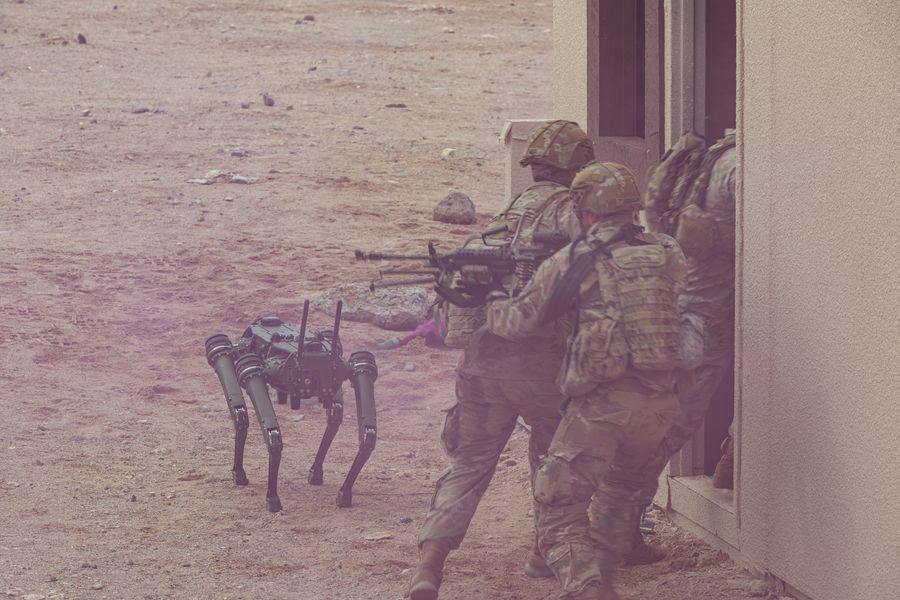
The quadcopters find a woman and two children huddled together, along with the man from earlier, now holding an assault rifle in the corner. His face is verified to match the raid’s target. One of the drones inspects the next room in the hallway, which is empty. Soon after, a 4-legged robot with a belt-fed machine gun on its back climbs the stairs. It moves into the room enough to aim at the man with the rifle. With the quadcopters already watching the target and confirming that no bystanders are behind the wall, the robot dog opens fire, killing the terrorist.
These scenarios are hypothetical but highlight a real and persistent challenge for counterterrorism: traditionally, precision has limits and often compromises the safety of troops. Gaza has made this dilemma strikingly apparent.
Israel was unprepared to eliminate Hamas without causing immense destruction: no military is built to fight 30,000 combatants in tunnels below densely populated areas, let alone while neighboring governments bar the evacuation of civilians. By Hamas’ design, minimizing harm to innocents was an unprecedented challenge. However, even if the IDF took every measure at its disposal to protect civilians, it wasn’t enough.
Outcry was so intense that then-President Biden suspended the delivery of certain weapons for his final eight months in office. This backlash cannot be dismissed as an overrepresented fringe: for the first time, Gallup found that more Americans are sympathetic toward Palestinians than Israelis. The next war must be fought differently.
This brings us back to the less conventional house-clearing method outlined earlier. In theory, this option would leave by far the best odds of verifying the target’s identity and avoiding physical harm to civilians, soldiers, or homes. It would allow militaries to surgically eliminate terrorists without leveling buildings or facing the subsequent outrage.
This would greatly reduce the consequences of terrorists embedding themselves in populated areas: in strategic and humanitarian terms, using hospitals as command centers or digging tunnels under apartment complexes would make much less of a difference.
Tapping into this potential hinges on one question: does the technology exist to make this scenario more than idealistic science fiction? The short answer is yes.
Quadrupedal unmanned ground vehicles (Q-UGVs), or “robot dogs,” are getting more advanced and affordable by the day. For decades, the U.S. military has experimented with them for other roles, and canceled those projects for inapplicable reasons (i.e., excessive noise). China has unveiled a Q-UGV that can fit through doorways, traverse staircases, and carry an assault rifle. Boston Dynamics made one that can open doors, which suggests that these operations might not even require a single soldier.
The primary limitation is battery life — a single dog might only have enough power to clear one building before recharging. If militaries buy enough units to rotate through a charging-cycle between raids, the technology is viable. This leads to perhaps the most promising feature of Q-UGVs: surprisingly, they’re affordable enough to buy in meaningful numbers.
Precision-focused military equipment is typically more expensive, but robot dogs break that trend, especially when accounting for long-term costs. The Boston Dynamics Q-UGV referenced earlier, “Spot,” has a 90-minute battery life, a 40-pound payload, and a ~$75,000 price tag (not including a gun or its mount).
If that sounds like a steep investment, governments sometimes spend about $50,000 on each pair of night vision goggles for missions outlined earlier, such as the L3Harris GPNVG-18. They also need to pay for other equipment, training, housing, and compensating the families of soldiers lost in combat, none of which apply to robot dogs.
As for the other equipment leveraged by this approach, reconnaissance quadcopters, bulletproof shields, and bomb-disposal suits are already in service with militaries around the world. Today, practical shortcomings are likely less of a barrier than the willingness of militaries to adopt such an ambitious approach.
This is only an introduction to how technology can radically increase precision in counterterrorism, without sacrificing the safety of soldiers. It doesn’t unpack every detail for optimizing unmanned systems, such as using fiberoptic cables to control them underground and avoid the intense bombing required to collapse tunnels. It also omits important considerations irrelevant to equipment, such as cooperating with local partners and normalizing relationships with civilian populations.
I’m not arguing that more creative weapons can solve every grievance between Israelis and Palestinians. Still, reforming how asymmetrical wars unfold is not only possible, but essential.
Alexander B. Lee is an Associate at Windham Knox and a recent graduate from Washington University in St Louis. He has been featured in The Diplomat, The National Interest, and Defense News.
4. https://news.gallup.com/poll/702440/israelis-no-longer-ahead-americans-middle-east-sympathies.aspx

A Defense Win for Americans and Israelis in Arkansas
By Bradley Bowman • RealClearDefense
A Path to Success Against Iran
By Michael Schwartz • RealClearDefense
The World Cup Is Over. The Drone Threat Isn’t.
By Mitzi Perdue • RealClearDefense
AI Should Speed Veterans’ Benefits, Not Decide Them
By Rob Schroder • RealClearDefense
Don’t Be Swayed by Tactical Nukes
By Benjamin Giltner • RealClearDefense

Big Surface Combatants are so Hot Right Now
By CDR Salamander
USS Stout Loses Power During Port Visit Due to ‘Engineering Casualty’
By USNI News
Air Force Lessons Learned From Operation Epic Fury
By Tabitha Reeves, National Defense
Marines Need Nine More Amphibious Warships To Carry Out Its Missions
By TWZ
AFRL, ACC Fly XQ-67A Drone To Test Autonomous Teaming
By Airforce Technology