
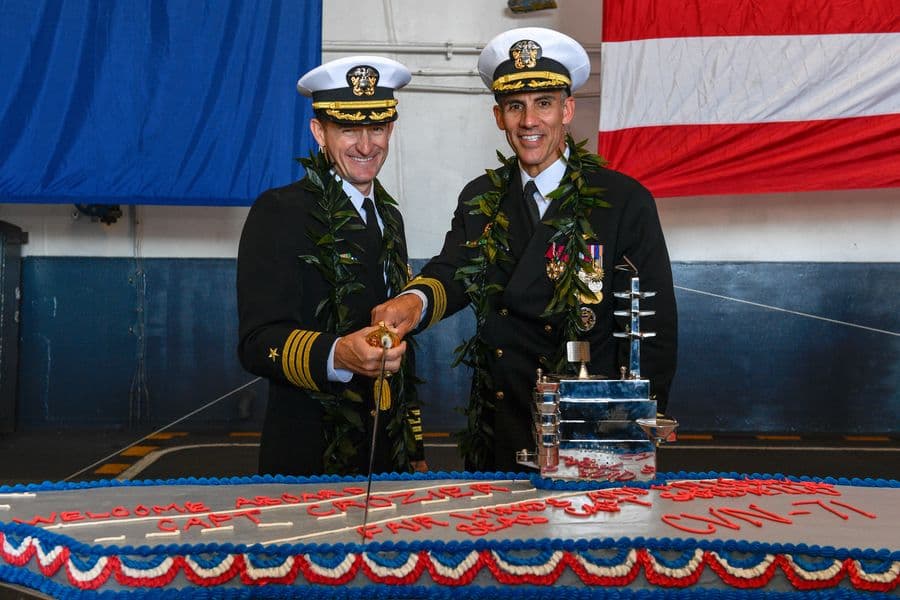
Brett Crozier Isn't Bitter
Last updated 12:34 AM EDT • Read time: 14m
Captain Brett Crozier lost his job in the early days of the COVID-19 pandemic. Not because of a layoff. Not because his position was terminated. No, Captain Crozier lost his job because he sent an email. The “to” line of that email happened to include a few admirals and several Navy captains, and the contents criticized the Navy’s management of a COVID-19 outbreak aboard Crozier’s ship, the USS Theodore Roosevelt. Crozier had wanted permission to evacuate nearly the entire crew over concerns that he could not adhere to social distancing guidelines promulgated by the CDC. “We are not at war,” Crozier wrote. “Sailors do not need to die.” But Crozier’s superior officer had decided evacuating the ship was a step too far. And so, as the confirmed cases of COVID-19 multiplied and senior Navy officials deliberated what to do with the ship’s crew, Crozier sent his email demanding action. It wasn’t long before the email leaked to the San Francisco Chronicle, prompting acting-Secretary of the Navy Thomas Modly to swiftly and summarily discharge Crozier for demonstrating “extremely poor judgment.” When Crozier walked off the ship a final time, the crew applauded and chanted his name.
Despite all that, Crozier is not bitter about how his Navy career ended. “I would have stayed in the Navy for as long as they would have had me,” he told me by telephone. “Acting-Secretary Modly had the right to fire me—for good or bad.” Like most who serve, the military has been a family business for Crozier. His loyalties run deeper than one job, one boss, one disappointing outcome. “My oldest son was an aircrewman. My younger son is in flight school. I still encourage people to pursue a career in the Navy.” Crozier’s equanimity comes across in his enjoyable new book, Surf When You Can (Atria, 2023). In 10 digestible chapters, Crozier explains the thought processes and leadership approach he developed over the course of his career as a Navy pilot. It’s an approach that treats leadership as a relationship between those who issue the orders and those who execute on them, an approach Crozier applied when making the decision to press his leaders for authority to protect the crew of the Roosevelt. We talked about losing his command, his long career leading sailors and what might come next.
On March 30, you sent an email pleading for authority to evacuate most of your crew for quarantine ashore. That email leaked to the San Francisco Chronicle the next day. Two days after that, on April 2, you were relieved of command. Do you have any regrets?
No. I knew I was rocking the boat when I sent the email. Even when it ended up that I was relieved of command, I was at peace with the decision because this was an extremis situation and we were there on the frontlines. We had the doctors on-hand to make an informed decision and we were worried [the virus] would spiral out of control. But being captain of the Theodore Roosevelt was the best job I ever had and I’ve known that since the beginning. I mean, all the things I could do on any given day. I could be flying in a helicopter. I could be in the kitchen slinging food. I could be on the bridge driving the ship with Chinese boats chasing us. I might even jump in a Super Hornet and fly. So, I made the best decision I could have made in the moment and I understood the consequences. All that aside, yes, I could have done more to make sure that people understood the gravity of what was happening aboard ship.
What surprised you most about the incident—from your chain of command not allowing you to take your crew ashore, to the political fallout and your relief from command?
What surprised me most was the micromanagement at the highest levels, the barriers that went up the chain of command. In the Navy, whether it’s ships or airplanes, you’re given a lot of authority to do your mission in combat. Because I was a commander, I thought I had the inherent right to defend my ship and that was the basis of my decision. So, I think we probably have too many deliberate decisions [outside of the combat environment] where people get involved from afar and exercise leadership without the full facts. Combat seems to be something different.
Media fallout was enormous. You were forward-deployed near Guam when you wrote the email to other senior Navy officers. The very next day, that email was international news.
It’s the ability to communicate in ways we never communicated before. When I was a junior officer, we could not communicate by cell phone or by email, and so there was more trust among leaders that not everything could become bigger than it was. A commander was given authority to make decisions. But every sailor on my ship had a cell phone. More communication is typically good but the downside is the insatiable appetite for more information. You sometimes feel like you’re not a leader but an administrator simply trying to feed information at all times. In my situation, I think that type of pressure came outside the Department of Defense.
Let’s get into the book. We live in an age of the charismatic CEO who won’t stop talking about the “nonstop grind.” Work hard! All the time! But you write that “work is easy” for people in leadership. That seems counterintuitive. What do you mean?
I think if you are doing something you like to do, then it’s not even work. Many leaders—if they do it right—really enjoy doing work and so it doesn’t even feel like work.
“You are here to make big decisions,” you write. “And the only way you can make big decisions is if you have the time to think big thoughts. And the only way to think big thoughts is to have uninterrupted time to yourself.” Leaders aren’t paid to punch the clock, right?
I use the phrase “surf when you can.” It’s a mantra about staying fresh as a leader. Surfing was a way to leave everything at work and be out on the water focused only on the moment. Of course, I also like the physical aspect and the beauty but there’s also no distractions out there. Surfing gives a space for my mind to work in a new way. It’s a totally different experience for the mind to be surfing. Throughout my career, I always found ways to get outside the office and play softball, go running, do something physical. Because leaders vote with their time. It comes down to prioritizing correctly. If I was going to a meeting, I wanted it to be a decisional meeting, and I find that hard in civilian life, too, where people are not using the leader’s time to put forward a big decision. I want to go to the meeting and have the information on-hand to tell people where we ought to go. You cannot do that type of directional leadership if you’re doing 100 emails per day. As a senior person, you need to be able to step back and talk to the right people and think strategic thoughts. It’s not about the number of Zooms or the number of emails, it’s about gaining the strategic picture to make good decisions when the time comes.
What looks like recreation is still work. A leader’s mind is always churning on problems—is that what you are saying?
You’re always thinking. Surfing allows you to do it in a way with less distraction. For example, I had a conference the other week in DC. Toward the end of the first day, I said to myself: “I’m here in DC. The weather is gorgeous. I’m going to run for an hour or two around the Mall and take in all the sights.” It’s fun, of course, but it also allows me to think in a new way that changes my ability to lead. When I was a junior officer flying helicopters, I was the operations officer for our detachment. My roommate was the operations officer for the ship. Now, as aviators, we pride ourselves on getting rest. My roommate was the opposite. He prided himself on being awake when I went to bed and awake when I got up in the morning. He was miserable and looked like a zombie but that was his leadership mentality—to work harder than everyone else.
This sounds like an approach to leadership. His was more anxious than yours. Tell me about your approach to leading people.
You can choose to lead from strength or from timidity. You have commanders of ships who are terrified of all the stuff that they cannot control. They micromanage. They create barriers. Everything bad they’re worried about, they actually make it worse by not trusting other people. I tried a different approach. I knew my crew and my systems and tried to entrust these teams to do the right thing. I trusted they would bring me problems. I trusted they could perform their jobs. But that was one approach. The other was working from sun-up to sun-down trying to manage absolutely every detail. Colin Powell advised leaders to “delegate to the point you are uncomfortable,” and that’s the opposite of timid leadership.
Otherwise, the amount of stress will drive you crazy. A nuclear aircraft carrier is powered by two massive nuclear reactors. We’re cooking 15,000 meals a day. There’s an engineering department. It’s a floating airport at sea with millions of pounds of bombs and fuel and 5,000 people doing different things. But stress is in the eye of the beholder. For aviation, pilots are used to dealing with stress and managing it as individuals but leadership is different. The only way through that knothole is by building trust with the people who work for you, then delegating properly. If you cannot do that, then the stress is off the charts. Stress will never go away, mind you. You are the commanding officer and so you are always the one accountable. Though you can compartmentalize the stress and give people the tools, you cannot delegate the stress away. I think I did a good job of this. If you asked my wife, she would say that I wasn’t anymore stressed as a commanding office as I was on my first solo flight.
You stayed in the Navy for two years after being relieved of command. Did you feel like a failure or a pariah in the community?
No. You see folks who are relieved of command very quickly in the Navy. If it does happen, don’t be bitter or angry—it’s just a part of the territory. I felt like I was embraced with open arms after I was relieved. They were going to reinstate me at one point and then they changed but I felt I was welcomed back. I was given a good job afterward that had responsibility. Though I knew I was not going to make flag rank, I was content with the leadership opportunities I was given. My chain of command was really good. The admiral I worked for was supportive. “Hey, that stuff happens. On a personal side, you are a great guy, Chopper. We want to continue to leverage your skills.” Nobody had to do that. I even kept flying Super Hornets because I was current and they needed more instructors. I did my staff job for three weeks and then went up to Lemoore to fly and instruct. Most people within the Navy were very supportive.
I had an instructor at the infantry officer course who said "there will be a day when your best isn’t good enough.” It was good advice. I think of this in light of your story. You wanted jets out of flight school but got helicopters instead. Much later, you made your best decision and lost your career.
In a perfect world, there is an unlimited opportunity for everybody. Going through flight school, I was above average but I was not top of the class. I knew that meant I probably would not get jets. Some people could get frustrated by that and feel slighted, but most of us end up loving what we do, whether it’s flying helicopters or P-8s. I was much better when I went back through flight school the second time for jets and I had a very successful career flying F-18s, which led me to command the TR. When I had to make the decision the cost me command, it was a conscience versus career decision. I stuck to what I thought was important—I made it in the interests of the crew. I gave myself the “rocking chair” test, meaning I wanted to be able to look back and know that I did the right thing for the right reasons. The military is different from civilian leadership, though. You have to have certain billets and jobs behind you before you can get into a command position. There’s objectivity to it. There’s more subjectivity to promotion in the civilian world, and that’s where people struggle. Feeling like they did all they could and still getting passed over for the job.
You seem open-minded and willing to fail. You changed courses multiple times in your career—from helicopters to jets, from aviation to nuclear power. Now, you’re an executive at a nonprofit. Talk about openness as a leadership quality.
Openness is a mindset of wanting to grow personally and professionally. I wanted to go back to flight school to transition from helicopters to jets. I was more mature. I was more successful, too. When I went back to school for nuclear power, that was totally eye-opening. I hadn’t touched a calculator for years, but I wanted to command an aircraft carrier and I knew that two years of nuclear power school was part of qualifying for the job. No matter your age, you have to be confident that you can learn new things if you put your mind to it, and the willingness to be open to the experience. Good leaders have to accept being wrong and accept being bettered by those around them. People get comfortable but leaders have to be open and humble about learning.
What's next? Will you enter politics?
I’ve been asked. There’s an assumption that if you get into the news cycle at all, that you’ll enter into politics. To be honest, I don’t know my path right now. I like servicemembers and veterans issues. I like foreign policy and I think we’ve mucked up our foreign policy for a long time. I believe in peace through strength. I think we’re going down paths right now that could lead to major conflict. It goes back to national power and the DIME model, how the “M” is the biggest by far. But if the only tool you have in the toolbox is a hammer, then everything looks like a nail. One winner. One loser. You have to maintain a strong presence to deter aggressors but it’s a trap. You go down these paths where strength forces a reaction. Do we expect our peer competitors in the South China Sea to give in? Is it our way or the highway until a major regime falls? That’s a strategy of hope more than anything. We’re accepting incredible amount of risk by prioritizing the military above other tools, like diplomacy and information. If I did go into politics, it would be about veterans and making better decisions. Before you go into conflict, you need to decide how you’re going to get out of it. We fail by going into conflicts without thinking about how we will get out of them.
John Waters is a writer in Nebraska. His novel River City One publishes this fall.

Iranian Cyber Operations
By Michael Groen • RealClearDefense
Reflecting on an Epic Horse Campaign in the Mountains of Afghanistan
By Brian Glyn Williams • RealClearDefense
The Godfather of American Foreign Policy Realism Speaks to Today’s World
By Francis P. Sempa • RealClearDefense
In Pursuit of Nuclear Abolition
By Peter Huessy • RealClearDefense
Innovation Alone Won’t Prepare the U.S. for the Future Battlefield
By Joshua Segal • RealClearDefense

26th MEU – U.S. Needs Crisis Response MAGTF
By Marine Corps Compass Points
The Influence of History on a Sea Power
By CDR Salamander
Navy Civilianizes Six Former Flag Billets, Reduces Six to Captains
By Mongilio, USNI N.
Raytheon's $8B Contract for Strategic Comms Terminal Modernization
By M+A El
America’s Maritime Moment Will Not Wait
By CDR Salamander