
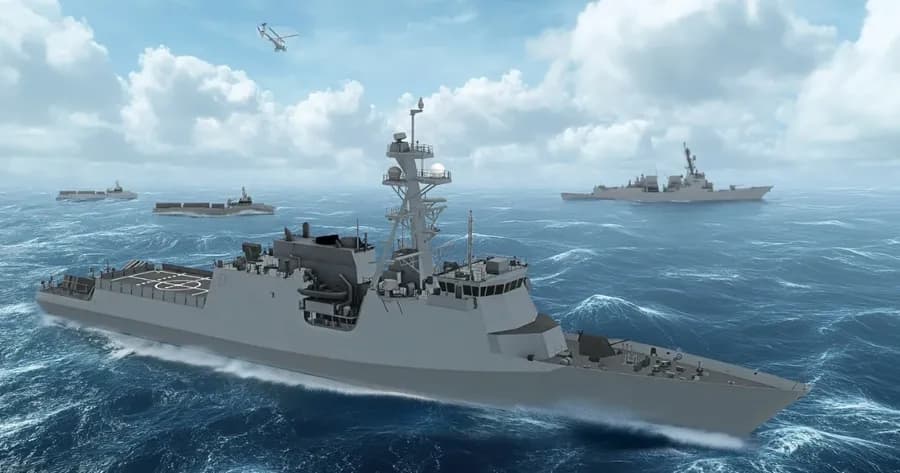
Bridging the VLS Gap: The Navy's Frigate Pivot
Last updated 06:21 AM EDT • Read time: 5m
The United States Navy is facing an acute crisis of capacity. With the Ticonderoga-class cruisers rapidly aging out and the Constellation-class frigate program capped due to severe design delays and industrial bottlenecks, the fleet is staring down a massive deficit in Vertical Launch System (VLS) cells. In naval warfare, VLS cells are the absolute currency of combat power.
To prevent this deficit from crippling the fleet in the 2030s, the Navy is being forced into a radical, pragmatic pivot: sacrificing the pursuit of the "gold-plated" ideal in favor of high-volume, mature industrial production.
Stretching the Backbone: The Arleigh Burke Backlog
The immediate stopgap to the VLS crisis relies heavily on the longest-running surface combatant program in modern history: the Arleigh Burke-class (DDG-51) destroyer.
However, American drydock capacity is completely choked. General Dynamics Bath Iron Works (BIW) and Huntington Ingalls Industries (HII) currently have an absolute backlog of 27 Flight III destroyers under contract or targeted for procurement. While Flight III introduces the massive power and sensor revolution of the AN/SPY-6(V)1 active electronically scanned array (AESA) radar, these new hulls are effectively replacing retired cruisers on a one-for-one basis rather than expanding the total fleet count.
Because the Navy cannot afford to drop a single active VLS cell while waiting for new deliveries, it has funded 40-year life extensions for 12 early Flight I hulls (DDG-51 to DDG-71). Originally slated for a 35-year Expected Service Life (ESL), hulls like USS Arleigh Burke and USS John Paul Jones will be pushed into the mid-2030s. The un-extended Flight I and Flight II hulls—which lack organic helicopter hangars but possess critical Aegis upgrades—will be forced to time out sharply at their 35-year marks unless shipyard delays force the Navy to wring out even more structural fatigue hours.
The Solution: The FF(X) 'Legend' Pivot
Recognizing that an 8,000-ton multi-mission warship could not be built fast enough, the Navy canceled the Constellation class beyond its first two ships. To get hulls in the water by 2028, the Navy turned to a proven, domestic hull form: the Coast Guard’s Legend-class National Security Cutter (NSC).
The resulting FF(X) program represents a two-phase scramble to field combat mass.
Flight I: The Stripped-Down Dash
The initial Flight I hulls accept a severe limitation to ensure production speed: zero integrated Mk 41 VLS cells. Instead, they rely heavily on a structurally reinforced "capability in a box" platform elevated above the stern boat deck. This modular space can host containerized setups, including:
- 16 deck-launched Naval Strike Missiles (NSM) for a dense anti-ship punch.
- 48 AGM-114 Hellfire missiles for counter-UAV and swarm defense.
- Containerized Mk 70 Payload Delivery Systems, allowing the ship to act as a distributed strike node.
Flight II: The VLS Integration
A frigate without a VLS is a liability in high-intensity theater operations. Consequently, the Navy fast-tracked Flight II to restore organic teeth to the hull. Historically, HII proposed a 12-cell Mk 41 layout that required no major structural modifications to the NSC hull. However, to maximize capability, Flight II accepts forward hull modifications to standardize a 16-cell Mk 41 VLS footprint.
Utilizing "Tactical Length" cells, a Flight II FF(X) will not carry heavy Tomahawks, but it can carry up to 64 quad-packed ESSM Block 2 missiles. This transforms the ship into a highly capable escort with a robust local air-defense umbrella.
The Global Scale: Why 4,800 Tons is Not "Too Small"
Critics frequently dismiss the 4,800-ton FF(X) as too small, viewing the 7,300-ton Constellation as the minimum acceptable baseline for a modern frigate. This critique stems from an analytical bias that conflates raw size with survivability while ignoring both history and international standards.
Class
Full Load Displacement
Missile / VLS Capacity
WWII Fletcher DD
~2,500 tons
None (Gun/Torpedo focus)
FF(X) (Legend Hull)
~4,800 tons
16 Cells + 16 NSM (Flight II)
Type 054A (China)
~4,000 tons
32 Cells
Mogami (Japan)
~5,500 tons
32 Cells
Arleigh Burke Flt III (Destroyer)
~9,700 tons
96 Cells
When stood against a World War II Fletcher-class destroyer—the front-line fleet workhorse that won the Pacific War—the modern FF(X) is nearly twice as heavy, 40 feet longer, and vastly more survivable in high sea states. Globally, the most capable, mass-produced frigates in the world, such as China’s Type 054A and Japan’s Mogami class, operate squarely in the 4,000-to-5,500-ton sweet spot. The U.S. Navy's insistence on calling 9,700-ton Arleigh Burkes "destroyers" has artificially inflated expectations. The FF(X) is not a dead-end hull; it is a realistically scaled frigate designed to be built.
The Additive Fleet: Co-Producing an Americanized Mogami
While the FF(X) solves the design bottleneck, the physical drydock bottleneck remains. BIW and Ingalls are flat out with heavy combatants, and HII is simultaneously spinning up the Legend-based line. To truly close the VLS gap, the U.S. must look beyond its own shores for additive hull volume.
The ultimate industrial workaround is an allied division of labor utilizing Japan's highly automated Mogami-class production lines. Currently pumping out two hulls per year with massive design-for-manufacturing efficiency, Mitsubishi Heavy Industries (MHI) offers a readily available pipeline.
An "Americanized Next-Gen Mogami" would execute a simple, devastatingly effective industrial strategy: "Built in Japan, Armed in America."
- The Japanese Hull: Japanese yards fabricate the clean, stealthy steel hull, install the main propulsion machinery, and deliver a floating "green hull" across the Pacific.
- The American Fit-Out: Underutilized U.S. West Coast yards (such as NASSCO in San Diego) receive the hulls and install standardized U.S. combat systems—specifically the AN/SPY-6(V)3 radar and 32 Tactical-Length Mk 41 VLS cells.
Because this pipeline operates entirely in parallel to domestic production, it does not cannibalize a single hour of labor from Maine or Mississippi. It introduces an additive stream of 64 VLS cells to the fleet every year. By marrying American systems integration with Japanese heavy manufacturing, the U.S. Navy can restore its high-low mix, field a 90-sailor automated frigate, and permanently bridge the VLS deficit before the clock runs out on its legacy destroyers.
Bruce Allen Lubbering held several management positions with aerospace manufacturing companies in a career that lasted over 30 years.

In Pursuit of Nuclear Abolition
By Peter Huessy • RealClearDefense
Innovation Alone Won’t Prepare the U.S. for the Future Battlefield
By Joshua Segal • RealClearDefense
The sUAS Tactical Trifecta
By Bryan T. Woody • RealClearDefense
The Revolutionary War: When Strategic Options Share the Same Weakness
By Henry Yep • RealClearDefense
The Houthis Are Testing the Limits of Collective Defense
By Saima Afzal • RealClearDefense

Who Shoots Down the Drone Over the Shipyard?
By John Ferrari & Dillon Prochnicki • RealClearDefense
Northrop Grumman Breaks Out the Big Guns at AUSA
By Daniel Terrill, Defense News
Army Pursuing Diverse Array of New Anti-Air Interceptors
By Trevithick, The WarZoneWho Shoots Down the Drone Over the Shipyard?
By John Ferrari & Dillon Prochnicki, RCD
F-35C Lands for the First Time on a Ford-Class Aircraft Carrier
By The Aviationist