
Combat Motivation in the Navy
Last updated 09:40 PM EDT • Read time: 5m
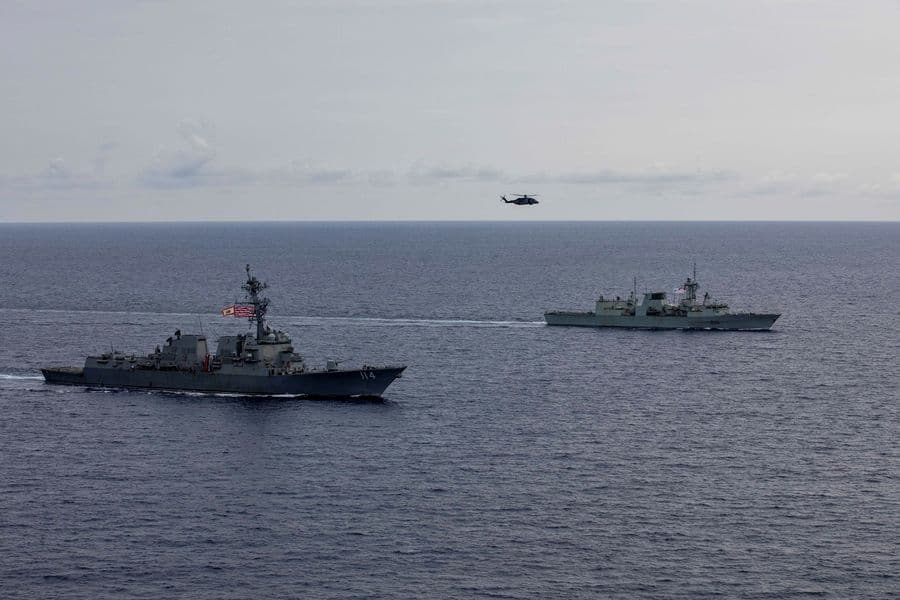
(June 18, 2024) The Arleigh Burke-class guided-missile destroyer USS Ralph Johnson (DDG 114), left, conducts bilateral operations with Royal Canadian Navy Halifax-class frigate HMCS Montreal (FFH 336) in the South China Sea, June 18, 2024. Combined operations such as this are intended to improve interoperability between allied navies and support a free and open Indo-Pacific. Ralph Johnson is forward deployed and assigned to Destroyer Squadron (DESRON) 15, the Navy’s largest DESRON and the U.S. 7th fleet’s principal surface force. (U.S. Navy photo by Mass Communication Specialist Seaman Trevor Hale)
Back in my days at National Defence Headquarters (NDHQ) in Ottawa, Canada, I worked at the Operational Research and Analysis Establishment, and was assigned to write a report on combat motivation in naval forces. I got the job right after graduating with my honour’s degree in Sociology from the University of King’s College, where I wrote my thesis on combat motivation in the infantry. My supervisor at NDHQ, Anthony Kellett, was the author of a well-received book on that topic, and he thought that a paper that concentrated on motivation in the sea service would break new ground, and indeed it did. My 37-page report entitled “Combat Motivation and Behaviour Among Naval Forces: A Discussion Paper” garnered applause from the American Chief of Naval Operations, SACLANT, CINCPACFLEET, the Chiefs of Staff of the German, Australian, Italian, Chilean, New Zealand, and Canadian navies, plus senior officers of the Royal Navy, French navy, and Korean navy.
I began the paper with a quote from military historian Gwynne Dyer, who said in the first edition of his book, War, that he didn’t think that combat motivation was very important in naval forces. This surprised me, as Dyer had served in the navies of Canada, the UK and the US. He said: “For practical purposes, navies are as old as armies, but they have always lived and fought in what was, by contemporary standards, a high-technology environment. They have never faced the same acute problems of control as armies, since their men are all contained within their ships and less often exposed to physical terror. By and large, naval officers have tended to view human behavior in the same essentially pessimistic way as their army counterparts, but their view of battle has always been simpler. Battle at sea is a complicated and unpredictable problem, but all the relevant factors depend either on technology or on human decisions made in relatively unharassed circumstances by a commanding officer who knows that all his ships will obey his orders so long as they are afloat, and the fears of individual sailors will probably not sabotage his plans.” (p. 137) In the pages that followed, I challenged this view, which appeared to be one that was commonly held, and the reason why few studies of combat motivation in naval forces existed at the time.
I discussed the naval environment, with its inherent hostility to mankind, and suggested that its unique dangers made combat motivation just as important for sailors as it obviously is for soldiers. Combat at sea has the potential for great loss of life, such as the destruction of aircraft carriers during World War II. I used the example of submariners undergoing the horrors of a depth charge attack to suggest, with all due respect to Dr. Dyer, that these circumstances are certainly not “unharassed” and that self-discipline, leadership, crew rotation policies, training, cohesion and pride all play the same key role in the navy as they do in the army. Another example I used was a survey that discovered that despite the extremely stressful life of American submariners in World War II that they actually had a lower neuropsychiatric breakdown rate than their allies in surface ships. This was due to high selection and training standards, as well as well-thought-out policies for crew rotation, liberty, and the maintenance of the fighting spirit.
I sent a copy of my report to the renowned submarine skipper and author Captain Edward L. Beach, USN (ret.), and he really liked it. However, he did point out that many USN submarines did not perform well in World War II: “I think you’ve accurately put your finger on our motivation in the Submarine Force, particularly as relates to ‘good’ submarines, of which there was quite a number. As you can imagine, however, there were also quite a few that did not perform well, and in every case, it was my reaction that this was because of the officers and their ability – or inability—to inspire their crews. Some skippers, in fact, were known to be not only ineffective, but in some cases, they seemed to be lacking in courage – although as a qualification to this indictment one would have to cite the improperly-directed training they had received in the prewar years.”
Captain Beach’s endorsement as a combat veteran in the Pacific gave my research the credibility it needed to be taken seriously, and I am pleased to report that in the current edition of Dyer’s book, published in 2016, the offending paragraph quoted above has been removed. Perhaps he changed his mind? I don’t know, but hopefully there will be more studies on the importance of combat motivation in naval forces.
Roger Thompson is a Fellow of the Inter-University Seminar on Armed Forces and Society, a Researcfh Fellow at Dalhousie University’s Centre for the Study of Security and Development, the author of “Lessons Not Learned: The US Navy’s Status Quo Culture”, and a former researcher at Canada’s National Defence Headquarters.
Notes:
Gwynne Dyer, War (New York: Crown Publishers, 1985).
Edward L. Beach, letter to Roger Thompson, 31 March, 1994.

Iranian Cyber Operations
By Michael Groen • RealClearDefense
Reflecting on an Epic Horse Campaign in the Mountains of Afghanistan
By Brian Glyn Williams • RealClearDefense
The Godfather of American Foreign Policy Realism Speaks to Today’s World
By Francis P. Sempa • RealClearDefense
In Pursuit of Nuclear Abolition
By Peter Huessy • RealClearDefense
Innovation Alone Won’t Prepare the U.S. for the Future Battlefield
By Joshua Segal • RealClearDefense

Navy Civilianizes Six Former Flag Billets, Reduces Six to Captains
By Mongilio, USNI N.
Raytheon's $8B Contract for Strategic Comms Terminal Modernization
By M+A El
America’s Maritime Moment Will Not Wait
By CDR Salamander
Armor Up?
By Marine Corps Compass Points
Who Shoots Down the Drone Over the Shipyard?
By John Ferrari & Dillon Prochnicki • RealClearDefense