
Fixing America's Navy
Last updated 09:21 AM EDT • Read time: 6m
After dominating the world's sea lanes since the end of World War II, surviving challenges from the Soviet Navy throughout the Cold War, the United States Navy faces its first significant threat to naval superiority. China seeks to become not only the master of the South China Sea (SCS), but project Naval power globally.
While China grows their fleet to extend beyond the South China, the U.S. Navy has much of its fleet tied up in the Persian Gulf, Caribbean Sea, and a limited presence in the South China Sea. The U.S. Navy is spread thin and with China on the verge of having multiple carrier strike groups, the U.S. Navy’s sea dominance will soon be challenged.
The challenge comes as China’s shipbuilding is rapidly outpacing the U.S. making the situation appear dire, particularly after failed endeavors like the Littoral Combat Ship, Zumwalt-class destroyer, and a domestically designed frigate. This, while the Navy is rapidly decommissioning the Ticonderoga-class destroyer without a replacement.
Without fundamental changes to Navy planning, budgets, and execution, China could soon pass the U.S. on the way to dominating the seas.
There are, however, shimmers of nighttime red sky for the U.S. Navy. First, the Navy, particularly the Pacific fleet, has proven exemplary at integrating sea control with joint operations with the ability to fire long-range hypersonic anti-ship missiles capable of reaching the People’s Liberation Army Navy (PLAN) throughout the First Island Chain.
Adding to the U.S. Navy’s lethality will be the ability to integrate the capabilities of the U.S. Army, U.S. Marine Corps, and U.S. Air Force showcased recently in the Philippines with Exercise Balikatan 2026.
And while the Navy is facing a deficit in the ability replenish at sea, this capability is only just being developed by China’s PLAN.
Despite the glimmers of red skies at night there lurks a red sky at dawn for the U.S. Navy.
First and foremost is Shipbuilding and Maintenance. While the Ships ACT seeks to reverse years of industrial decline since World War II, it will take years, if not decades to achieve the capacity required for both commercial and naval shipbuilding. There is also the potential to utilize the capabilities of allies such as South Korea and Japan to increase shipbuilding capacity and maintenance in the near term, the “America First” agenda stands in the way of making any solid commitment.
The Navy also needs to consider the decommissioning of ship before there is a viable replacement, such as the Ticonderoga-class cruiser with its batter of missiles that cannot be supplanted by the Arleigh Burke-class destroyers or any other ship in the active fleet. Ships will need to have their service life extended until we are able to produce a viable combat ready replacement.
Decades ago, I suggested that, rather than requiring ships with working power plants and sound hulls to be retired, we should consider replacing sensor and weapons systems with updated modules the Navy is doing this to some extent with Arleigh Burke class, but we should do the same thing with amphibious vessels and minesweepers. We should also consider buying back amphibs and minesweepers that we sold to allies.
To counter Chinese advancements like containerized missiles on merchant ships. We should consider doing something similar with retired oil tankers. With our current emerging autonomous technologies, we have the ability to neutralize the Chinese recon-strike complex.
Secondly, Personnel, Education, and Training. As the fleet expands to statutorily required minimums and beyond, so too will the number of Navy personnel. Automation and AI will help, but there will still be many tasks that require a human at the helm.
Expanding Naval ROTC programs would be useful at meeting short term needs, but the Navy should also consider employing a version of the Marine Corps' Platoon Leader Class program in which college students spend one or two summers at OCS before commissioning at graduation. Something similar should be done with enlisted ranks. Rising high school seniors could finish boot camp in their post-junior summer allowing them to go directly to their MOS training school after graduation. Most high school students look for good summer jobs, and such a program would be very competitive with the civilian job market.
Regarding training, the Navy should consider getting back to the basics of seamanship by working without advanced navigation aids and increasing training in electronic warfare along with incorporating unmanned systems. Reviewing the first naval battle of Guadalcanal where radar played very little part and ship-to-ship communications were limited were invaluable lessons that are still relevant today.
Lastly, Eliminate Marine Corps Force Design. Force Design (FD) is the most detrimental factor limiting the Navy-Marine Corps team from modernization to meet not only the China threat, but also potential threat across the globe.
The obsolete short range, subsonic NEMSIS missile system is preventing the Marine Corps from acquiring over-the-horizon long range hypersonic anti-ship missiles. And the Landing Ship Medium needed to support FD would adversely affect the construction of large deck amphibious ships needed to support the administration's expanded need for a ready Navy-Marine Corps presence in all combatant command areas of operation.
There is nothing fundamentally wrong with the Navy that cannot be fixed with proper planning, budget, and execution that has been lacking for decades. The short term fixes I listed would save money and allow the Navy to achieve their objectives before China.
Gary Anderson is retired Marine Corps Colonel who served as a civilian Special Advisor the Deputy Secretary of Defense. He is the author of Beyond Mahan, A Proposed Naval Strategy for the 21st Century.
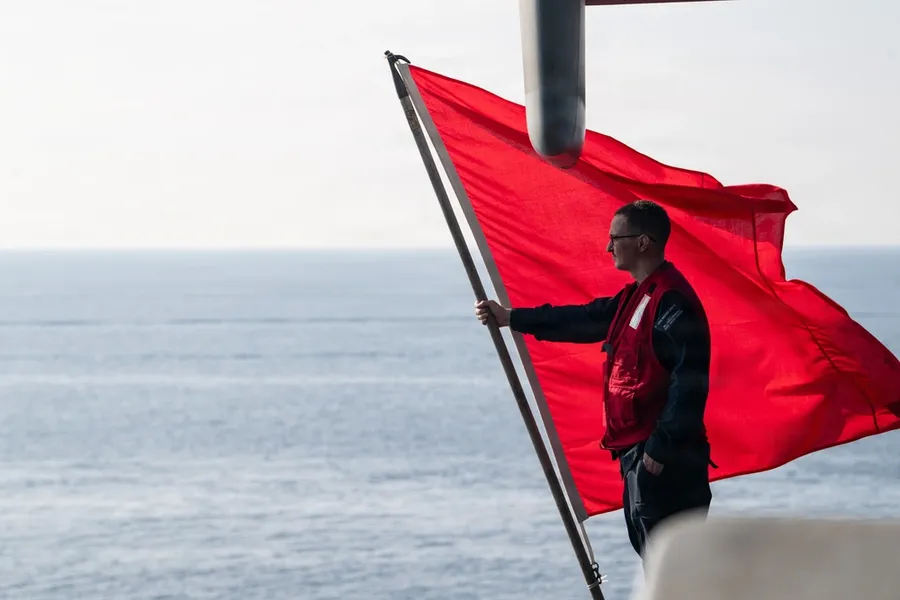
image: U.S. Navy Quartermaster 3rd Class Joshua Nelson, assigned to Wasp-class amphibious assault ship USS Boxer (LHD 4), holds a flag marker at the ship’s bow to align Boxer with Lewis and Clark-class dry cargo and ammunition ship USNS Alan Shepard (T-AKE 3), during a replenishment-at-sea, June 15, 2026. Boxer, flagship of the Boxer Amphibious Ready Group, is underway with the 11th Marine Expeditionary Unit in the U.S. 7th Fleet area of operations. U.S. 7th Fleet, the Navy’s largest forward-deployed numbered fleet, routinely interacts and operates with allies and partners to preserve a free and open Indo-Pacific. (U.S. Navy Photo by Mass Communications Specialist 3rd Class Martin Perez)

Iranian Cyber Operations
By Michael Groen • RealClearDefense
Reflecting on an Epic Horse Campaign in the Mountains of Afghanistan
By Brian Glyn Williams • RealClearDefense
The Godfather of American Foreign Policy Realism Speaks to Today’s World
By Francis P. Sempa • RealClearDefense
In Pursuit of Nuclear Abolition
By Peter Huessy • RealClearDefense
Innovation Alone Won’t Prepare the U.S. for the Future Battlefield
By Joshua Segal • RealClearDefense

26th MEU – U.S. Needs Crisis Response MAGTF
By Marine Corps Compass Points
The Influence of History on a Sea Power
By CDR Salamander
Navy Civilianizes Six Former Flag Billets, Reduces Six to Captains
By Mongilio, USNI N.
Raytheon's $8B Contract for Strategic Comms Terminal Modernization
By M+A El
America’s Maritime Moment Will Not Wait
By CDR Salamander