
Navigating the Deep: An Analysis of the Canadian Patrol Submarine Project (CPSP)
Last updated 06:48 AM EDT • Read time: 7m
The $80 billion Canadian Patrol Submarine Project (CPSP) represents one of the most consequential defense procurement decisions in modern Canadian history. Driven by the impending retirement of the Royal Canadian Navy’s (RCN) aging Victoria-class submarines, the program seeks to acquire a fleet of up to twelve conventionally powered, under-ice capable submarines. As the evaluation narrows to the final stages, two primary contenders have emerged with distinctly different operational philosophies and economic frameworks: South Korea’s Hanwha Ocean proposing the KSS-III, and Germany’s ThyssenKrupp Marine Systems (TKMS) offering the Type 212CD.
The Proposals: A Comparative Baseline
The CPSP competition has evolved beyond simple platform specifications into a duel of comprehensive industrial strategies. Because the submarines will be constructed outside of Canada, the economic offset packages—mandated to stimulate domestic industry—are as vital as the technical schematics.
Hanwha Ocean (KSS-III)
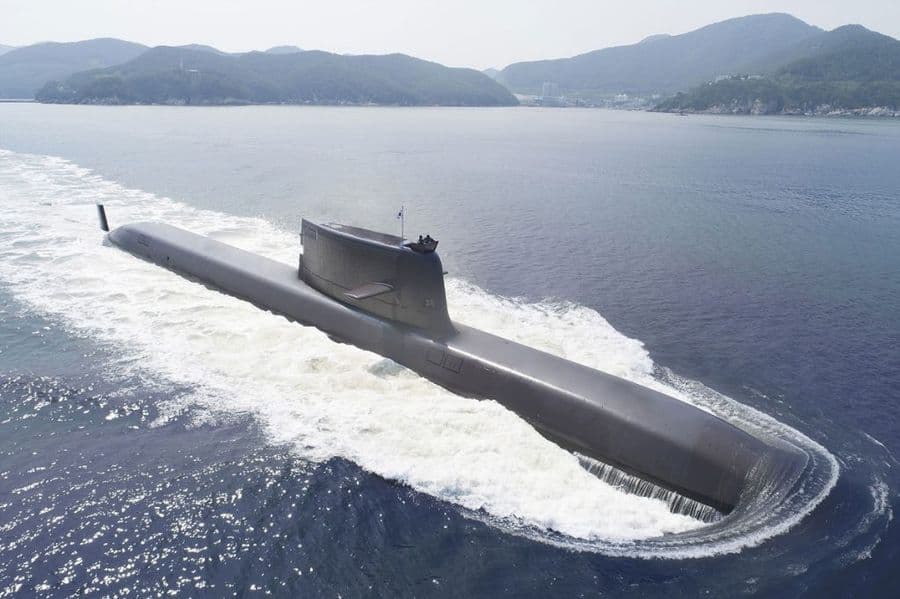
Hanwha Ocean is offering a modified, scaled-down export variant of the active KSS-III platform. While the South Korean domestic Batch-II variants displace roughly 3,600 tons, the variant proposed to the RCN is redesigned to approximately 2,800 tons to align with existing Canadian port infrastructure and maintenance realities. Its propulsion relies on a combination of Air-Independent Propulsion (AIP) and advanced lithium-ion batteries.
Economically, Hanwha’s proposal is anchored by a $94 billion projected GDP impact and $60 billion in economic opportunities between 2026 and 2044, supporting an average of 22,500 full-time jobs annually. The package focuses heavily on direct manufacturing muscle and high-tech infrastructure:
- The Automotive and Steel Tie-In: Hanwha signed a conditional agreement with the Automotive Parts Manufacturers' Association to build heavy military vehicles in Canada using domestic steel and aluminum, directly sustaining existing manufacturing bases.
- Naval Infrastructure: The proposal establishes maintenance, repair, and overhaul (MRO) facilities on both Canadian coasts, alongside the Hanwha Arctic and Defence Innovation Centre (HADIC) to fund R&D in AI, digital engineering, and autonomous systems.
- The Aerospace Expansion: Expanding beyond traditional heavy industry, Hanwha's latest addition to the package introduces a strategic investment into Canada's domestic commercial space launch sector, partnering with local firms to actively bolster light-to-medium lift capabilities.
TKMS (Type 212CD)
ThyssenKrupp Marine Systems is offering a derivative of the Type 212CD, an advanced platform currently under joint development by Germany and Norway. Displacing around 2,500 tons, the 212CD is engineered primarily for extreme acoustic stealth. Its defining feature is a faceted, angular "diamond" hull shape explicitly designed to deflect active sonar, paired with an ultra-quiet hydrogen fuel-cell AIP system.
The TKMS economic offset package projects an $86 billion boost to the Canadian GDP, heavily front-loaded in the initial years of the contract. Rather than focusing purely on traditional manufacturing, the German proposal is a broader geoeconomic play. It includes establishing domestic facilities for manufacturing heavy torpedoes and anti-torpedo systems, alongside non-defense investments such as funding carbon capture infrastructure and developing the Port of Churchill in Manitoba for liquefied natural gas (LNG) and critical mineral exports to Europe.
The Delivery Gap: 2032 vs. 2036 Promises
The most critical pressure point in the CPSP is the timeline. The current Victoria-class fleet is running on borrowed time. Acquired from the British Royal Navy in the late 1990s (having been built in the 1980s), the fleet requires extensive life-extension measures. To prevent the atrophy of its submarine cadre before new boats arrive, Canada is executing the $1 billion Victoria-class Modernization (VCM) program—incrementally installing digital masts, sonar upgrades, and habitability improvements to keep the aging 40-year-old hardware safe for operation.
Against this backdrop, the delivery promises of the two finalists present vastly different risk profiles.
The Hanwha Timeline (2032–2035)
Hanwha Ocean has promised to deliver the first KSS-III hull by 2032, with a total of four boats delivered by 2035.
- Pros: This timeline is rooted in the reality of a currently active, hot production line. Because the KSS-III is actively being built and deployed, the supply chain is mature, reducing the risk of component bottlenecks. Delivering the first vessel by 2032 drastically minimizes the window during which the RCN must rely on the modernized but fragile Victoria-class.
- Cons: Meeting this aggressive schedule with a newly modified 2,800-ton export variant leaves minimal margin for error in the redesign and systems integration phase, requiring immediate and decisive contract finalization by the Canadian government.
The TKMS Timeline (2036)
In the final stages of the competition, Germany formally pledged that TKMS could deliver four Type 212CDs to Canada by 2036. To achieve this, Germany and Norway offered to temporarily relinquish their own slots in the production queue.
- Pros: This arrangement guarantees Canada a place in a highly advanced European defense pipeline, ensuring seamless logistical and technical interoperability with key NATO allies.
- Cons: The 2036 timeline pushes delivery dangerously late into the decade. The Type 212CD is a highly complex, next-generation platform not yet in active service, carrying inherent developmental and schedule friction risks. Should delivery slip past 2036, Canada risks a severe capability gap where the Victoria-class may succumb to structural fatigue or parts obsolescence before replacements arrive, potentially grounding the submarine fleet entirely.
The VCM Risk Factor: Any delay beyond 2032 forces the RCN to continue rolling the dice on legacy hardware. In naval procurement, forcing crews to dive in hulls approaching 50 years of age represents a compounding, unacceptable mechanical risk.
The Strategic Importance of Vertical Launch Systems (VLS)
Beyond timelines, the most glaring technical disparity between the two bids is armament architecture. The TKMS Type 212CD relies entirely on traditional horizontal torpedo tubes, restricting its role strictly to anti-submarine warfare (ASW), anti-surface warfare, and covert intelligence gathering. In contrast, the Hanwha KSS-III is equipped with a Vertical Launch System (VLS).
VLS cells are specialized silos built into the hull of a vessel that allow for the vertical firing of long-range munitions, primarily land-attack cruise missiles. For Canada, acquiring a VLS-equipped submarine fleet fundamentally alters its maritime doctrine for several factual reasons:
- Distributed Lethality: Currently, Canada’s future surface combatants (the River-class destroyers) are designed with only 24 VLS cells per ship. Concentrating an entire navy's strike capability on a small number of surface ships creates high-value targets. Distributing VLS capability across twelve stealthy submarines multiplies the axes of threat against an adversary and ensures the fleet's offensive punch cannot be neutralized in a single surface engagement.
- Strategic Deterrence and Blue-Water Power: A submarine restricted to torpedoes can only threaten ships and submarines within a relatively short tactical radius. A submarine equipped with VLS can hold inland strategic targets, logistics hubs, and command centers at risk from hundreds or thousands of kilometers away while remaining submerged. This provides Canada with a conventional deterrent and a power-projection tool it has never historically possessed.
- Allied Interoperability: Modern US and allied naval doctrines in theaters like the Indo-Pacific increasingly rely on dispersed, long-range fires. A Canadian submarine equipped with VLS cells integrates seamlessly into this architecture, allowing the RCN to contribute tangible offensive firepower to allied task forces rather than acting purely as a defensive screening asset.
Conclusion
The Canadian Patrol Submarine Project forces Ottawa to choose between two distinct maritime futures. The TKMS Type 212CD offers the diplomatic comfort of deepening traditional European NATO ties and provides an engineering marvel optimized for localized, ultra-quiet surveillance. However, it requires accepting significant schedule risk that could stretch the Victoria-class beyond its safe operational limits.
Conversely, the Hanwha KSS-III offers the pragmatism of an active production line capable of meeting a strict 2032 delivery requirement. Backed by an economic package that feeds directly into Canada’s existing heavy manufacturing and burgeoning aerospace launch sectors, it also introduces a critical Vertical Launch capability that transforms the RCN’s submarines from localized defensive assets into strategic tools of distributed lethality. Ultimately, the decision will dictate Canada's under-ice and blue-water maritime readiness for the next half-century.
Bruce Allen Lubbering held several management positions with aerospace manufacturing companies in a career that lasted over 30 years. His responsibilities included Project and Program Management positions for companies supplying fabricated parts, assemblies and equipment for many different military and commercial aircraft including the F-15, B-2,737NG and among others.

In Pursuit of Nuclear Abolition
By Peter Huessy • RealClearDefense
Innovation Alone Won’t Prepare the U.S. for the Future Battlefield
By Joshua Segal • RealClearDefense
The sUAS Tactical Trifecta
By Bryan T. Woody • RealClearDefense
The Revolutionary War: When Strategic Options Share the Same Weakness
By Henry Yep • RealClearDefense
The Houthis Are Testing the Limits of Collective Defense
By Saima Afzal • RealClearDefense

Who Shoots Down the Drone Over the Shipyard?
By John Ferrari & Dillon Prochnicki • RealClearDefense
Northrop Grumman Breaks Out the Big Guns at AUSA
By Daniel Terrill, Defense News
Army Pursuing Diverse Array of New Anti-Air Interceptors
By Trevithick, The WarZoneWho Shoots Down the Drone Over the Shipyard?
By John Ferrari & Dillon Prochnicki, RCD
F-35C Lands for the First Time on a Ford-Class Aircraft Carrier
By The Aviationist