
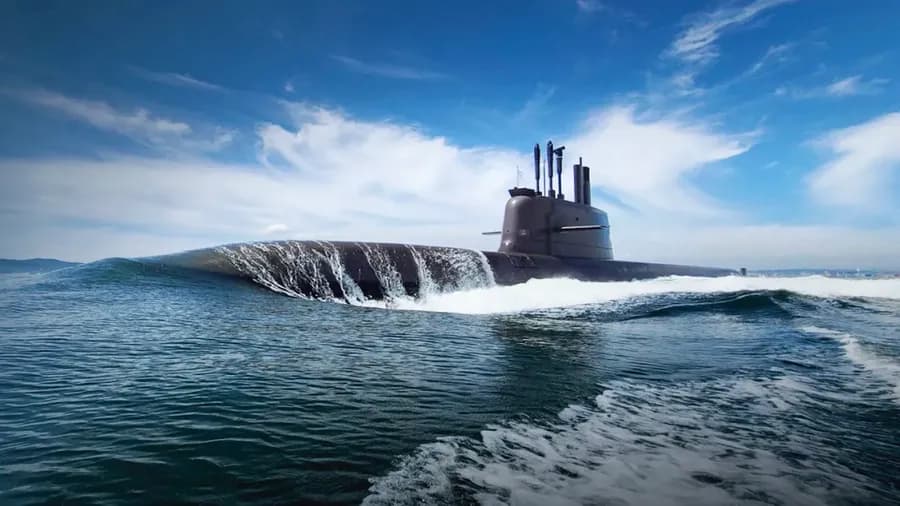
South Korea's Nuclear-Powered Submarine Ambition
Last updated 06:44 AM EDT • Read time: 5m
South Korea’s nuclear-powered submarine ambition has entered Washington’s strategic agenda. The inclusion of related language in the appendix report accompanying the Fiscal Year 2027 National Defense Authorization Act is not formal U.S. approval of Seoul’s program. Nor is it a commitment to provide nuclear fuel, reactor technology, or design assistance. But it is meaningful: Congress is now treating South Korea’s long-standing submarine ambition as a serious alliance issue requiring scrutiny.
That distinction matters. For years, South Korean advocates have argued that nuclear-powered submarines are necessary to counter North Korea’s expanding submarine-launched ballistic missile capabilities, improve anti-submarine warfare, and give Seoul greater endurance in undersea operations. These arguments are serious. But they have often been framed in South Korea as a question of national capability or naval prestige. In Washington, the issue is also about alliance management, nonproliferation, technology security, cost, and regional stability.
The FY2027 NDAA appendix language should, therefore, be read carefully. It directs the U.S. Department of Defense, with the Department of State, to examine bilateral cooperation, regional security implications, cost, effects on conditions-based wartime operational control transition, and proliferation risks. Congress is asking whether South Korea’s ambition can become a disciplined alliance project rather than an open-ended political demand.
For Seoul, this is both an opportunity and a warning. The opportunity is evident. South Korea’s case is stronger today than it was a decade ago. North Korea is no longer merely a land-based missile threat. Pyongyang is investing in sea-based nuclear delivery options, larger submarines, submarine-launched ballistic missiles, and potentially unmanned underwater systems. A South Korean nuclear-powered submarine fleet would not eliminate these threats, but it could improve Seoul’s ability to track and deter North Korean undersea platforms.
Conventional diesel-electric submarines remain capable near the Korean Peninsula. But they are limited in endurance, speed, and sustained operations across wider maritime areas. Nuclear-powered submarines offer longer patrols and better survivability. Properly integrated into combined planning, they could enhance the U.S.-South Korea alliance’s undersea deterrence posture and reduce pressure on overstretched U.S. naval forces in the Indo-Pacific.
That is the strongest argument Seoul can make in Washington: South Korean nuclear-powered submarines would not be a symbol of strategic autonomy from the United States, but a contribution to alliance burden-sharing. They would allow South Korea to assume greater responsibility for deterring North Korea while supporting a more resilient allied undersea architecture. But that argument will work only if Seoul defines the mission clearly. If the submarines are presented as a prestige project or a steppingstone toward an independent nuclear option, support in Washington will narrow.
The warning is equally important. The FY2027 NDAA appendix language shows that Washington will examine risks as seriously as benefits. The most sensitive issue is nonproliferation. Nuclear propulsion is not the same as nuclear weapons, but it still involves the military use of nuclear material. South Korea remains a non-nuclear-weapon state under the Nuclear Non-Proliferation Treaty. Any arrangement involving submarine fuel would therefore attract international attention.
Seoul must be ready to answer hard questions. Would the submarines use highly enriched uranium or low-enriched uranium? How would nuclear material be safeguarded? What role, if any, would the International Atomic Energy Agency play? How would spent fuel be managed? Would the arrangement create a precedent for other non-nuclear states? These questions are inevitable. The United States cannot support such a program unless it can defend that support as consistent with the global nonproliferation regime.
Technology security is another major challenge. The broader FY2027 NDAA appendix report also reflects concern over Chinese Communist Party influence in South Korea, a reminder that Washington will view any sensitive submarine cooperation through the lens of technology protection and political resilience. That does not mean Washington distrusts Seoul. But the United States will be sensitive to technology leakage, cyber intrusion, industrial espionage, political influence, and supply-chain vulnerability. Even without U.S. transfer of reactor designs or propulsion technology, serious cooperation could touch on fuel arrangements, acoustic signatures, undersea warfare systems, command-and-control integration, and classified operational concepts.
There is also a fiscal problem. Nuclear-powered submarines are costly. They require specialized shipyards, trained nuclear personnel, safety institutions, maintenance facilities, regulatory systems, and decades of stable funding. A small fleet may offer limited strategic value; a larger fleet may impose major budgetary tradeoffs.
This is why the report’s reference to conditions-based wartime operational control transition is important. Washington is asking whether South Korea’s pursuit of nuclear-powered submarines could divert resources from other capabilities needed for OPCON transition and combined deterrence, including missile defense, ISR, command and control, cyber resilience, precision fires, munitions stockpiles, and hardened logistics. If the program crowds out more urgent capabilities, it could weaken deterrence.
The policy path forward should be disciplined. Seoul should establish a clear mission statement focused on North Korea, undersea deterrence, anti-submarine warfare, and alliance burden-sharing. It should propose a standing U.S.-South Korea working group on nuclear propulsion, safeguards, technology security, cost, and operational integration. It should develop a credible nonproliferation framework based on conventional armament and strict nuclear material controls. It should also strengthen counterintelligence and cyber protections before expecting deeper U.S. cooperation.
The FY2027 NDAA appendix language is therefore not the end of the debate. It is the beginning of a more serious one. South Korea’s nuclear-powered submarine ambition has entered Washington’s strategic agenda. That is a significant achievement. But Seoul must now make the case in terms Washington understands: alliance value, nonproliferation discipline, technology protection, affordability, and regional stability. The case can be made. But it will require a disciplined strategy, not slogans.
Jihoon Yu, Ph.D., is a research fellow at the Korea Institute for Defense Analyses. He served in the ROK Navy for 27 years as a submarine officer and a strategic officer.

In Pursuit of Nuclear Abolition
By Peter Huessy • RealClearDefense
Innovation Alone Won’t Prepare the U.S. for the Future Battlefield
By Joshua Segal • RealClearDefense
The sUAS Tactical Trifecta
By Bryan T. Woody • RealClearDefense
The Revolutionary War: When Strategic Options Share the Same Weakness
By Henry Yep • RealClearDefense
The Houthis Are Testing the Limits of Collective Defense
By Saima Afzal • RealClearDefense

Who Shoots Down the Drone Over the Shipyard?
By John Ferrari & Dillon Prochnicki • RealClearDefense
Northrop Grumman Breaks Out the Big Guns at AUSA
By Daniel Terrill, Defense News
Army Pursuing Diverse Array of New Anti-Air Interceptors
By Trevithick, The WarZoneWho Shoots Down the Drone Over the Shipyard?
By John Ferrari & Dillon Prochnicki, RCD
F-35C Lands for the First Time on a Ford-Class Aircraft Carrier
By The Aviationist