
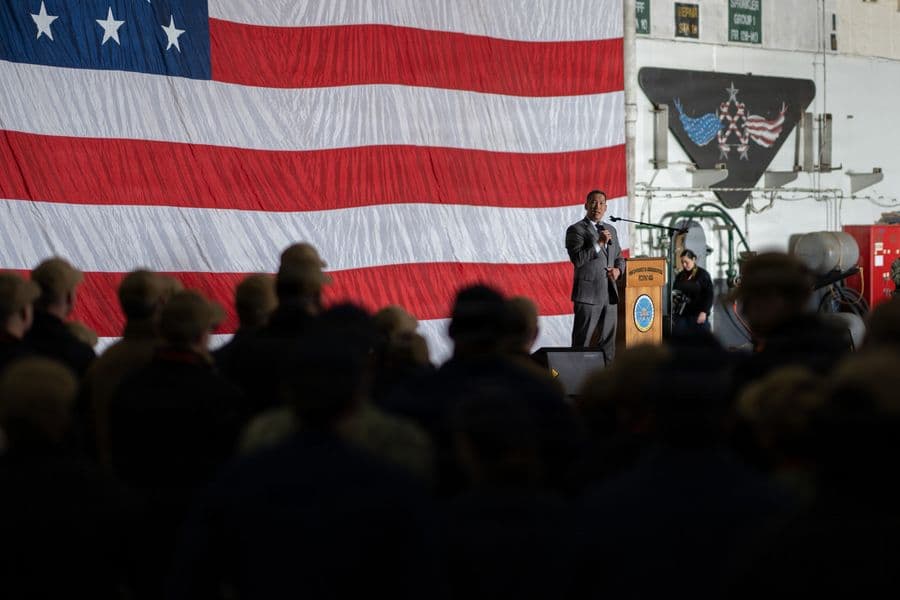
The Dilemma of Hung Cao
Last updated 05:48 AM EDT • Read time: 19m
The Myth of the “Accidental Admiral”
In October 2014, James G. Stavridis published The Accidental Admiral, a reflective account of his rise to four-star rank and his tenure as Supreme Allied Commander of NATO. The “accidental” in his title is meant metaphorically: careers—especially within large, complex institutions—rarely unfold according to design, instead taking shape through opportunity, adaptability, and professional growth.
As a leadership lesson, this is unobjectionable. Taken literally, however, the premise collapses. There is neither precedent nor plausibility for an officer attaining flag rank—admiral—by anything resembling accident. Advancement to the highest echelons demands far more than talent or fortuitous timing. It requires sustained superior performance, deliberate career management, and above all a precise grasp of institutional expectations. There are, in short, no “accidental” admirals.
Yet even these attributes are insufficient. Talent and discipline are necessary but not sufficient. From the earliest stages of a career, those who ultimately reach flag rank make deliberate choices that subordinate personal preference—and, at times, personal conviction—to institutional realities. They pursue assignments that are not merely demanding but visible and competitively allocated, cultivating the relationships upon which further advancement depends. In time, they come to understand that consistent demonstrations of loyalty to sponsors constitute the final, indispensable condition of success. Their ascent is not an accident; it is methodical, exacting, and—above all—calculated.
The Politics of It All
The U.S. military places extraordinary emphasis on maintaining an apolitical officer corps. Its legitimacy depends on public trust and on unequivocal subordination to civilian authority. Within this framework, the armed forces must be seen to serve the nation as a whole—not any party, ideology, or internal leadership faction. Regulations, professional norms, and promotion systems are explicitly designed to reinforce this expectation of neutrality.
Formally, the system functions as intended. Officers are trained to avoid overt political expression, and most adhere closely to these constraints in public.
Yet this formal structure coexists with a more complex reality.
It is widely assumed—both within and outside the service—that senior leaders operate above politics, guided solely by objective military judgment. The assumption is reassuring. It is also incomplete. Advancement to the highest ranks depends not only on performance, but on alignment: the ability to earn and sustain the confidence of senior mentors whose support is the indispensable sine qua non of selection to flag rank. Within such a system, the expression of doubt—let alone open disagreement—by an ambitious junior officer is rarely without consequence. More often than not, it is professionally limiting.
Over time, a recognizable pattern emerges. A small cohort of officers is identified early, placed into career-enhancing assignments—frequently within the Pentagon’s “E Ring”—and developed for senior command beyond the tactical level. Their advancement becomes increasingly probable. In return, an implicit understanding develops: the perspectives and priorities of their sponsors are absorbed, reflected, and perpetuated. Institutional continuity is thus preserved not by accident, but by design. Yet this comes at a cost: senior officers become surrounded by a penumbra of “yes men” who not only never question the admiral’s decisions but also enforce those decisions—good or bad—throughout the organization.
At the most senior levels, this dynamic intersects directly with the actual political system of the U.S. government. While one- or two-star admirals may largely avoid explicit political considerations in their day-to-day duties, that insulation diminishes with each additional star. Promotion to three- and four-star rank is not solely an internal military matter. The Chief of Naval Operations, with input from the Secretary of the Navy, nominates candidates to the U.S. Department of Defense, after which the process moves to the White House. The President formally nominates these officers, and the United States Senate must confirm them. This is not a perfunctory sequence. Candidates are vetted, scrutinized, and evaluated within an explicitly political environment.
Consequently, attainment of vice admiral rank and above renders an officer’s career inseparable from the broader political context. The system neither advances nor nominates officers whose perspectives are fundamentally incompatible with prevailing institutional or political expectations. In practice, few officers reach the threshold of consideration without already exhibiting substantial alignment with the sustained outlook of the flag community. Thus, whatever their formal commitment to neutrality, those who attain these ranks have successfully navigated a system in which political compatibility—if not outright alignment—cannot be ignored.
This alignment operates on two levels. First, within the Navy, officers destined for flag rank must consistently and visibly support the perspectives of their sponsors and more senior leadership. Second, because vice admirals and above are themselves products of a politically fraught selection environment, their orientations inevitably propagate downward, shaping the broader culture of the service.
The Consequences
Since the end of the Cold War, this process has produced a notable degree of ideological convergence within senior naval leadership. One generation of admirals has selected and cultivated the next, reinforcing continuity across successive administrations. The result has been a system that tends to reproduce its own assumptions.
Against that backdrop, the Republican administrations of this century have had limited success in altering what many perceive as an increasingly Democratic-leaning orientation within the flag ranks. A cohort of senior leaders—sometimes informally labeled “Clintonistas”—advanced and, in turn, selected and developed their successors with relatively little reference to passing Republican leadership.
As for the administration of George W. Bush, consumed by the demands of the post-9/11 wars, it functioned largely as an intensive user of military power rather than an active shaper of the institution itself. Focused on operational demands in Iraq and Afghanistan, it paid comparatively less attention to the evolving dynamics of senior military leadership. That inattention—combined with a degree of institutional naiveite regarding the Navy’s drift to the Democratic end of the political spectrum—left existing patterns largely undisturbed, setting conditions that carried forward into the subsequent administration. As for the Obama administration, it appeared to increasingly consider the military to be an appropriate venue for social engineering, regardless of the cost in readiness, and this perspective was aggressively carried forward by the Biden administration, which found a military led by like-minded senior leadership.
The first administration of Donald Trump, while representing a profoundly different orientation, was unprepared to address the military’s inclination. Its relationship with senior military leadership was frequently disjointed, at times bordering on shambolic. In practice, this disconnect allowed elements of the uniformed leadership to default to a strategy of passive endurance—of waiting out the Trump administration— rather than active alignment, as required by law and history, preserving continuity in their long-developed perspectives despite the change in political leadership.
The cumulative effect has been the persistence of a relatively narrow band of viewpoints at the highest levels of naval leadership—one that has endured across administrations of both parties. Whether appropriate or not, and irrespective of the formal expectation of apolitical conduct, changes in civilian leadership have not produced commensurate changes within the senior ranks. The result is a senior officer corps that functions, in effect, as a politically coherent institution. There is, ultimately, nothing particularly apolitical about military leadership.
Case Study: Alignment in Practice
In practice, the incentives are clear: officers who align with senior expectations are advanced; those who do not are quietly set aside.
A case from the late-1990s illustrates the dynamic. Under mounting budget pressure, the Navy sought to reduce crew sizes on surface combatants. A guided-missile cruiser typically carried roughly 360 sailors, yet senior leadership sought reductions to lower operating costs. Whether such crew-size reductions were operationally sound was a secondary consideration.
A well-connected captain—widely understood to be on a path to flag rank—was tasked with conducting the study. He understood both the desired conclusion and the professional consequences of deviating from it. The resulting report found that significant personnel reductions would have no meaningful impact on mission performance—precisely the outcome senior leadership expected.
The commanding officer of the ship involved strongly disagreed, arguing that the conclusions bore little resemblance to operational reality. His objections were noted but had no effect. The study stood; the policy advanced.
The subsequent career trajectories were instructive. The author of the study rose to four-star rank and as he rose, he carried forth the political inclinations inculcated in him by his sponsors. His perception of what was wanted was rewarded, and the perspectives of the “Clintonistas” was sustained across time. As for the ship’s commanding officer, it is impossible to say whether his objection caused harm to his career, but what is fair to say is that he boasted of an otherwise sparkling resume, featuring a highly competitive executive assistant posting. Nevertheless, he retired as a captain.
In time, the study’s conclusions proved to be fundamentally flawed, but by then the institutional decisions were already locked in.
The lesson is straightforward: the system rewards alignment, not dissent.
Senior Leadership and Policy Convergence
In the contemporary environment, most officers continue to observe the norm of public neutrality, regardless of private views. At the level of three- and four-star command, however, neutrality becomes more complex. These officers are not merely shaped by the system—they also help sustain it, and their decisions carry institution-wide consequences.
While not a naval officer, the case of Mark Milley is illustrative. As Chairman of the Joint Chiefs of Staff, Milley publicly and aggressively supported diversity and inclusion initiatives as contributing to military effectiveness and endorsed policies permitting transgender individuals to serve. These policies were subsequently implemented across the services, including the Navy, through established civilian and military channels.
Once promulgated, there was no discernible institutional resistance across the uniformed services. Critics argued that this raised legitimate questions about whether dissenting professional judgments were adequately surfaced during policy formation, particularly regarding potential impacts on readiness, cohesion, and discipline. At the same time, the principle of civilian control is unambiguous: lawful policy decisions are to be executed by the military.
The more consequential issue is therefore not compliance, but candor—whether senior officers meaningfully surface dissenting professional assessments before decisions are finalized, particularly when such decisions affect core warfighting effectiveness. In practice, the incentives to do so are limited, and the risks are clear. There is little evidence that any senior leadership pushed back against the Obama administration, whether these policies contributed to lethality or not. The fact is that military leadership, by this point, was already aggressively enforcing diversity and inclusion throughout the ranks.
Whether these dynamics are interpreted as principled leadership or political alignment is, in one sense, secondary. The structural reality remains: no officer reaches this level without operating within a political framework. Advancement, authority, and influence are inseparable from it.
Political Expression After Service
In 2019, Vice Admiral Doug Crowder argued in Proceedings magazine that retired flag officers should refrain from endorsing presidential candidates, warning that such actions risk politicizing the military in the public eye. His position reflected a long-standing institutional ideal: that the profession of arms must remain, at least from the civilian perspective, as above partisan conflict.
The reaction was instructive. A substantial number of retired admirals rejected any expectation of restraint, asserting their right as private citizens to engage in political advocacy. The exchange exposed a tension that is typically managed rather than resolved: the norm of apolitical conduct does not eliminate political belief; it regulates its expression. Once removed from uniform, many senior officers abandon that constraint altogether.
This shift is revealing. It does not indicate the sudden emergence of political identity, but rather a pretention of prior containment. The idea that flag officers are meaningfully apolitical while serving becomes difficult to sustain when many subsequently engage in open political activity. Indeed, since the end of the Cold War, several admirals have gone on to run for office as Democrats, though unsurprisingly, not a single admiral has run for elected office as a Republican. (The one exception was Ronny Jackson, who ran for and won a seat, as a Republican congressman from Texas. However, while in uniform, Jackson served as a career officer in the U.S. Navy Medical Corps. Admirals who impact Navy policy are limited to “line officers” who have commanded either submarines, aviation squadrons, or ships.) The continuity suggests that underlying orientations were always present—shaped, reinforced, and selectively expressed within the system that advanced them.
The central point remains: the apolitical admiral is, to a significant degree, an institutional fabulism. Appearance is enforced; neutrality is conditional. The system does not select for political detachment, but for conformity, alignment, and the capacity to subordinate personal conviction to institutional and political realities when required.
The Admiral’s Revolt as Institutional Memory
The 1949 “Admiral’s Revolt” remains the canonical reference for civil-military tension in the United States. It centered on postwar restructuring that prioritized strategic air power over naval aviation and carrier doctrine.
Budget reductions and cancellation of the USS United States, as the Truman administration leaned aggressively toward the Air Force and the nuclear option triggered open dissent among senior naval officers, some of whom publicly challenged policy. The Navy was ultimately overruled, and institutional consequences followed.
Within naval memory, the episode functions less as defeat than precedent: a moment when senior leaders directly contested strategic direction despite institutional cost. Over time, it has become both historical event and institutional mythology.
Since then, overt confrontation has been replaced by internal adaptation and external compliance. The question is this: Is there any point at which a flag officer should stand on principle, regardless of the personal outcome?
The Contemporary System Under Pressure
At the 38th National Symposium of the Surface Navy Association in January 2026, a striking dynamic was evident. Conversations with active-duty senior officers and senior civilian officials, reflected a consistent assessment: even modest resistance to the current administration could carry immediate career consequences. As one Deputy Assistant Secretary of the Navy stated, “everyone is running scared.”
The President, shaped by his first-term experience and clashes with senior uniformed leadership, appears to have concluded that the military can default to passive resistance that outlasts civilian leadership.
To counter that risk, the administration has installed civilian leadership focused on tightening control over promotion pathways. Under Pete Hegseth at the Department of Defense, senior officers perceived as misaligned with the administration’s priorities, particularly regarding merit and the primacy of lethality, have been removed or bypassed in favor of officers aligned with those criteria. More troubling, it appears that an actual criterion for an officer’s advance is a demonstrated personal loyalty to the President, himself. Understandably this is resulting in a fracturing situation in the flag ranks, suggesting that an officer’s value is based upon loyalty to an individual rather than to the Constitution, that every officer swears to uphold and defend.
The effect is a force operating under heightened political pressure. Whether this constitutes correction or overcorrection remains contested, but the institutional condition is clear: adaptation now occurs under sustained scrutiny rather than routine professional autonomy.
The Golden Fleet and Feasibility Tension
The Navy’s embrace of the so-called “Golden Fleet,” announced in late 2025, provides the clearest example of this tension. The proposed program includes a new class of capital ship—the “Trump-class” battleship—with ambitious construction timelines and high-visibility design priorities.
Public statements emphasize not only lethality but aesthetics, with senior officials describing the platform as “the largest, deadliest and most versatile—and best looking warship—anywhere on the world’s oceans.”
Within serious naval professional discourse, such framing is striking. The suggestion that aesthetics would carry meaningful weight relative to survivability, lethality, or operational effectiveness would ordinarily be dismissed as misguided at best.
Even more challenging is the timeline. Construction beginning in 2028 strains credibility. Major surface combatants require years of design maturation, systems integration, and industrial preparation before construction can begin. A capital ship incorporating undeveloped technologies cannot plausibly meet such a schedule. The technologies envisioned—directed-energy systems and the power generation required to support them—remain largely conceptual and undeployed.
While the program reflects long-term technological aspiration, the near-term execution timeline is effectively unworkable.
At the symposium, senior leaders nonetheless expressed broad support for the Golden Fleet concept. Admirals and civilian officials spoke in expansive terms about its promise. No evident public skepticism emerged regarding feasibility or timelines.
The absence of dissent was notable among those most familiar with technical constraints. The question is not whether those constraints are understood—they almost certainly are—but how they are interpreted: whether as guidance to be questioned privately but executed publicly, or as direction to be implemented with professional skepticism deferred to future correction.
The Dilemma of Hung Cao
Hung Cao now serves as acting Secretary of the Navy, replacing Secretary John C. Phelan, who appears to have been removed amid persistent friction with senior defense leadership—particularly over shipbuilding priorities and the feasibility of the “Golden Fleet” and related programs.
The Secretary of the Navy is the civilian steward of the Department of the Navy, responsible for translating presidential intent into institutional direction across both the Navy and Marine Corps. The role is less operational management than continuous mediation among competing systems: the military bureaucracy, the defense industrial base, and the political leadership of the administration. It requires sustained navigation of budgets, force design, procurement priorities, and personnel policy while maintaining credibility with both uniformed leadership and the White House, where ultimate authority resides.
Cao, a former Navy captain with strong operational credentials, is widely regarded as grounded in real-world warfighting experience rather than institutional positioning. His decision not to pursue flag rank reinforced the perception that his authority derives from operational credibility rather than career advancement within the flag structure. At the same time, Cao is an avowed Republican with demonstrated political ambition, including a 2024 Senate campaign in Virginia. He is therefore not outside politics but fully embedded within it. Unlike the flag officers he now oversees, he makes no pretense of institutional apoliticality—and is not required to.
The challenge for Cao is that these identities pull in different directions. As Secretary, he must implement presidential directives while transmitting the Navy’s professional judgment back to civilian leadership. The tension lies in whether he can, or will, challenge internal assessments that many within the institution recognize as strained—particularly the technological and schedule assumptions underpinning elements of the “Golden Fleet.”
At the same time, the uniformed Navy faces a parallel structural dilemma: whether to continue signaling compliance with directives viewed internally as unrealistic, or to reassert professional candor at potential institutional cost. The incentives remain asymmetrical—alignment is rewarded, while friction is contained.
Cao’s position is therefore inherently political. He is expected to execute presidential intent faithfully even when it diverges from professional military judgment. Whether he personally involves himself in flag selection, as his predecessor did, remains uncertain. He certainly understands that capable officers exist throughout the system and that political loyalty alone should not determine advancement.
Yet he operates under explicit civilian direction. The question is not whether he has access to institutional judgment, but how that judgment is weighted against political imperatives in practice. What governs his role—professional assessment or political alignment—will determine whether the system preserves conformity or reopens limited space for dissenting professional truth within senior naval leadership.
Conclusion: The Hard Road Ahead
What emerges across these cases is not ambiguity, but a clear structural tension between obligation and behavior. Flag officers are entrusted—by design and by the taxpayers who fund the force—to act in the best interests of the Navy’s warfighting mission. That is their function. That is the job.
Civilian control is not in question. It is absolute and non-negotiable. But there is a critical distinction between lawful obedience to elected authority and political expedience aimed at preserving position within the system. The former is a constitutional requirement. The latter is an institutional failure.
When senior leaders passively accommodate policies that may degrade warfighting capacity—whether framed as diversity initiatives detached from operational effect—or, conversely, display uncritical loyalty to a single political figure or program despite clear feasibility concerns, the outcome is the same. In both cases, professional judgment yields to alignment. In both cases, the obligation to provide candid military advice is subordinated to the perceived demands of the moment.
This is not neutrality. It is adaptation for survival within a system that rewards it.
The historical precedent remains instructive. The “Admirals’ Revolt” demonstrated that senior officers can, at professional risk, forcefully articulate dissent when they judge the stakes to warrant it. They were overruled—but they fulfilled their duty by ensuring that their professional assessments were heard, not filtered out in advance.
A common rejoinder is that those officers would have served the Navy better by remaining within the system, moderating change from the inside rather than confronting it openly. In practice, that argument too often serves as a rationalization for inaction—one that privileges personal advancement and continued access over institutional integrity. Influence deferred is frequently influence forfeited. At some point, leadership requires the willingness to draw a line, to accept professional consequence, and to state clearly where policy and warfighting reality diverge.
That standard remains the benchmark.
Today, the test is more subtle but no less consequential. Programs such as the “Golden Fleet” demand rigorous scrutiny, not rhetorical support. Policies that affect readiness and lethality demand candid evaluation, not silent compliance. The responsibility to ask hard questions does not disappear under political pressure—it becomes more important.
This obligation applies equally to uniformed leadership and to civilian stewards such as Hung Cao. The Secretary’s role is not merely to execute direction, but to ensure that decisions are informed by unvarnished professional judgment. If that judgment is muted—by fear, by ambition, or by calculation—then the system ceases to function as intended.
The issue, ultimately, is not whether the Navy is political. It operates within a political system and always will. The issue is whether its leadership consistently acts in service of the mission, or in service of the incentives that govern their advancement.
If alignment—whether to ideology, policy trends, or personality—replaces candid professional assessment, the Navy risks something more serious than bureaucratic distortion. It risks failing in its core purpose.
And in war, that is not theoretical. It is decisive.
Captain Eyer is a retired Surface Warfare Officer who served on active duty for 27 years. He deployed in seven cruisers and commanded three Aegis cruisers—the USS Thomas S. Gates (CG-51), Shiloh (CG-67), and Chancellorsville (CG-62). He completed tours on both the Navy Staff and Joint Staff and attained a master’s from the Fletcher School of Law and Diplomacy at Tuft’s University. He was the U.S. Naval Institute Proceedings Author of the Year in 2017, and three-time winner of the Surface Navy Association’s Literary Award.

Innovation Alone Won’t Prepare the U.S. for the Future Battlefield
By Joshua Segal • RealClearDefenseThe sUAS Tactical Trifecta
By Bryan T. Woody • RealClearDefense
The Revolutionary War: When Strategic Options Share the Same Weakness
By Henry Yep • RealClearDefense
The Houthis Are Testing the Limits of Collective Defense
By Saima Afzal • RealClearDefense
Radio Frequencies in the Intelligence Ecosystem
By Craig Brower • RealClearDefense

Who Shoots Down the Drone Over the Shipyard?
By John Ferrari & Dillon Prochnicki • RealClearDefense
Northrop Grumman Breaks Out the Big Guns at AUSA
By Daniel Terrill, Defense News
Army Pursuing Diverse Array of New Anti-Air Interceptors
By Trevithick, The WarZoneWho Shoots Down the Drone Over the Shipyard?
By John Ferrari & Dillon Prochnicki, RCD
F-35C Lands for the First Time on a Ford-Class Aircraft Carrier
By The Aviationist