
Don't Let a Commercial Space Grab Put American Aviation at Risk
Last updated 06:33 AM EDT • Read time: 4m
The Trump Administration deserves credit for its National Space Transportation Policy, which calls for more than 1,000 U.S. launches and reentries a year by 2030, cementing American leadership in space for a generation. The Federal Communications Commission (FCC) is right to ask what it will take to get there, including the radio spectrum that rockets and aircraft depend on for communications, tracking and telemetry.
However, buried inside this same review is a petition that has nothing to do with expanding opportunity, and everything to do with a land grab. A commercial space trade group, the Commercial Space Federation (CSF), is petitioning to dismantle the longstanding coordination system used to manage spectrum for flight testing of America’s fighters, bombers, missiles, passenger jets, and advanced air mobility systems. The FCC should reject this petition outright.
Think of spectrum like a highway. Different users use different lanes – or radio frequencies – so their signals don’t collide. One of the lanes of the highway is dedicated to emergency vehicles, while the rest of the road is available to all. Flight test spectrum – where the safety of others is the primary goal – is this emergency lane, although others can use it when capacity allows, with careful coordination.
Since 1969, a coordinating body called the Aerospace and Flight Test Radio Coordinating Council (AFTRCC) has managed that lane, working to deconflict its use for flight testing and occasional rocket launches. Flight test is used to ensure systems are safe and effective before they reach America’s warfighters and the flying public. During a test, telemetry transmits real-time data from the aircraft or missile to engineers on the ground, allowing them to monitor the system, evaluate its performance, and make safety-critical decisions while the test is underway. The military systems that depend on this spectrum include the F-35, F-22, F-47, and B-21, along with missiles, weapons systems, and unmanned aircraft. Virtually all commercial airplanes depend on spectrum for their testing too. Flight testing is not simply a one-time hurdle. It continues as aircraft and weapons systems are upgraded, modified, and equipped with new capabilities.
To enable 1,000 rocket launches per year – compared to fewer than 200 in 2025 – CSF wants to replace AFTRCC and its team of seasoned experts with a decentralized, database-driven system where companies coordinate spectrum access on their own, with no priority given to critical flight testing. This would pave the way for commercial rocket launches to crowd out test operations, benefiting a small group of stakeholders over the broader flying public and military.
The risk here is mechanical, not abstract. Ground receivers tracking a test aircraft are tuned to pick up a relatively weak signal from a distance. A rocket launch transmits on similar frequencies at far greater power. Without a neutral coordinator keeping the two apart, receivers can lock onto the stronger rocket signal instead, interrupting the real-time telemetry engineers rely on to monitor the aircraft safely.
More than 20 filings from America’s defense primes, commercial airframers, pilots’ unions, and civil aviation groups told the FCC that this petition threatens flight test safety. This isn’t simply one company protecting its own interests. It is much of the aviation and defense ecosystem warning a regulator against disrupting infrastructure used to test the systems America’s military depends upon.
Nothing about protecting this coordination system requires slowing down commercial space launch. These frequencies already accommodate rocket launches today, coordinated safely alongside military and civil flight tests. What this petition proposes is not modernization, but a demand that decades of tested, working coexistence be torn up to hand commercial space operators priority access.
The FCC should set this petition aside, not because commercial space doesn’t matter, but because the platforms that defend this country and enable safe air travel cannot be put at risk to accommodate a rushed petition on a compressed timeline. America’s aerospace and defense industry has made its case. The Commission’s obligation now is to listen to the people who test America’s aircraft before it listens to a petition that would leave them flying blind.
Jeremy Bayer is the founder of 202 Consulting and a 25-year veteran of Washington’s business, public policy, and national security community. He advises companies and organizations on navigating complex policy issues, strengthening their strategic positioning, and engaging effectively with Washington’s policy and thought-leadership community.
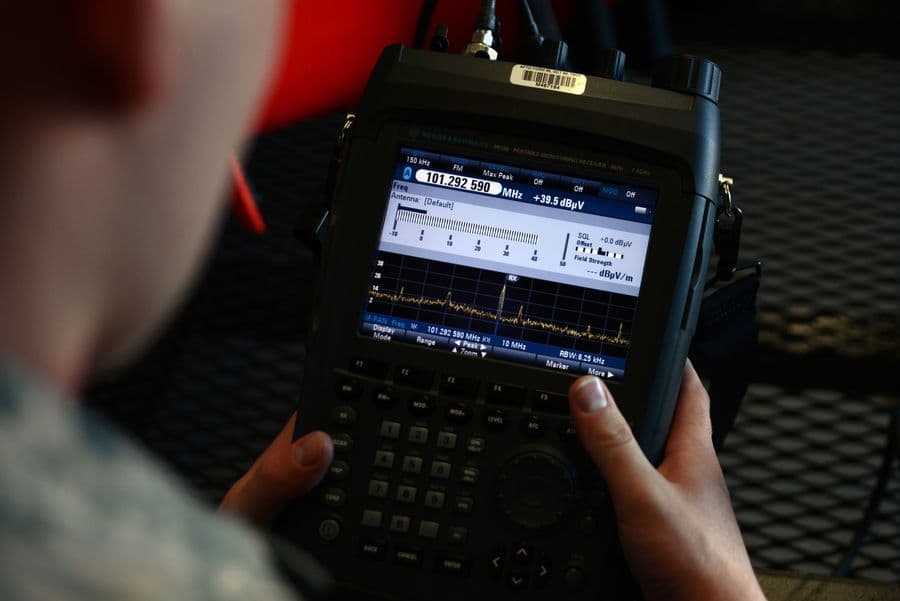
image: U.S. Air Force Staff Sgt. Geoffery Smith, 20th Communications Squadron installation spectrum manager, views the display on a radio spectrum analyzer at Shaw Air Force Base, S.C., Jan. 13, 2017. The equipment is used by communications Airmen to listen to radio frequencies and pinpoint transmitter locations. (U.S. Air Force photo by A1C Kathryn R.C. Reaves)