
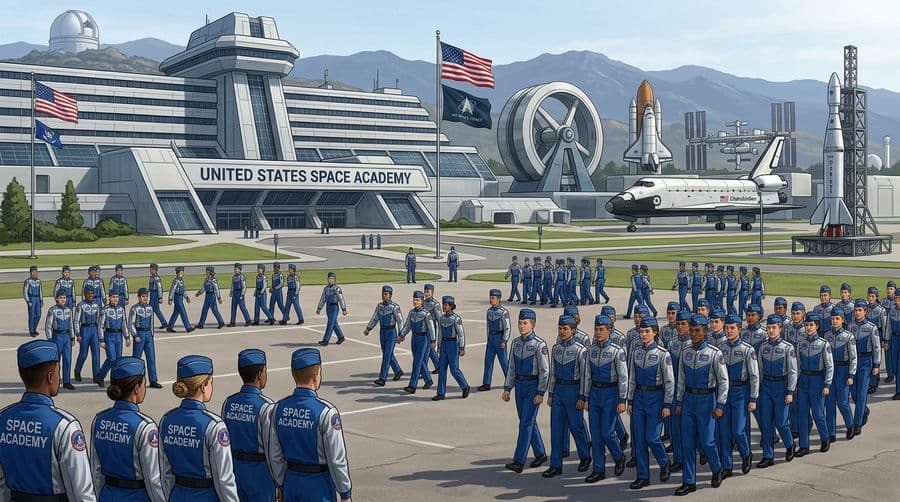
The U.S. Space Academy Must Build a New Culture of American Spacepower
Last updated 06:20 AM EDT • Read time: 5m
President Donald Trump has provided the United States an extraordinary opportunity to shape the future of American spacepower.
On August 28th, President Trump established a Presidential Commission charged with designing a new United States Space Academy. His executive order recognizes that American superiority in space depends upon developing the people who will “explore, secure, and build the industries critical to it.” The proposed academy, led by NASA, is intended to educate not only future government officials and warfighters, but astronauts, scientists, engineers, operators, and entrepreneurs as well.
That expansive vision is exactly right. But if the United States wants an academy capable of bringing these communities together, it should look to an institution that has quietly performed a similar mission for the maritime domain for generations: the United States Merchant Marine Academy at Kings Point, New York.
The USMMA is not simply another military academy. Administered by the Department of Transportation's Maritime Administration, Kings Point educates officers for America's entire maritime enterprise. Its graduates may sail in the merchant marine, enter maritime-related government or industry positions, or serve on active duty in the armed forces.
Yet they share something important: military service. USMMA graduates incur a military service obligation, and graduates who do not serve the required period on active duty maintain commissions in a reserve component. Many enter the Navy Reserve's Strategic Sealift Officer Force.
This model, in turn, should inspire the U.S. Space Academy. A NASA-administered Space Academy could educate students for careers throughout American spacepower. Some graduates could become NASA engineers or civil servants. Others could join commercial space companies. Still others could enter the Space Force or another military service on active duty. But all should be commissioned military officers. For most graduates, that should mean service as part-time officers in the U.S. Space Force.
The result would be something America has never possessed: a corps of space professionals distributed throughout the nation's civil, commercial, and military space communities but joined by a common education, professional identity, and commitment to national service.
The timing is fortuitous, because the Space Force is currently creating the personnel system capable of making such a concept possible. In July, the first 18 Guardians entered part-time Space Force positions. The service is therefore building its part-time force at almost precisely the moment the nation is considering how to build its Space Academy.
The Space Force should seize the opportunity to design these two institutions together.
Simply reproducing the traditional military reserve system would miss much of the potential of part-time Guardians. Instead, the Space Force should develop a career path modeled in part on the Navy's Strategic Sealift Officer program. The Navy understands that a merchant mariner's civilian profession is not an unfortunate distraction from military service. It is precisely the expertise that makes that officer valuable to the Navy.
Spacepower presents an even greater opportunity. Imagine a Space Force officer spending his or her civilian career designing launch vehicles, managing satellite constellations, developing lunar infrastructure, conducting research at NASA, or building the next generation of commercial space enterprises. Properly managed, that civilian experience would not compete with military service. It would be a major part of that Guardian's military value.
Such an arrangement would also answer an important question about the relationship between the new Space Academy and the U.S. Air Force Academy. They should be complimentary, rather than competitors.
Again, the maritime domain provides the example. The Naval Academy, Coast Guard Academy, and Merchant Marine Academy produce different kinds of officers for different portions of American Seapower. Annapolis primarily produces active-duty naval and Marine Corps officers. Kings Point connects commercial maritime power to national defense. Together with the Coast Guard Academy, these institutions support different components of a much larger national maritime enterprise.
American spacepower deserves the same institutional sophistication. The Air Force Academy should continue producing active-duty Space Force officers alongside its Air Force graduates. The Space Academy, meanwhile, could produce officers whose careers extend throughout the larger space domain. Some Space Academy graduates would serve full careers in uniform. Many others would spend their careers at NASA or in commercial space while simultaneously serving as part-time Guardians. Together, they could produce officers approaching spacepower from different perspectives but sharing a commitment to both the space domain and to national service.
The greatest contribution of the Space Academy, however, may ultimately be cultural. Trump's executive order calls for the academy to develop a “professional corps of civically grounded leaders” prepared to advance American interests in space. That ambition should be taken seriously.
For most of the Space Age, America's military, civil, and commercial space communities have developed as separate cultures connected by technology but divided by organizations, personnel systems, and institutional traditions. Yet the future of American spacepower will increasingly depend upon all three.
A USMMA-inspired Space Academy could help erase those artificial divisions. Its graduates could wear different uniforms—or business suits, flight suits, and lab coats. They could command Space Force units, design spacecraft, build commercial space stations, explore the Moon, or lead NASA programs. But they would share an academy, a commission, and an understanding that their individual professions contribute to something larger: American spacepower.
Trump has said that “superiority in space is a measure of national vision and willpower.” Creating the Space Academy demonstrates that vision. Designing it correctly can turn that vision into an enduring institution.
If we get this right, the United States Space Academy will do much more than educate students for jobs in space. It will help create America's first truly national space professionals.
Brent D. Ziarnick is a Senior Fellow in Defense Studies at the American Foreign Policy Council, a graduate of the U.S. Air Force Academy Department of Astronautics and an Air Force Reserve space operations officer.

Innovation Alone Won’t Prepare the U.S. for the Future Battlefield
By Joshua Segal • RealClearDefense
The sUAS Tactical Trifecta
By Bryan T. Woody • RealClearDefense
The Revolutionary War: When Strategic Options Share the Same Weakness
By Henry Yep • RealClearDefense
The Houthis Are Testing the Limits of Collective Defense
By Saima Afzal • RealClearDefense
Radio Frequencies in the Intelligence Ecosystem
By Craig Brower • RealClearDefense

Who Shoots Down the Drone Over the Shipyard?
By John Ferrari & Dillon Prochnicki • RealClearDefense
Northrop Grumman Breaks Out the Big Guns at AUSA
By Daniel Terrill, Defense News
Army Pursuing Diverse Array of New Anti-Air Interceptors
By Trevithick, The WarZoneWho Shoots Down the Drone Over the Shipyard?
By John Ferrari & Dillon Prochnicki, RCD
F-35C Lands for the First Time on a Ford-Class Aircraft Carrier
By The Aviationist