
Congress Needs To Do the Right Thing—Support Our Combat-Injured Servicemembers
Last updated 05:25 AM EST • Read time: 4m
It’s time for Congress to do the right thing and fix an inequity that is affecting our combat injured veterans.
Under current policy, military members forced to retire after a combat-related injury must forfeit a dollar of military retirement pay for every dollar of Veterans Affairs (VA) provided disability benefits they receive. Reducing the retirement pay of a combat-disabled veteran—effectively using it to pay for their disability benefit—is as wrong as it sounds.
It’s very shallow thinking for our lawmakers to tell a combat-injured servicemember that they are worried about “the cost” of ending an unjust pay offset. It’s a tone-deaf approach—especially when the same lawmakers use wasteful continuing resolutions and other fiscally irresponsible practices to avoid important budget decisions.
In essence, we are telling combat-injured servicemembers that our nation cannot afford to pay them for their service. We love telling them, “Thank you for your service”—but not enough to pay and honor them for their sacrifice. This is not how we keep faith with those who have chosen to volunteer to serve our country and go in harm’s way, especially when military recruiting is in crisis mode.
Military retirement pay and VA disability compensation are two benefits established by Congress for entirely different reasons. Reducing pay because of a combat disability is not the way to achieve savings. Some would argue that it is not an ethical solution.
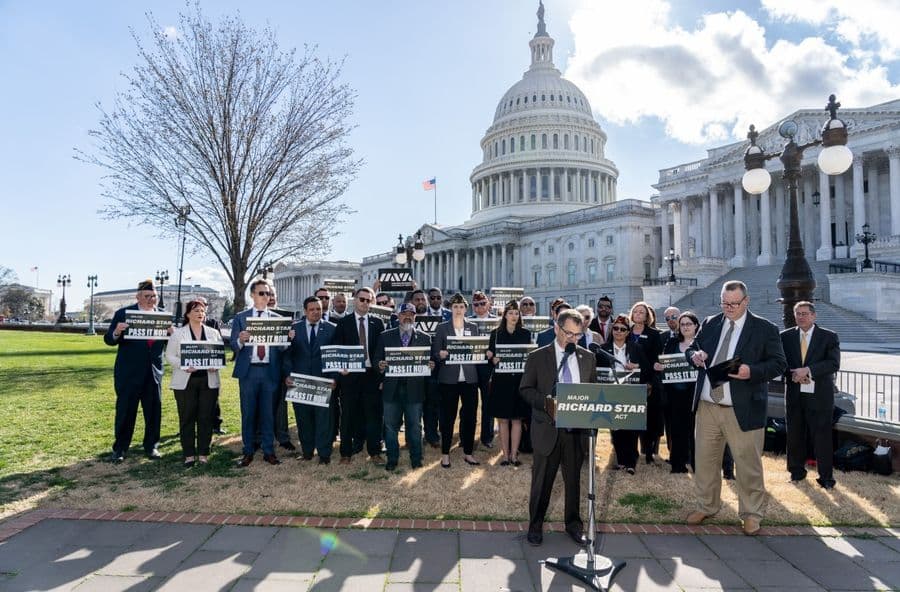
Legislation to correct this wrong, the Major Richard Star Act, has the support of 72 senators and 327 representatives who already co-sponsor the bill. The Star Act would repeal this unfair offset that prevents more than 50,000 veterans who live with the wounds of combat from accessing both their VA disability benefits and retirement pay.
Legislation for the Star Act must be included in the Fiscal Year 2025 National Defense Authorization Act (NDAA). Congress must go beyond lip service to this legislation by merely saying, “It’s a good idea.” Instead, Congress must say, “The Richard Star Act must be a priority so we can recognize those who have paid the price for showing bravery and courage for our country.”
The hang up, it appears, is that Congress must figure out how to pay for the Star Act by cutting government spending somewhere else, in accordance with the “CUTGO Rule.” CUTGO is short for cut-as-you-go and is an internal rule used by the House, meaning that it does not apply to consideration of legislation in the Senate. CUTGO prohibits consideration of legislation that would increase mandatory spending over the period covered by the budget. It’s meant to restrain increases in spending from new legislation to ensure that it will not add to the deficit.
There are clearly many ways Congress can achieve savings without putting the cost back on our military members. But Congress needs the motivation of constituents and veteran support groups like the Military Officers Association of America (MOAA). Supporting our combat-injured veterans should be a national imperative. That is why MOAA, and its 362,000 members support inclusion and passage of the Major Richard Star Act in the FY 2025 NDAA. It is one of MOAA’s top advocacy issues.
The legislative champions for the Major Richard Star Act have been Senators Jon Tester (D-Mont.) and Mike Crapo (R-Idaho). On the House side it’s been Reps. Gus Bilirakis (R-Fla.) and Raul Ruiz (D-Calif.).
“Imagine a servicemember getting injured during their fourth deployment,” says Bilirakis, speaking about combat-injured members. “While they had been close to full retirement and benefits, they will now have their hard-earned retirement reduced since they did not reach 20 years of service through no fault of their own. These heroes voluntarily took the call to protect our nation, and there should be no question that they are able to receive the benefits they earned......They earned their DoD retirement the hard way. It’s time to fix this hidden tax on our combat injured.”
Political leaders like Tester, Crapo, Bilirakis, and Ruiz are saying their colleagues must make certain our veterans are not short-changed by unfair rules that cancel out one earned benefit so they can receive another. Veterans should not be pushed aside because they were injured in war. Regardless of their time in service, these veterans have earned all their benefits through extraordinary sacrifice while doing what their country asked them to do. Combat-injured service members deserve better.
Tom Jurkowsky served in the Navy for 31 years, beginning his service as an enlisted sailor. He is a board member of the Military Officers Association of America (MOAA). MOAA is a non-profit advocacy organization that supports those who serve and have served in the military. He is also the author of “The Secret Sauce for Organizational Success: Communications and Leadership on the Same Page.”

Iranian Cyber Operations
By Michael Groen • RealClearDefense
Reflecting on an Epic Horse Campaign in the Mountains of Afghanistan
By Brian Glyn Williams • RealClearDefense
The Godfather of American Foreign Policy Realism Speaks to Today’s World
By Francis P. Sempa • RealClearDefense
In Pursuit of Nuclear Abolition
By Peter Huessy • RealClearDefense
Innovation Alone Won’t Prepare the U.S. for the Future Battlefield
By Joshua Segal • RealClearDefense

26th MEU – U.S. Needs Crisis Response MAGTF
By Marine Corps Compass Points
The Influence of History on a Sea Power
By CDR Salamander
Navy Civilianizes Six Former Flag Billets, Reduces Six to Captains
By Mongilio, USNI N.
Raytheon's $8B Contract for Strategic Comms Terminal Modernization
By M+A El
America’s Maritime Moment Will Not Wait
By CDR Salamander