
Congress Wants to Fix One Broken Promise to Veterans by Breaking Another
Last updated 06:08 AM EDT • Read time: 6m
Last Thursday morning, the House of Representatives did something it almost never does, it blinked. Republican leadership pulled the Take Care of America's Veterans Act off the floor minutes before a final vote, after a motion to send the bill back to committee failed by exactly one vote, 210-211. Speaker Mike Johnson told colleagues the bill likely will not come up again “for weeks.”
For a bill with the word “veterans” in its title twice, that is a strange way to close out a week.
I spent the summer of 1988 at Marine Corps Officer Candidate School learning one lesson that stuck harder than any other: you take care of your people, and you do not pay one Marine's medical bill by shorting the next one's. My youngest brother made that same trade a career, retiring as a Green Beret Weapons Sergeant. My oldest son wears a West Point ring for the same reason. I have spent over a decade coaching youth sports, and the first thing you teach a fifteen-year-old about discipline is that shortcuts always manifest at the worst times. Congress just tried to cut the same corner it teaches kids not to cut and got caught doing it on national television.
H.R. 9237, the Take Care of America's Veterans Act, bundles more than 60 separate veterans bills into one package sponsored by House Veterans' Affairs Chairman Mike Bost and, in the Senate, by Chairman Jerry Moran. Its centerpiece is the Major Richard Star Act, named for an Army officer who developed lung cancer from burn pit exposure in Iraq and Afghanistan and died in 2021 at 51. Under current law, a combat disabled service member medically retired with fewer than 20 years cannot collect full military retired pay and full VA disability compensation at the same time. One offsets the other, dollar for dollar. Troops call it the wounded veteran tax, and they are right to call it that. H.R. 9237 would end the offset for that group and let roughly 54,000 combat injured retirees collect both checks in full starting January 1, 2027.
The bill does not stop there. It ties Dependency and Indemnity Compensation, the tax-free benefit paid to survivors of troops who died in the line of duty or of service-connected illness, to Social Security cost of living increases plus an extra percentage point for five years. It creates a new $833.33 monthly supplement for veterans already rated at the highest levels of aid and attendance, the ones who need full-time caregiving. Every piece of that, standing alone, is the kind of legislation you would expect a Marine Corps veteran and the father of a West Point graduate to cheer without reservation. I do.
Here is the part that got the bill yanked off the floor. Section 108 pays for the whole package by codifying a 2022 VA proposal to tighten the disability rating schedule for tinnitus and sleep apnea, two of the most commonly claimed service-connected conditions in the entire compensation system. Existing ratings are protected. Future claimants are not. Representative Mark Takano called the projected $57 billion in savings “the golden egg that has not been laid yet,” and for once the man is not wrong. Chairman Bost's counterargument, that the VA will make these same rating changes administratively whether Congress acts or not, is honest as far as it goes. But there is a real difference between an agency rule a future administration can rewrite and a statute Congress bakes permanently into the U.S. Code. One is a policy. The other is a habit, and Congress is about to acquire a very bad one: paying tomorrow's veterans' bills with tomorrow's veterans' benefits.
The veterans' service organizations split exactly where you would expect. The VFW and Disabled American Veterans came out hard against the offset, stating that the government has never before stripped disability benefits from one group of veterans to fund benefits for another group. The American Legion took the opposite view, arguing that the rating change is coming regardless and that walking away from the rest of the package to make a point costs veterans real money for no real gain. Both sides are arguing from inside the same trap because Congress structured the choice as take the cut or take nothing. That is not a debate. That is a hostage negotiation dressed up in a closed rule and one hour of floor time.
To be fair to Chairman Bost, finding an honest offset for a benefits expansion this large was never going to be easy, and the alternative floated by Democrats Mark Takano and Richard Blumenthal, pulling $57 billion from already appropriated, unspent Defense Department funds in last year's reconciliation law, is its own kind of budget gimmick. Unobligated does not mean unneeded, and raiding defense accounts to fund VA compensation sets a precedent conservatives should not want either. Robbing Peter to pay Paul does not improve when Peter wears a different uniform.
The honest fix is the boring one nobody in this Congress wants to take credit for. Split the bill. The Major Richard Star Act already has bipartisan support strong enough to sustain a discharge petition on its own; pass it standalone and let members vote their conscience without 59 other bills riding along as cover. Debate the tinnitus and sleep apnea rating schedule in the open, on its own timeline, with actual hearings, not smuggled into a 600-page package under a closed rule that allowed one hour of general debate and zero amendments. If the savings are real, they will survive scrutiny. If they are not, it is better to find that out before the statute is permanent than after.
My brother came home from Special Forces selection able to do things most people cannot imagine and unable to sleep through a thunderstorm without waking up ready to move. Veterans like him are not a budget line to be balanced against each other. Congress has the votes, bipartisan support, and the moral case to fix the Star Act offset this year. What it does not have is the discipline to do it honestly. Until it finds some, the wounded veteran tax stays on the books, and so does the House's very strange definition of taking care of America's veterans.
Jay Rogers is a financial professional with more than 30 years of experience in private equity, private credit, hedge funds, and wealth management. He has a BS in criminal justice from Northeastern University and has completed postgraduate studies at UCLA, UPenn, and Harvard. He is a 1988 graduate of Marine Corps Officer Candidate School. He writes about issues in finance, constitutional law, national security, human nature, and public policy.
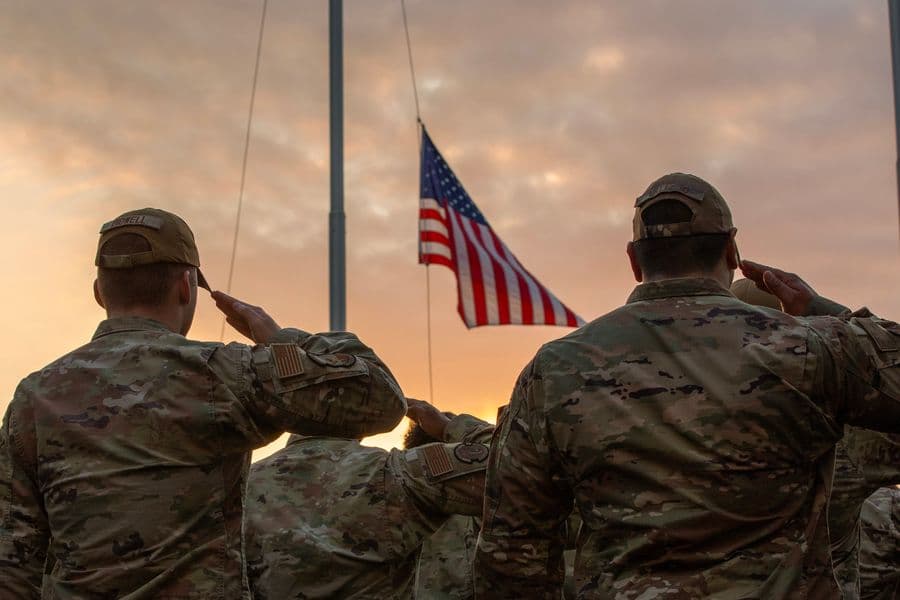
image: Military personnel salute during a Veterans Day retreat ceremony at Yokota Air Base, Japan, Nov. 9, 2023. (DVIDS)

In Pursuit of Nuclear Abolition
By Peter Huessy • RealClearDefense
Innovation Alone Won’t Prepare the U.S. for the Future Battlefield
By Joshua Segal • RealClearDefense
The sUAS Tactical Trifecta
By Bryan T. Woody • RealClearDefense
The Revolutionary War: When Strategic Options Share the Same Weakness
By Henry Yep • RealClearDefense
The Houthis Are Testing the Limits of Collective Defense
By Saima Afzal • RealClearDefense

Who Shoots Down the Drone Over the Shipyard?
By John Ferrari & Dillon Prochnicki • RealClearDefense
Northrop Grumman Breaks Out the Big Guns at AUSA
By Daniel Terrill, Defense News
Army Pursuing Diverse Array of New Anti-Air Interceptors
By Trevithick, The WarZoneWho Shoots Down the Drone Over the Shipyard?
By John Ferrari & Dillon Prochnicki, RCD
F-35C Lands for the First Time on a Ford-Class Aircraft Carrier
By The Aviationist