
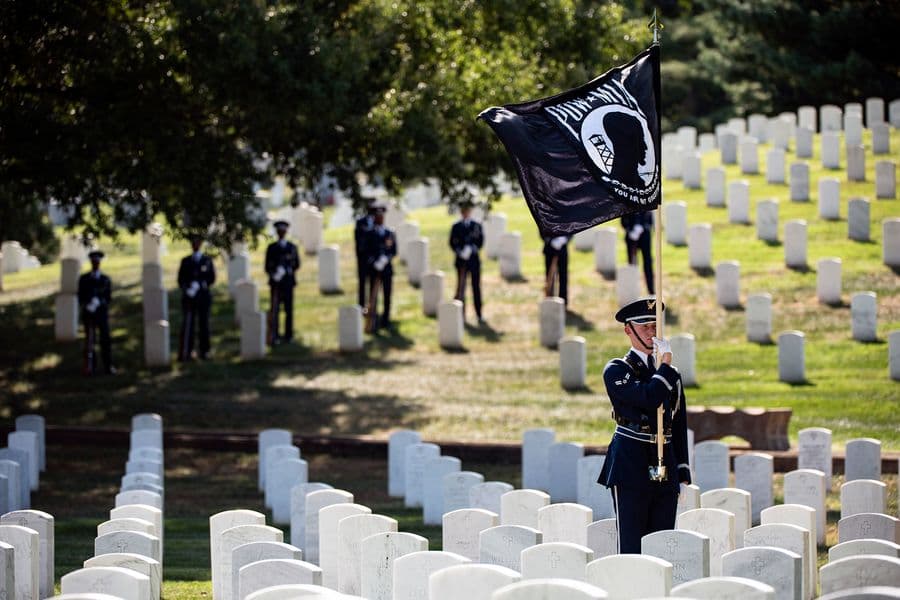
Leaving No One Behind: A Commitment That Matters Beyond the Military
Last updated 08:15 PM EDT • Read time: 5m
This Friday Americans across the country will honor National Prisoner of War/Missing in Action (POW/MIA) Recognition Day. A year ago on that day, I attended a wreath-laying ceremony and film screening at the United States Navy Memorial in Washington D.C. to recognize our nation’s POWs and MIAs. Speaking at the event was Commander (ret.) Everett Alvarez, Jr., the first pilot captured and held as a POW in the Vietnam War. He stated that America’s commitment to return all POWs home helped him endure the eight and a half years of imprisonment and torture that he endured while held captive by the North Vietnamese at the infamous prison dubbed the “Hanoi Hilton.”
Major General (ret.) Kelly McKeague, who serves as the director of the Defense POW/MIA Accounting Agency (DPAA) within the U.S. Department of Defense (DOD) also attended the event, where he described his mission at DPAA as one aimed at providing the fullest possible accounting for our MIA personnel to their families and the nation — a mission he rightly characterized as “sacred.”
America’s military is exceptional in keeping its obligation to leave no one behind, whether with combat search and rescue or the repatriation of POWs and MIAs. Regarding the latter, nearly 82,000 Americans are still considered missing: 72,598 from World War II, 7,580 from the Korean War, 1,587 from Vietnam, 126 from the Cold War and six from other conflicts since 1991.
Bringing home our fallen service members is no doubt a noble cause, but at a time when confidence in our military is the lowest in over two decades, why should Americans care about returning the remains of someone who fought in, what may be to them, a forgotten war?
The answer to that question is because leaving no one behind matters to more than just the military. First and foremost are the five million family members across four generations whose loved ones did not return. The absence of closure for these Americans is painful and deep, even for descendants who may not have known their MIA relatives directly. Families are the focus of efforts by DPAA and partners like Project Recover to research, find and account for the missing in past conflicts. Since 1995, the DOD has engaged over 17,000 family members face-to-face to keep them informed about the U.S. government's worldwide mission to account for those still missing and to discuss in detail the latest information available about their specific cases.
Leaving no one behind also matters to the nearly 19 million Veterans in the U.S. who swore the same oath as their missing teammates. Those of us who served in the U.S. armed services are united in our values, ethics and standards across all ranks and in all service branches. Our common culture, combined with the fact that our success and survival depended upon taking care of each other, created what the U.S. Army calls the warrior ethos: “I will never leave a fallen comrade.” It is institutionalized in the American military today, and it is the reason that after over two decades of combat in Afghanistan, not a single service member is listed as missing in action. Although no longer on active duty, America’s Veterans continue to embrace the warrior ethos and serve as leaders in advocacy and action to return our MIAs, whether through volunteering with DPAA or supporting nonprofit partners.
Our nation’s commitment to bring everyone back might be most important to the next generation of American service members. The DOD is already experiencing crisis levels of recruitment, and it is occurring at a time when China is undergoing the largest military buildup seen anywhere since World War II. We are unlikely to attract the talent we need — or support from their families — unless we renew our resolve to return POWs and MIAs both today and in the future.
After returning home, Everett Alvarez served as the Deputy Administrator of the Veterans Administration under President Ronald Reagan. During this time, he was in the audience when Reagan gave a speech on National POW/MIA Recognition Day where he said, “Along with us today are some of the relatives and friends of those still missing…They too have shown more than their share of heroism, holding the stand for those who went away and have not yet returned to us, insisting that the world remember and respond.” Reagan then promised them, “We write no last chapters, we close no books, we put away no final memories until your questions are answered…Your sons and fathers and brothers did their duty by this nation, and this nation will do our duty by them.” As our nation stands deeply divided on many issues, let us unite in keeping this promise to leave none of our service members behind.
Rear Admiral (U.S. Navy, ret.) Tim Gallaudet, Ph.D., is the CEO of Ocean STL Consulting, LLC, a member of the advisory board for Project Recover and Vice Chairman of the Board of Directors for the Veterans nonprofit Force Blue. Previously, Gallaudet served as the Acting and Deputy Administrator at the National Oceanic and Atmospheric Administration (NOAA), as well as acting Under Secretary and Assistant Secretary of Commerce. Prior to NOAA, he served for 32 years as an oceanographer in the Navy.

In Pursuit of Nuclear Abolition
By Peter Huessy • RealClearDefense
Innovation Alone Won’t Prepare the U.S. for the Future Battlefield
By Joshua Segal • RealClearDefense
The sUAS Tactical Trifecta
By Bryan T. Woody • RealClearDefense
The Revolutionary War: When Strategic Options Share the Same Weakness
By Henry Yep • RealClearDefense
The Houthis Are Testing the Limits of Collective Defense
By Saima Afzal • RealClearDefense
Navy Civilianizes Six Former Flag Billets, Reduces Six to Captains
By Mongilio, USNI N.
Raytheon's $8B Contract for Strategic Comms Terminal Modernization
By M+A El
America’s Maritime Moment Will Not Wait
By CDR Salamander
Armor Up?
By Marine Corps Compass Points
Who Shoots Down the Drone Over the Shipyard?
By John Ferrari & Dillon Prochnicki • RealClearDefense