
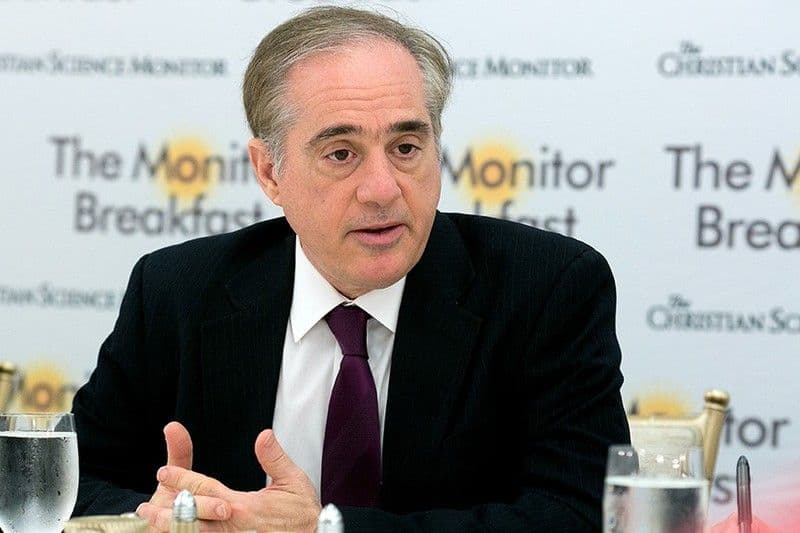
Secretary Shulkin Bringing Veterans Affairs out of "Critical Condition"
Last updated 05:50 PM EDT • Read time: 6m
Veterans Affairs Secretary Dr. David Shulkin, today made a rare appearance for a Trump Cabinet Official, addressing plans to revive the VA which he described as being in “critical condition.”
Shulkin skillfully avoided the now infamous Disney waiting lines analogy of his predecessor, and former boss, Bob McDonald. Congress grabed hold of McDonald’s comparison of wait lines at Disney to veterans seeking care. Lost in the discussion was simply that McDonald was emphasizing the priority of quality of care without diminishing issues with access at a few VA facilities.
Instead, Shulkin emphasized the need for bold and innovative changes in contrast to previous practices of slow and incremental change to return lost confidence in the veterans served by the VA.
The most controversial innovations proposed by Shulkin and swirling around the halls of Congress has been the Choice 2.0 initiative scheduled to debut this fall.
In testimony given to the Senate Committee on Veterans’ Affairs on June 7th, Shulkin laid out his proposals to partner the private sector with the VA to address access to care.
Testimony by several veterans organizations raised concerns over a previously undisclosed pilot VA Insurance program that could ultimately lead to the elimination of the VA through insurance for medical care in the private sector.
The proposal, however, was not initiated by Shulkin, and he reassured everyone today that there is no substitute for the care available at VA health centers. Shulkin instead advocated for a system where the private sector fill the gaps in services either due to overloaded VA centers, or areas where Veterans are simply unable to access VA facilities within their geographic location.
Carlos Fuentes, of the Veterans of Foreign Wars headquarters in Washinton D.C., told RealClearDefense today that Secretary Shulkin and his team have worked diligently in coordinating with veterans’ groups such as the VFW and others to ensure that the needs of the Veterans are addressed in Choice 2.0.
Shulkin has taken Veterans to heart in his efforts to revive the VA in becoming a “strong and stable” organization that veterans can have confidence in, speaking of his mandate to make bold and innovative changes, to regain the “lost confidence” of veterans.
During Shulkin’s “State of the VA” address at the end of May, he identified 13 major risk areas within the VA ranging from access to care in collaboration with the private sector, to his number one priority, reducing the alarming rate of veteran suicides.
The 13 risk areas are a broad swath of needed reforms within the VA which Secretary Shulkin has proposed as five priorities to be addressed immediately.
- Giving Veterans more Choice. Shortly after taking office, Shulkin won the approval of President Trump to extend the Veterans Choice Program (VCP) to allow veterans to seek care in their communities, particularly those far from VA facilities. This plan, known as “Choice 2.0” will be officially rolled out this fall, will allow veterans that either live over 40 miles from a VA facility or that have waited over 30 days for an appointment to seek care outside the VA System at fixed Medicare cost.
Shulkin was careful to acknowledge that this would not lead to a complete privatization of the VA healthcare system, but rather augment the VA Health system. Simply put, the private sector just isn’t suited to address many of the issues facing veterans, such as post-traumatic stress and suicide. However, there was room for collaboration with the private sector regarding issues like traumatic brain injuries highlighted in professional sports.
- Modernizing the VA systems. The legacy VA electronic health system,
also known as VistA, has gone from an expensive legacy system failing to meet the needs of veterans to glowing praise according to a recent Medscape survey of over 15,000 physicians.
Members of Congress have been highly critical of VistA, and Secretary Shulkin also acknowledges the need to change.
Shulkin wants to create the “next generation” Electronic Health Record (EHR) system. The VA is already in the midst of what Shulkin described as four-month contract negotiations with health information technology information solutions company Cerner. Cerner recently rolled out a test launch of their commercial off-the-shelf system, known as Military Health System (MHS) GENESIS at Fairchild Air Force Base in Spokane, Washington.
The VA plans to integrate MHS GENESIS with the VA's new EHR better, as the DoD system does not fully address the needs of Veterans, the VA Health System and care provided in the private sector.
- Improving the timeliness of services. Wait times, although generally good at most VA facilities, wait times are unacceptable at a few notable facilities. Beyond wait times, Mr. Shulkin also wants to provide better access to benefits and better response times for appeals for benefits.
- Focusing resources on services of need to Veterans. While improving services provided by the VA headquarters and underperforming hospitals, Dr. Shulkin wants the VA to prioritize services to Veterans not otherwise offered in the civilian sector.
- Lastly, but perhaps the highest priority to Secretary Shulkin is to reduce and prevent suicide by veterans which are at what he calls “crisis proportions.”
An aggressive agenda proposed by Secretary Shulkin, but in line with his call for bold and innovative change. However, there are still obstacles in his way, many of which have stymied his predecessors.
Instilling a culture of service and high morale requires a dedicated workforce committed to the care of America’s Veterans. One step in accomplishing this goal was through the 13th June passage of the Veterans Affairs Accountability and Whistleblower Protection Act of 2017.
Secretary Shulkin said the act would give the VA the authority rid the administration of employees that fail to adhere to the standard of Veteran care. Employees such as those convicted of successive DWIs, or those caught illegally transferring (stealing) controlled substances such as prescription opioids. Shulkin plans to delegate this authority down the chain of command but would still require his final approval.
Lastly, but perhaps most important to the future success of the VA system, would be the authority of the VA Secretary to move funds between various VA sections to address needs. Shulkin said that the VA has the money to meet current needs, but cannot move the money from sections with excess funding to those in need. An issue sure to be contested in Congress, but a legitimate concern for a government bureaucracy attempting to compete with the private sector, regarding effectiveness and efficiency.
Shulkin has set an aggressive agenda but has so far moved quickly to make the bold moves he has promised. The question going forward will be whether or not Congress will support him and the VA, and whether veterans feel the impact of those changes.

In Pursuit of Nuclear Abolition
By Peter Huessy • RealClearDefense
Innovation Alone Won’t Prepare the U.S. for the Future Battlefield
By Joshua Segal • RealClearDefense
The sUAS Tactical Trifecta
By Bryan T. Woody • RealClearDefense
The Revolutionary War: When Strategic Options Share the Same Weakness
By Henry Yep • RealClearDefense
The Houthis Are Testing the Limits of Collective Defense
By Saima Afzal • RealClearDefense

Who Shoots Down the Drone Over the Shipyard?
By John Ferrari & Dillon Prochnicki • RealClearDefense
Northrop Grumman Breaks Out the Big Guns at AUSA
By Daniel Terrill, Defense News
Army Pursuing Diverse Array of New Anti-Air Interceptors
By Trevithick, The WarZoneWho Shoots Down the Drone Over the Shipyard?
By John Ferrari & Dillon Prochnicki, RCD
F-35C Lands for the First Time on a Ford-Class Aircraft Carrier
By The Aviationist