
VFW's Opposition of the Take Care of America's Veterans Act
Last updated 06:30 AM EDT • Read time: 5m
VFW Has Forgotten the Meaning of Selfless Service by Opposing TCAVA
In America’s military, selfless service is a core value. It’s why we put the safety, well-being, and even lives of others ahead of our own. It’s rarely as dramatic as taking a bullet for your fellow soldiers in combat. Selfless service usually takes other forms, like sharing gear out in the field with those who need it in the moment, instead of keeping it all for yourself. It’s something I felt all proud veterans carried long after we take off our uniforms.
That’s why I was shocked to see the Veterans of Foreign Wars (VFW) contradicting 71% of veterans and a coalition of 23 major veteran service organizations led by the American Legion in a near-singlehanded attempt to shoot down the Take Care of America’s Veterans Act (TCAVA). In doing this, they’re risking the welfare of veterans who need benefits the most.
TCAVA bundles more than 60 provisions that would bring badly needed support to our sickest and most injured veterans, their widowed spouses, and their caregivers.
It would eliminate the “wounded veteran tax” paid by nearly 60,000 Chapter 61 veterans who were medically retired from the armed forces early due to injuries or serious illnesses. As it stands, these veterans must forfeit one dollar of their earned military retirement pay for every dollar they receive in VA disability benefits.
TCAVA would also expand eligibility for the U.S. Department of War’s Survivor Benefit Plan, which pays for widowed spouses of deceased vets. Those who qualify to receive a financial lifeline for life: 55% of a retired service member's military pay to help cover bills. That is, until widowed spouses remarry before they turn 55. They must forfeit this income. TCAVA would fix that injustice.
This bill would also extend support for veterans’ family members who become their caregivers. It will extend health coverage, as well as workforce-transition support, helping take immense strains off households that are already immensely strained.
Veterans have been fighting for these and dozens of other provisions for years – some of them decades. TCAVA is our best opportunity to help those veterans and their caregivers who were arguably left behind.
There is a catch. Congressional budget laws require new spending to be offset by spending cuts elsewhere. That’s where TCAVA’s Section 108 comes in – and where the VFW is splitting with the rest of us.
In order to pay for these badly needed provisions, lawmakers proposed removing disability ratings for sleep apnea, which has become much cheaper and easier to manage thanks to new at-home medical device technologies, and tinnitus, which is hard to prove and, rightly or wrongly, has been singled out by the media as a source of veteran benefit abuse. Section 108 is estimated to save $57 billion over 10 years. That’s a small price to pay for TCAVA’s net gains.
VFW leaders call this “robbing Peter to pay Paul.” The vast majority of veterans call this a pragmatic solution that supports our most vulnerable veterans, keeps the VA benefits system flexible with the changing times, and ensures strong public support for veterans’ benefits in the future.
Section 108 is not “robbing” anyone. It would not take money away from veterans already receiving sleep apnea and tinnitus-related benefits in their disability payments. It would only apply to future benefit applicants who would benefit from newer and more cost-effective technologies, like at-home CPAP machines, which the VA offers for free to qualified veterans anyway.
Yet the VFW has left no room for discussion. They’re selfishly fighting to keep every dollar, risking benefits for those in most need, and eroding the integrity of the benefits system in the process. They’ve forced Congress to either strike Section 108 or vote “no” on TCAVA if they don’t remove it.
VFW’s pressure succeeded in delaying the vote, which they celebrated as a victory. That’s truly unfortunate. If VFW’s leaders could look past themselves and realize they’re not the only people in the room, they’d understand this is a major loss for Chapter 61 veterans who are losing hundreds – sometimes thousands – of dollars thanks to the wounded veteran tax, and many other veterans in need.
Most veterans disagree with the VFW. Fifty-eight percent of veterans feel the VA should update their disability ratings schedule as medicines and medical technologies advance, which is sensible. If doctors cured or curtailed a disease or health issue that’s on the VA’s disability schedule, why shouldn’t we use that saved money to expand future benefits elsewhere?
Veterans and their families understand that if we want to take care of those who sacrificed the most, we must be willing to modernize, prioritize, and sometimes make tough choices about limited resources. The VFW’s refusal to accept that reality isn’t selfless service; it’s the opposite.
Donyale Hall is a Dover City Councilwoman, Delaware and leads the Frederick Douglass Freedom Alliance Veterans Center and as a disabled veteran with two active-duty sons.
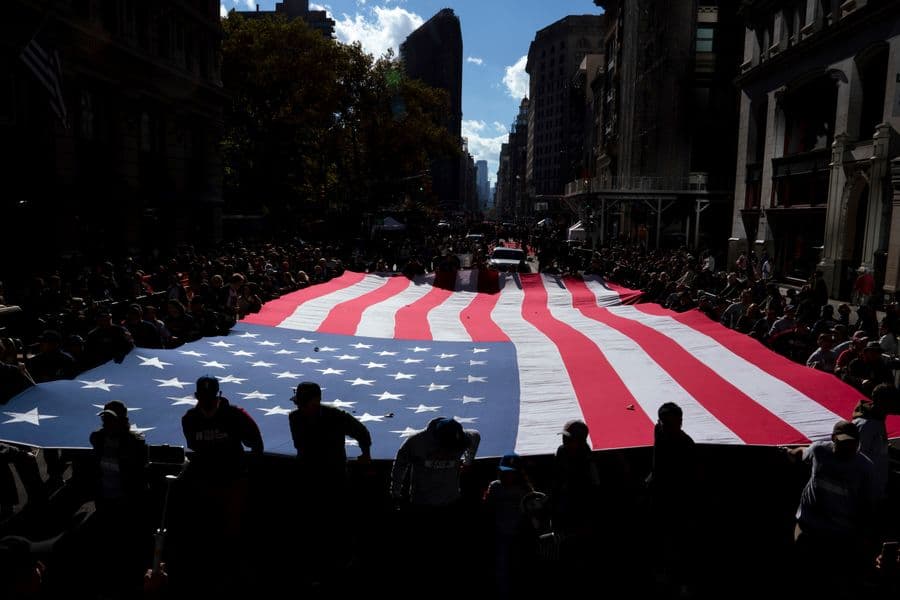
image: People carry the American flag during the annual Veterans Day Parade, Monday, Nov. 11, 2024, in New York. (AP Photo/Adam Gray)

In Pursuit of Nuclear Abolition
By Peter Huessy • RealClearDefense
Innovation Alone Won’t Prepare the U.S. for the Future Battlefield
By Joshua Segal • RealClearDefense
The sUAS Tactical Trifecta
By Bryan T. Woody • RealClearDefense
The Revolutionary War: When Strategic Options Share the Same Weakness
By Henry Yep • RealClearDefense
The Houthis Are Testing the Limits of Collective Defense
By Saima Afzal • RealClearDefense

Who Shoots Down the Drone Over the Shipyard?
By John Ferrari & Dillon Prochnicki • RealClearDefense
Northrop Grumman Breaks Out the Big Guns at AUSA
By Daniel Terrill, Defense News
Army Pursuing Diverse Array of New Anti-Air Interceptors
By Trevithick, The WarZoneWho Shoots Down the Drone Over the Shipyard?
By John Ferrari & Dillon Prochnicki, RCD
F-35C Lands for the First Time on a Ford-Class Aircraft Carrier
By The Aviationist