
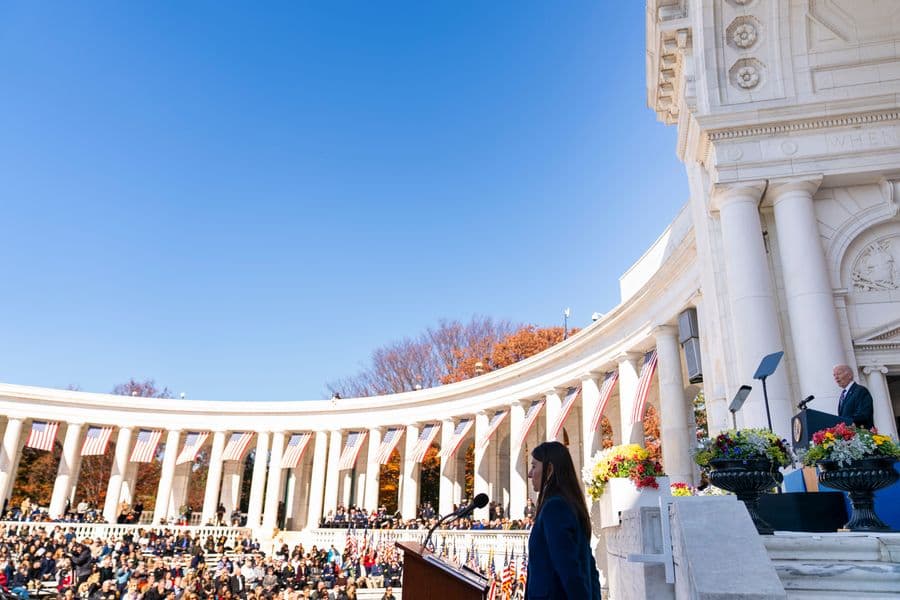
Who Are America's Veterans?
Last updated 10:29 AM EST • Read time: 5m
Military veterans represent about six percent of the American population. And yet, their contribution to national security and our national character cannot be measured by numbers alone. As the country reflects on veterans, their lives, and the meaning of their sacrifice, we spoke with Marine Corps veteran Cole Lyle of Mission Roll Call, a nonprofit that provides advocacy and other services to former servicemembers living across the country. Lyle says, “the purpose of Veteran’s Day is to celebrate and honor America’s veterans for their willingness to serve and sacrifice, borne out of their love of country, in order to protect and defend the United States and our way of life.” The following is a lightly edited transcript of our conversation.
Describe our veteran community through current statistics.
According to U.S. census 2022 one-year estimates, there are roughly 16.2 million veterans. Roughly 4.8 million have at least one disability. 26.5 percent of veterans are age 75 and older. At the other end of the age spectrum, 8.5 percent of veterans were younger than age 35. As for where they served: .04 percent served in World War II; 4.1 percent served in the Korean War; 33.6 percent in Vietnam; 24.4 percent in the first Gulf War (August 1990 to August 2001); and 26.3 percent in the second Gulf War (September 2001 or later).
Why do veterans harm themselves?
There’s no “one thing.” It’s usually a conglomeration of financial stress, relationship issues, unemployment, substance abuse, lack of purpose and connection, and service-connected disabilities (including mental health). But it does not always occur as a result of a service connected mental health issues, which is why Mission Roll Call has advocated for taking the VA’s Office of Suicide Prevention out of the Veteran’s Health Administration and become a senate-confirmable position reporting to the Secretary.
How do today’s statistics on veteran suicide compare to historical statistics? In other words, what is particularly noteworthy or significant about today’s statistics?
Suicide is the 10th leading cause of death in the United States. Although suicide rates have increased among the U.S. general population over the past two decades, veterans have been disproportionately affected. According to the VA, in 2020, the suicide rate for veterans was 57.3 percent greater than for nonveteran U.S. adults, adjusting for age and sex, and an average of 16.8 veterans died by suicide per day. I should add that recent research suggests these figures are incomplete based on how the VA collects data, that the actual rate is much higher.
What happened after World War Two, Korea, and Vietnam, in terms of veterans’ mental health? Can those statistics tell us anything about contemporary issues?
There is very little, if any, data on veteran suicide rates for previous generations of warfighters. The stigma around suicide has only recently, in the past few decades, been reduced, allowing for research and treatments to emerge. We do know that, of current generations being analyzed, Vietnam veterans have the highest number of suicides based on their being the largest percentage of veterans. However, post-9/11 veterans end their own lives at a higher rate.
Two years after American troops left Afghanistan, two-thirds of Americans said that the war “was not worth fighting,” according to a new poll conducted by the Pearson Institute for the Study and Resolution of Global Conflicts. Do you believe the Afghanistan War was worth fighting? Do veterans?
Because Afghanistan was a conflict spanning more than 20 years, this is a hard question to answer. I’m supremely confident that the American population and the veteran community agreed with America’s response to 9/11, to punish those responsible. But as time went on and mission-creep set in, it is hard to accurately gauge the veteran community’s opinion of the conflict and its worthiness in subsequent years after Osama bin Laden was killed.
Personally, I think the war was worth fighting. I believe we accomplished our goals in Afghanistan, punishing those responsible for 9/11 and keeping the American homeland safe from another attack. It is my personal view that, much like we did in Germany, Japan, Korea, and Iraq, it was advisable for national security to keep a small force in Afghanistan, but that didn’t happen and I had nothing to do with it, so I must come to terms with it.
It has been well-documented by the Special Inspector General for Afghanistan Reconstruction (SIGAR) and the Afghanistan Papers that there were long-standing issues with the war’s “progress” and it’s viability in achieving any well-defined goals. Veterans are mixed on whether we should have pulled out of Afghanistan entirely, but the overwhelming majority of American veterans take issue with the execution of the withdrawal itself.
Do you believe Americans forgotten the Afghanistan War?
Largely, yes. I think the burdens of the war’s conduct were shouldered by a shrinking minority of American families. As such, Afghanistan was not (and is not) prominent in their daily lives because they didn’t bear those sacrifices.
Is there a correlation between public sentiment about the Afghanistan War and veterans’ mental health? If so, please explain.
There is not enough data to suggest a correlation, but after speaking with so many veterans over the past few years, it is anecdotally true that the veteran population was affected by the Afghanistan withdrawal in a negative way.
Cole Lyle is the Executive Director of Mission Roll Call. Prior to MRC, Cole worked as an advisor to senior leadership at VA and on veteran policy in the United States Senate. Notably, Cole and his service dog, Kaya, were essential in the PAWs Act being created and signed into law. Cole was honorably discharged as a Non-Commissioned Officer in the Marine Corps after serving six years, including a deployment to Afghanistan.

The Godfather of American Foreign Policy Realism Speaks to Today’s World
By Francis P. Sempa • RealClearDefense
In Pursuit of Nuclear Abolition
By Peter Huessy • RealClearDefense
Innovation Alone Won’t Prepare the U.S. for the Future Battlefield
By Joshua Segal • RealClearDefense
The sUAS Tactical Trifecta
By Bryan T. Woody • RealClearDefense
The Revolutionary War: When Strategic Options Share the Same Weakness
By Henry Yep • RealClearDefense
Navy Civilianizes Six Former Flag Billets, Reduces Six to Captains
By Mongilio, USNI N.
Raytheon's $8B Contract for Strategic Comms Terminal Modernization
By M+A El
America’s Maritime Moment Will Not Wait
By CDR Salamander
Armor Up?
By Marine Corps Compass Points
Who Shoots Down the Drone Over the Shipyard?
By John Ferrari & Dillon Prochnicki • RealClearDefense