
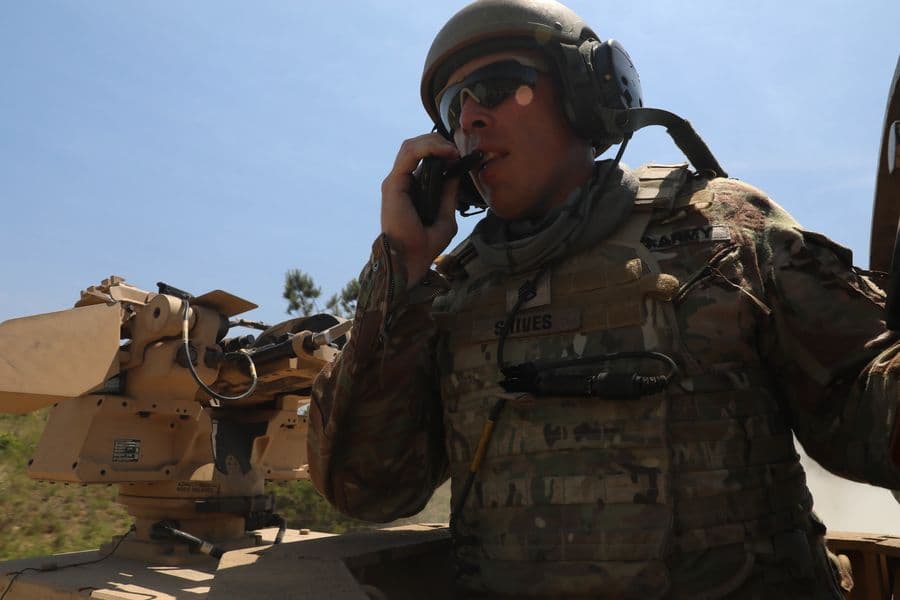
TRAX: The One Capability That Can Make JADC2 Successful
Last updated 08:23 PM EDT • Read time: 6m
The U.S. military’s vision of the future is of seamless, real-time interoperability at the tactical edge. This means that every sensor and weapons platform/system regardless of who it belongs to can connect in near real time using correlated data. The program that is supposed to achieve this remarkable feat is called the Joint All-Domain Command and Control (JADC2) system. As envisioned, JADC2 will provide the ability to pass relevant information from the highest headquarters out to the tactical edge.
Each of the Services is building its own version of an overarching command, control, and communications (C3) system which will be part of the overall JADC2 construct. There is the Army’s Project Convergence, the Navy’s Project Overmatch, and the Air Force’s Airborne Battle Management System.
The problem for JADC2 and all its Service components is that the military currently operates dozens of communications systems using a variety of data formats, protocols, and frequencies. Simple things, like a ground operator communicating its location to an overhead platform, can be an excruciatingly complex process because the two use different data formats and may be operating on incompatible radio frequencies. Imagine trying to do this thousands of times across the expanse of a modern battlefield.
At present, it is unclear how JADC2 will manage the requirement to flow information between these separate Service-based C3 systems, or how it will manage to synthesize information across multiple, incompatible communications networks and data formats. What will JADC2 do to allow the free flow of information across the entire military enterprise? How will it bring in the Intelligence Community (IC), other government agencies, and coalition partners? Unless each of these networks can connect to one another seamlessly and share information instantly based on a common data fabric, JADC2 will fail.
There is a solution that has already been proven. It is called the Tactical Radio Application eXtension (TRAX). TRAX, currently in use with SOCOM, the U.S. Army, Marine Corps and Air Force, is bringing sense to the current state of C3.
TRAX is, in effect, a software translator that takes information in any commonly used format and provides it in the language needed by the recipient so that unit, platform, or weapons system can act. It is like an online translator, but one that can convert multiple languages simultaneously into fluent English. TRAX processes complex Military Standard data that may be generated by a one-of-a-kind sensor or presented in a unique format and translate it into a common, exposable interface to enable the integration of user interfaces, the querying of databases, and the application of analytics at machine speeds.
TRAX will enable the U.S. military’s future JADC2 network-of-networks to manage and move data from multiple sensors to dozens of otherwise incompatible, geographically disparate multi-domain radios, sensors, networks, and weapons to fuse it into a common operational picture (COP). This COP can then be used to accurately move forces and platforms or put fires on targets in real time. With TRAX there is no need to send battlefield sensor information back to a higher headquarters to have it translated into a format that the designated weapons system can understand. This process is near instantaneous.
An example of TRAX’s ability to link disparate systems includes the Army’s 2021 Project Convergence experiment, which demonstrated the ability to reduce the time it takes to pass information from air- and space-based sensors through a C3 node and out to long-range fire systems, which then successfully engaged targets in seconds. It was TRAX that allowed the information to be passed so seamlessly.
A recent article written by three military officers experienced in using TRAX in a variety of exercises is illustrative of what the system can do:
“TRAX is able to bridge information across domains and waveforms though its ability to understand and communicate across multiple military standard communications protocols. In the case of the Korean counter-fire fight, TRAX is able to take the Q-53 radar’s variable message format (VMF) K-series targeting data messages and broadcast J-series messages on the Tactical Data Links (TDLs) so that aircraft may receive them. A terminal loaded with TRAX, with a connection to an Advanced Field Artillery Tactical Data System (AFATDS) terminal and TDL connectivity, is able to bridge information from machine-to-machine on its respective waveforms much quicker and with greater volume than any current manual relay procedure.”
With TRAX available, there is no need to go through the laborious and expensive process of adding new communications systems or additional data formats to existing platforms or sensors to enable them to pass data. The cost savings from applying TRAX across the military is almost incalculable.
TRAX also can overcome one of the thorniest problems confronting military coalitions: communicating with allies and coalition partners. TRAX uses the most common joint and coalition military standards, which allow U.S. forces to seamlessly exchange information with 53 countries that use tactical data links such as LINK 16 and/or the Joint Range Extension Applications Protocol. TRAX enables aircraft, ships, and land units from multiple countries to exchange information over long-distances through satellite links.
It also uses the Joint Variable Message Format to exchange information between land forces. TRAX is likewise able to connect U.S. and foreign air defense systems through the Integrated Battle Command System network, including multiple land, sea, air and space-based sensors, and a range of weapons systems. TRAX will ultimately facilitate U.S. and coalition command, control, and communications interoperability for multi-domain operations.
Sierra Nevada Corporation (SNC) has not only provided a unique and extremely cost-effective solution to the problem of interoperability it also has established a way around the Pentagon’s Byzantine acquisition system. For a fee, the company provides a user with an unlimited license to use TRAX on any and all its communications systems. SNC provides continued modernization, maintenance, and customization of the TRAX software as communications systems change or new capabilities are added to the network. To date, SOCOM and the U.S. Army have purchased licenses.
Dan Gouré, Ph.D., is a vice president at the public-policy research think tank Lexington Institute. Gouré has a background in the public sector and U.S. federal government, most recently serving as a member of the 2001 Department of Defense Transition Team. You can follow him on Twitter at @dgoure and the Lexington Institute @LexNextDC. Read his full bio here.
Washington Cannot Ignore Afghanistan’s Weapons Legacy
By Saima Afzal • RealClearDefense
Moral Injury at One O'Clock
By Jeff Hood • RealClearDefense
The Mirror-Life Trap: When Deterrence Must Prevent Invention
By Lawrence J. Kaiser • RealClearDefense
The Pentagon’s AI Agents Could Complete the Mission and Still Leak Secrets
By Burak Oktenli • RealClearDefense
A Passage to the Middle East: India as a Mediator and Security Partner
By Irina Tsukerman • RealClearDefense
U.S. Intel Confirms This Is China’s Secret Spaceplane
By Joseph Trevithick, The WarZone
Navy Sees 10-year High For Class A Aviation, Afloat Mishaps
By H. Mongilio, USNI News
U.S. Navy To Install AI Vessel Detection System on Five Destroyers
By The Defense Post
U.S. Navy’s CHAOS Program
By Dylan Malyasov, Defence Blog
Two U.S. Navy Carriers Ready to Operate New MQ-25A Tankers
By Global Defense News