
Is Kazakhstan Russia's Next Target?
Last updated 11:09 PM EDT • Read time: 7m
This essay, rather than answer questions or recommend policies, instead poses a question that has not received sufficient attention and that when posed, merely generates still more questions. Is Kazakhstan, rather than another European state, Russia’s next target? This is not an idle or frivolous question, quite the contrary. Admittedly many NATO members and NATO’s senior leaders have recently warned that Russia has designs on their territory and within 3-8 years (depending on the speaker) might attack them. Those warnings are certainly well founded. Nevertheless, and although the European situation is certainly alarming and a rightful U.S. priority; we cannot, however, exclude alternative threats from Russia to other neighbors.
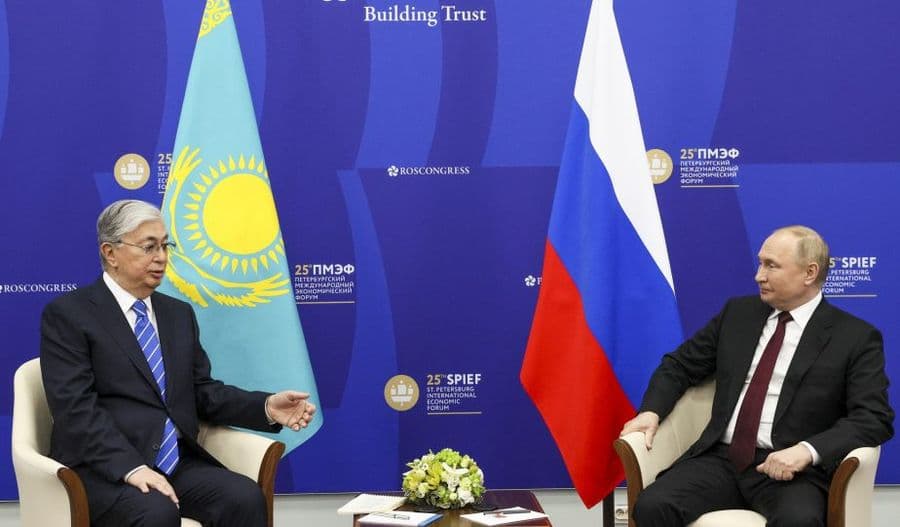
Indeed, in the last year the most consistent barrage of Russian threats has targeted Kazakhstan in Central Asia as a possible candidate for Moscow’s territorial aggrandizement and invasion. Presumably such threats are directed at least at Kazakhstan’s northern territory that adjoins the Russian Federation and which many Russian nationalists, not least Aleksandr’ Solzhenitsyn, claim should be or is actually part of Russia proper. These threats regularly appear on Russian media and enjoy support from high-ranking members of the Russian government, particularly Dmitri Medvedev, former President and Deputy Chairman of the Security Council, and Nikolai Patrushev, widely regarded as the No. 2 man in the regime and Head of the Council. These threats revolve around certain key points. Kazakhstan’s statehood is allegedly a “gift” from Russia since it never had a state before. Medvedev went further and stated that it was the Russians who settled (i.e colonized) Kazakhstan before the Kazakhs did. Moreover, Kazakhstan’s recent resettlement programs amount to a form of genocide of the Russians. Therefore “there will be no order until the Russians get there.” Others maintain that since Moscow bailed out the Tokayev government in early 2022 by sending Russian forces there, Kazakhstan’s subsequent objections and opposition to Russia’s war in Ukraine represent a betrayal of its obligations towards Russia and “disloyalty.” Meanwhile Patrushev’s office produces threats based on alleged Western efforts to incite Kazakhstan to conduct anti-Russian ethnic policies and threaten the Russian population there. When we remember that the long-standing Tsarist justification of invasions of neighbors dating back to Peter the Great is Russia’s self-ordained role as protector of Orthodox Christians and now, in Ukraine, of Russians, these threats must be seen as laying the groundwork for a Casus Belli (cause of war) against Kazakhstan. Moreover, this threat is now regularly reinforced on a weekly basis by prominent members of the Russian media.
Merely to pose this threat raises a host of questions that have not even been considered let alone answered. For example, why would Russia, especially with the lessons of Ukraine in mind consider such an adventuresome if not adventurist option? Second, what does it hope to gain thereby? Third, how would it strike at Kazakhstan and with what objectives in mind? Fourth, would Kazakhstan adopt policies that would increase the risk to itself given what it already knows about Russia’s imperialist proclivities? And, if so and fifth, why would it do so?
Furthermore, how would Kazakhstan either prepare for this war or defend itself? Obviously, nobody has even pondered these issues in print. But it is also all too likely that too few foreign analysts have even remotely considered this issue given the natural focus on Ukraine and Europe. But foreign governments, i.e., not only Kazakhstan, including those who are seriously involved with it in one or another form, do not, in fact, have the luxury of ignoring this potential scenario and others that may derive from or be linked to it. For example, Kazakhstan’s military has long had an association with both the U.S. armed forces expressed in joint exercises, and with NATO as a member of the Partnership for Peace. So, we do need to inquire how both Washington and/or NATO would react, and not only in the military domain, to any threat to Kazakhstan let alone a genuine act of war?
The same questions obviously apply to European countries that have equities in Kazakhstan both in view of their membership in NATO and/or their affiliation with the European Union, particularly as the latter is now intensifying its efforts to play a major role in Central Asia where Kazakhstan is the leading regional economic actor. In this connection we must inquire as to what impact any such contingency might have on all the multiple programs of international trade routes traversing Kazakhstan. Given all the multiple programs that either have been planned or that are in some stage of actual construction how would a war in Central Asia in general and in Kazakhstan in particular affect the long-term emergence of Central Asia as a significant actor in global trade and economics? Second how would events like those suggested here affect each Central Asian country? All of them, despite the still rudimentary nature of Central Asian cooperation, have strong and increasing ties with Kazakhstan, even possibly Turkmenistan, the most insular of them all, and those ties would be severely impacted by a war there.
Consequently, the vital interests of every Central Asian state would be in some manner affected and engaged by the scenario of a Russo-Kazakh war. But that gives us little or no insight into how any of them or any association of these states would tangibly react to such an invasion. Neither is it likely that anyone, outside of deeply closeted elements of those regimes’ security structures, is giving any thought to the likelihood of this scenario.
On the other hand, to judge from the public record, China has contemplated this option when Russia started making threats against Kazakhstan in 2022. As a result, and in view of his publicly expressed esteem for Sino-Kazakh relations in 2022, President Xi Jinping went out of his way in 2022 to warn against just such a scenario. Specifically, he stated then that,
Our countries always mutually provide firm support on key issues related to state sovereignty, security, and territorial integrity, respect each other’s development path, independently chosen in accordance with national realities, welcome the new achievements of the other side in state development and national revival.
This statement clearly represented then and now China’s warning to Russia to desist from such threats against Kazakhstan. But just as he also warned Putin against going nuclear in Ukraine, and regular nuclear threats and signals of escalation continue to appear, so too do the threats. Against Kazakhstan. So, while we may suggest with some plausibility that China would oppose a Russian invasion of Kazakhstan, we really have no idea of how that Chinese opposition might manifest itself, assuming that it would do so.
Nevertheless, our and other states’ security planners, wherever they may be situated within their regimes, owe it to their governments to start thinking seriously about this possibility given the volume, frequency, and regularity of these threats to Kazakhstan. They also owe it not only to their own governments, including the Kazakh state, to start a serious assessment of all the factors that might go into this possible contingency to bring pressure to bear on Russia to cease and desist from these threats, but also to Russia. Or, in other words their analyses should led to the restoration of deterrence by making clear in advance to Putin and his lieutenants what the cost of this adventure to Russia would be.
As in the case of Ukraine we see an erosion of Russian power in Kazakhstan and Central Asia in general before the invasion. And this occurs in an area where the fever dreams of Russian state nationalism and empire claim belongs to Russia. And, as we have seen, and indeed Putin’s KGB evaluations showed, a lowered sense of danger, i.e. an excessive toleration for risk that has only grown along with his power. Thus, it seems clear, that he and his subordinates, who are undoubtedly acting on his orders, may well succumb to what the Tsarist statesman Peter Valuev called the “lure of something erotic on the frontiers”. Even if this is an answer or policy recommendation to the questions we posed above, we should start thinking in earnest now about a Kazakh scenario and the need to restore conventional, not to mention nuclear deterrence before Putin plunges more of the world into another maelstrom.
Stephen J. Blank, Ph.D., is Senior Fellow at FPRI’s Eurasia Program. He has published over 1500 articles and monographs on Soviet/Russian, U.S., Asian, and European military and foreign policies.
The First Test of Peace Lies in Ukraine's Borderlands
By Dennis T. Cosgrove • RealClearDefense
The VFW’s Gambling Addiction Victimizes Veterans
By Jack Yoest • RealClearDefense
Superintelligence Exposes a Gap in the Law of Delegated Authority
By Sue Ghosh Stricklett • RealClearDefense
When the Network Goes Dark, Who Controls the Battlefield?
By Jonathan K. Corrado • RealClearDefense
We Cannot Build Tomorrow's Weapons With Yesterday's Alloys
By Joseph F. Krause • RealClearDefense
When the Network Goes Dark, Who Controls the Battlefield?
By Jonathan K. Corrado • RealClearDefense
Air Force Should Buy 250 Blended-Wing Tankers, as 2027 Demo Looms
By A&SF Mag.
Long Deployments to Be Navy Standard For Next Couple Years
By Mongilio, USNI NewsWhen the Network Goes Dark, Who Controls the Battlefield?
By Jonathan Corrado, RCD
Marines Deploy Neros Archer Drone in Live Fire Exercise for First Time
By USNI News